

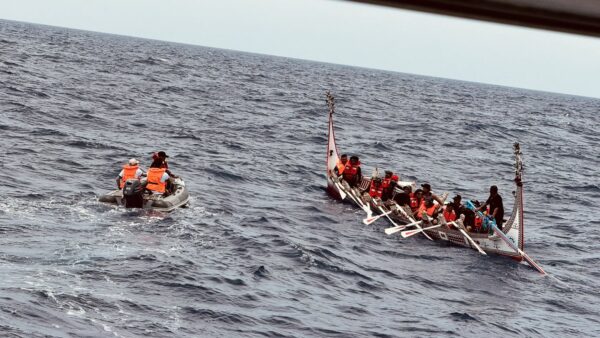
In June, a wooden plank vessel set out from Taiwan’s Orchid Island to Batanes in the Philippines. The vessel, named the Ovayan – meaning Golden Friendship – was a type of traditional vessel known as an ipanitika used by the Indigenous Tao people of Orchid Island.
Carrying 20 rowers at a time – accompanied by 40 other members of the Tao community on a support vessel, who helped take turns rowing – the Ovayan took about 24 hours to reach Batanes, the Philippines’ northernmost and smallest province. The Ovayan will remain in Batanes on display for six months before a delegation of rowers from Batanes sails it back to Orchid Island.
The voyage, retracing an ancient trade route, was meant to renew cultural and historical ties between Orchid Island and Batanes, said to have been disrupted 300 years ago by a misunderstanding.
The residents of Batanes are closely related to the Tao people. In fact, upon arriving in Batanes, the travelers remarked on the similarity of local cuisine to their native Tao food. The language spoken by the Tao is the only Indigenous Taiwanese language that is not classified as part of the Formosan grouping of Austronesian languages. Instead, it is classified as Philippine, and specifically part of the Batanic language branch of Malayo-Polynesian.
More broadly, Austronesian migration spans from Taiwan to Indonesia to Madagascar, New Zealand, Easter Island, and elsewhere. The “out of Taiwan” thesis posits that Taiwan is the origin of Austronesian peoples as dispersed across the Asia-Pacific.
A member of the Tao boat crew from Taiwan’s Orchid Island is greeted upon arrival at Philippines’ Batanes Islands, June 15, 2026. Photo via Facebook/ Indigenous Peoples Cultural Foundation (IPCF).
It proved an odd sequel to this event, then, when a group of Chinese academics sparked widespread outrage in the Philippines after a conference that framed Batanes as historically being part of China. The claims were made at a conference at Jinan University in Guangzhou, but did not fail to be noticed by Philippine media. Among the participants were academics from the Chinese Academy of Social Sciences, Guangdong University of Foreign Studies, Nanjing University, the National Institute for South China Sea Studies, and the Ocean University of China.
The scholars claimed that Batanes was administered from Taiwan during the Ming and Qing dynasties, and that the islands did not fall under the 1898 Treaty of Paris or the 1946 Treaty of Manila as territory administered by the Philippines. As such, the scholars called on China to “safeguard China’s sovereignty of the Batanes Islands.” The historical and cultural links between the people of the Batanes Islands and the Tao, as well as the fact that the Batanes Islands were used as fishing grounds during the Qing dynasty by Chinese fishermen, was highlighted to bolster these assertions.
The scholars primarily seemed to be reacting to warming ties between Japan and the Philippines, as part of which the Marcos and Takaichi administrations have agreed to begin maritime delimitation talks. The exclusive economic zones of both countries overlap in waters east of Taiwan. While the talks are framed as being in line with the U.N. Convention on the Law of the Sea (UNCLOS), the Chinese academics who asserted Chinese claims over the Batanes Islands accused the Philippines and Japan as being the ones to violate UNCLOS.
The talks are occurring at a sensitive anniversary for maritime disputes in the region, in that this month marks the 10-year anniversary since a U.N. arbitral tribunal formed under UNCLOS ruled against China and in favor of the Philippines in a dispute over China’s maritime claims in the South China Sea. China has rejected the ruling’s legitimacy, while critics point to the fact that China had tried to claim nearly all of the South China Sea.
For its part, Taiwan has criticized being left out of multilateral arbitration mechanisms. In terms of the 2016 ruling, Taiwan objected to the fact that Taiping Island, also known as Itu Aba – the largest natural feature in the Spratly Island group, administered by Taiwan – was deemed to be a rock rather than an island by the ruling. Under UNCLOS, that means Itu Aba is not entitled to a 200-nautical-mile EEZ. On the 10th anniversary of the ruling, Taiwan emphasized that its position has not changed. Both Democratic Progressive Party (DPP) and Kuomintang (KMT) legislators have at times traveled to Taiping Island to reiterate Taiwan’s claims.
Warming ties between the Philippines and Japan are driven by concern about Beijing’s assertiveness in the region – including with regard to the possibility of a Taiwan contingency. Both the Philippines and Japan have maritime territorial disputes with China. Japan and China alike claim the Senkaku/Diaoyu Islands (so does Taiwan, for that matter, although Taiwan’s government has come to a modus vivendi with Tokyo). Confrontations between the coast guards of China and Japan are not uncommon around the islands.
Similarly, China and the Philippines have competing claims to various features of the South China Sea, such as Scarborough Shoal. This has led to confrontations between coast guard vessels that have involved firing high-pressure water cannons, as well as instances when China is accused of deploying barriers or movable floating platforms to stake out claims over the Scarborough Shoal.
The claims by the group of Chinese academics led to outrage and mockery in the Philippines, with Philippine government officials stating that China has never administered the Batanes Islands. On social media, memes joking that the Philippines has sufficient historical basis to claim all of China circulated widely – not unlike memes in Taiwan framing China as “West Taiwan,” to mock the perceived absurdity of Chinese territorial claims.
This would not be the first time that China has sought to hit back at geopolitical antagonists by intimating that it has sufficient historical justification to claim part of their territory. Chinese state-run media have sometimes cast doubt on Japanese sovereignty over the island prefecture of Okinawa, which is home to the majority of U.S. bases in Japan. This is done by emphasizing the historical and cultural links that Okinawa has historically had with China, such that Okinawa was a tributary state of the Ming dynasty during the time of the Ryukyu Kingdom. During the Ming dynasty, Taiwan was, in fact, known as “Lesser Ryukyu.”
In this light, the role played by premodern antiquity as it figures into contemporary geopolitical imaginations of territorial sovereignty is notable. In Taiwan, an undercurrent of cultural works in past decades has been the assertion of “maritime Taiwan” – orienting Taiwan toward the ocean, as an island, and as a contact zone between Austronesian Indigenous peoples, Han settlers, Western colonizers (such as the Dutch, the Spanish, and the Portuguese), and other Asian powers such as Japan. Works by Indigenous creatives such as author Syaman Rapongan, who hails from Orchid Island and is arguably the most famous contemporary Taiwanese Indigenous author, have figured highly in this emphasis on Taiwan’s links to the ocean, alongside works by other acclaimed authors such as Wu Ming-yi.
As the emphasis on “maritime Taiwan” is implicitly meant to orient Taiwan toward the ocean – and away from the Chinese mainland – Chinese historical claims over Taiwan have sometimes done precisely the opposite. For example, some Chinese scholars have framed Indigenous peoples as also having come from China by way of the “out of China” thesis. This arguments holds that before Austronesian migration eventually came to span the Pacific Ocean, the ancestors of Austronesian peoples may have traveled to Taiwan via a land bridge from China. Taiwan’s Indigenous peoples are sometimes framed, in this light, as among the “ethnic minorities” who are still included in a broader notion of civilizational China.
Attempts to strengthen ties between Taiwan and Southeast Asian countries by way of the New Southbound Policy have often emphasized this history of maritime connections and the links that arise from Austronesian migration. At a time when Taiwan seeks to strengthen ties with other countries in the region not only to counter Chinese threats, but to avoid overreliance on the Chinese economy and strengthen ties with other regional economies, historical memory dovetails with present-day geopolitical concerns.
