

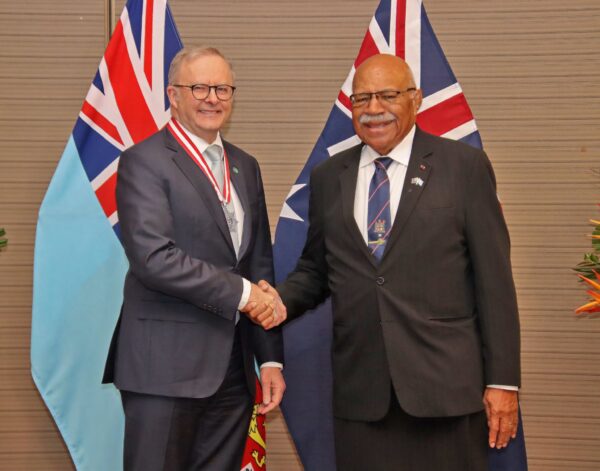
In the past week, Australian Prime Minister Anthony Albanese has signed security and defense agreements with Vanuatu and Fiji, visited Fiji and Solomon Islands, and hosted leaders from Papua New Guinea, Samoa, and Tonga in Brisbane.
Against this flurry of Pacific diplomacy, China tested a ballistic missile in the region, reminding all players of its presence and its growing power.
While the Albanese government has done much work in the Pacific and is generally on better terms with its leaders than the previous Morrison government, Australia can do more to be a good neighbor.
British colonists in Australia “discovered” the strategic importance of the Pacific Islands in the early 1800s, when Britain worried about old European rivals France and Germany moving into the region. Australian governments rediscovered it during the two world wars.
Since the late 2010s, they have rediscovered the Pacific’s importance yet again as strategic competition between China and Australia’s ally, the United States, has intensified.
This pattern of long stretches of amnesia and neglect punctuated by spurts of anxiety and activity has a cost for Australia’s relationships in the Pacific. It also has a cost for Australia’s security. As historian Neville Meaney once argued, Australia’s approach to its foreign policy should be summarized as “the search for security in the Pacific.”
Our argument, developed in our new book, is that we can break this pattern. But this will require understanding the ideas that have guided Australian foreign and strategic policy for two centuries.
Australia’s federation was built on the legal fiction of terra nullius, dispossession, and the extraordinary wealth this brought. It created a small settler community that felt acutely vulnerable: all that wealth, but nobody nearby to protect it.
Australia looked north for protection, first from Britain, then from the United States, and now, through the AUKUS security partnership, from both. It looked at its near neighbors in the Pacific with a mixture of suspicion and anxiety, despite being significantly larger and more materially powerful than them.
This historical dynamic has influenced how Australian policymakers have seen the Pacific. For decades, a fixation on island nations’ “smallness” and “weakness” led Canberra to treat the region as an irritating distraction from Australia’s “real” foreign policy objectives.
In 2018, Prime Minister Scott Morrison switched gears when he characterized the Pacific as Australia’s “family.” This family ideal has been continued by the Albanese government.
Australia’s Pacific relationships have undoubtedly improved over the past decade, exemplified by its landmark security treaties with Tuvalu, Nauru, Papua New Guinea, and Fiji, its Nakamal Agreement with Vanuatu, and its ongoing negotiations with Solomon Islands and Tonga.
But those improvements will always be limited if Australians don’t grapple with our complex history with the region and how it influences our ideas about the region and its people.
The history we tell reveals that seeing the Pacific as an “irritant” or as Australia’s “family” does not resolve a fundamental dilemma: the Pacific is too large and too diverse for a middle power like Australia to secure.
Pacific Island countries also often have differing interests from Australia. The result is that Australia is simultaneously unable to impose its will in the region and perceived as guilty of neocolonial overreach when it tries to do so.
This dilemma has existed for more than a century. It is now acute. For the first time since World War II, Australia faces the prospect of an adversary with military superiority and vastly deeper pockets seeking greater influence in the Pacific. This is happening at precisely the moment its longtime ally, the United States, appears to be in strategic retreat.
This dilemma cannot be resolved, but it can be better managed. The key lies in a middle-ground approach of “good neighborliness.” Australia’s recent Pacific treaties suggest that this language is favored by Pacific Island countries.
Falepili, the name of the 2023 treaty with Tuvalu, means “good neighborliness, duty of care and mutual respect.” The 2025 statement of intent to sign a treaty with Tonga characterized the Australia-Tonga relationship as one of Kaume’a Ofi, “close friendship.”
Changing how Australia talks about the Pacific is not a diplomatic nicety. It opens the way for a genuinely different mode of Australian engagement in the Pacific that is informed by history, respects Pacific sovereignty, and creates opportunities for improvement. We argue that to be a good neighbor to the Pacific, Australia’s policy should be guided by four key principles: respecting boundaries, disagreeing well, fostering self-awareness, and prioritizing cooperation over coercion.
Our history of Australia’s Pacific policy reveals instances when Australia has lived up to this standard of good neighborliness. The Pacific Patrol Boat Program launched in the 1980s has assisted Pacific Island countries to secure their maritime boarders and revenues from their tuna fisheries in one example.
Likewise, in the 1980s and early 1990s, Australia stood with the region on issues such as climate change and nuclear nonproliferation. These moments did not resolve Australia’s underlying dilemma, but they demonstrated that a good neighborly relationship is possible.
The challenge for Australian policymakers today is to not forget the Pacific when the current period of anxiety about China’s regional presence passes. Understanding Australia and the Pacific as neighbors reminds us that threats and challenges change. But geography doesn’t.
History tells us that good neighborliness is the only approach capable of producing the durable regional relationships that Australia’s long-term security depends on.
This article was originally published on The Conversation. Read the original article.
