

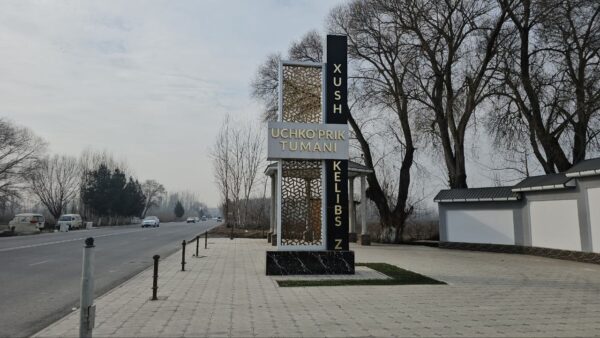
In Uzbekistan, a mahalla is traditionally a local community comprising the residents of a particular area. Its self-governing body, commonly known as the mahalla committee, is the administrative institution closest to the local population. Although formally outside the state administration system, in practice mahalla chairpersons – those chosen to head the mahalla committee – are closely linked to local authorities such as the district hokimiyat, the lowest official level of government administration, and often carry out their instructions.
The mahalla helps to distribute social assistance, organize community initiatives, liaise with state institutions, and participate in the implementation of state programs. Their chairpersons are required to represent the interests of residents while cooperating with the district hokimiyat.
In the spring of 2026, I learned that the mahalla chairperson in my home of more than 20 years, the Tinchlik mahalla in the Uchkuprik district in Fergana Region, was stepping down. I decided to stand for election to replace him.
Nearly 100 residents in the mahalla signed a petition in support of my candidacy. I have a university degree, many years’ experience in journalism and community work, and, as I believed, all the qualities necessary to stand for election to a position working on behalf of my community.
My name never appeared on the list of candidates.
The story of why illustrates that while Uzbekistan has made great strides and undertaken efforts to broaden citizen participation, increase the accountability of government authorities, and strengthen local self-government, there remains a gap between the law and the lived reality.
The testing of a democracy occurs not just as the national level, but at the hyper-local level, in the mahalla, where barriers remain to entry.
In March 2026, I learned that the chair of the Tinchlik mahalla committee intended to step down.
During our conversation, he described a role that differed significantly from what one might imagine when reading the legislation on citizens’ self-government. According to him, the district hokimiyat regularly assigned him additional tasks not directly related to the chairperson’s statutory duties. Carrying out these tasks was not a matter of choice, but in fact a mandatory requirement. The workload became too much for him, and he decided to step down.
For several years now, I have been formally unemployed. Invisible barriers, apparently linked to my civic activism, have prevented me from getting a job at any state institution. For many years, I had worked as a journalist in a local newspaper and been involved in community activism helping my neighbors with their day-to-day problems.
When deliveries of gas cylinders were delayed for several months, I contacted the relevant government authorities until deliveries resumed. When rubbish collection stopped, I raised the issue with local officials. Together with residents, I campaigned for our street to be tarmacked and helped organize the installation of a communal water pump. I also helped low-income families and people with disabilities navigate government procedures and secure the assistance they were entitled to.
The outgoing chairperson agreed that he would formally submit his resignation, while I would appeal to residents for their support in hopes of perhaps succeeding him.
Under the Uzbek law “On the Election of the Chairperson of the Citizens’ Assembly,” candidates are nominated taking into account the views of citizens permanently residing in the relevant area. The law sets out a number of requirements for candidates: they must have a university degree; possess organizational skills, life and professional experience; enjoy respect among the local population; and have been permanently resident in the relevant area for at least five years prior to the election.
I believed that I met these requirements and began talking to my neighbors.
By the end of this process, nearly 100 residents of the Tinchlik mahalla had signed a petition in support of my candidacy. People read the text, made up their minds, and left their signatures and telephone numbers.
On March 19, the incumbent chairperson and I went to the Uchkuprik district administration. He submitted his resignation; I handed over the residents’ petition supporting my candidacy.
At that time, I still held out hope that the rest of the process would play out as governed by the law.
However, the elections, which should normally have taken place within a month of the vacancy arising, were postponed. April passed, then May. When I contacted the district commission responsible for facilitating the elections, I was told that the necessary documents had not yet been received and that the date of the vote was unknown. I received no official explanation for the delay.
On May 18, I received a call from Mashrab Tursunov, chair of the district commission for facilitating elections. He asked me to come to the hokimiyat, as the district hokim wished to speak personally with potential candidates for the vacant mahalla chair.
The meeting lasted only a few minutes. The hokim asked me one question: “What sort of person should the mahalla chair be?”
I replied that, above all, the chair must be honest and conscientious, represent the interests of residents, explain new laws and presidential decrees to them, promote the fair enforcement of legislation, and strengthen trust between citizens and state institutions.
The hokim listened to me, asked no further questions, and wished me luck as I took my leave. Nothing in our conversation suggested that my candidacy might be rejected.
On June 8, I contacted the commission again and learnt that the elections were scheduled for June 14. However, when I asked whether I was on the list of candidates, I did not receive a clear answer.
The following day, Tursunov informed me that the hokim had not approved my candidacy. According to him, the hokim had decided to support two men for the chair. He apparently had said that he “could not work with women” and preferred to work with men.
I was not present during the alleged conversation and cannot independently confirm that the hokim uttered those words. I can only accurately relay what was told to me by the official responsible for facilitating the elections.
That same evening, official notices appeared at the school, the sports center, and the mahalla building. The list contained two candidates – both men.
My name was not on it.
I requested a written statement from the hokim. The document I received did not explain which specific legal requirement I had failed to meet. It did not state why the support of nearly 100 residents was not deemed sufficient even to allow me to stand for election, nor why other candidates were approved while I was rejected.
I appealed against the refusal to register my candidacy at the Fergana Inter-District Administrative Court, as I believe I met all the established requirements and was entitled at least to be included on the official lists of candidates.
The administrative court rejected my application, citing the fact that my place of residence – my propiska – is formally registered in the Tashkent Region, even though I have lived in the Tinchlik mahalla of the Fergana Region for over 20 years, a fact that could easily have been verified had the court so wished.
The court ruled that the legal requirement for a “candidate to have resided permanently in the relevant territory for at least five years” should be interpreted as a requirement to have permanent registration there.
During the hearing, I asked the judge if a person is registered at one address but actually lives elsewhere – a common occurrence in Uzbekistan – does that mean their permanent place of residence is their place of registration?
This question highlights the difference between formal registration and actual residence. The court did not examine this distinction and confined itself to its own interpretation of the law. As a result, the election for the chairperson of our mahalla took place on June 14 without my name on the ballot.
For a decade, Uzbekistan’s reforms have been aimed at strengthening local self-government and expanding citizen participation. For these changes to achieve their stated goals, the procedure for nominating candidates must be as transparent and predictable as the voting process itself. If candidates can be excluded without a clear legal basis, voters’ choices are limited even before they turn up to vote.
This is about more than a just community leadership position. International financial organizations investing hundreds of millions of dollars in large-scale projects, such as improving rural infrastructure and other development initiatives, often involve the mahalla in consultations. The mahalla chair is expected to represent the views of local communities in those discussions.
Such consultations are particularly important when projects affect land, sources of income, socially vulnerable groups or access to public services. However, consultations are only meaningful if the community representatives taking part have been given their mandate through open, independent, and inclusive procedures.
My case does not imply that all mahallas are incapable of representing their residents. But it raises the question: How representative are these institutions if a qualified candidate, who enjoys the clear support of the local community, can be excluded even before the election takes place?
Over the past decade, Uzbekistan has significantly modernized its legal and institutional framework. Constitutional and legislative reforms have been aimed at broadening citizen participation, increasing the accountability of the authorities, and strengthening local self-government. These changes are important.
Local self-government could significantly improve the quality of governance in Uzbekistan – provided that citizens are free to choose candidates who genuinely represent their interests. The chairs of mahalla committees are closest to Uzbekistan’s citizen: they know the families in their mahallas personally and are the first to recognize who is most in need of state support – whether it be children, people with disabilities, women, or large families.
If the people of Uzbekistan were able to freely elect their mahalla chairpersons, without interference from local administration officials, this could create a far fairer and more effective system of governance and significantly improve the lives of people in my country.
