

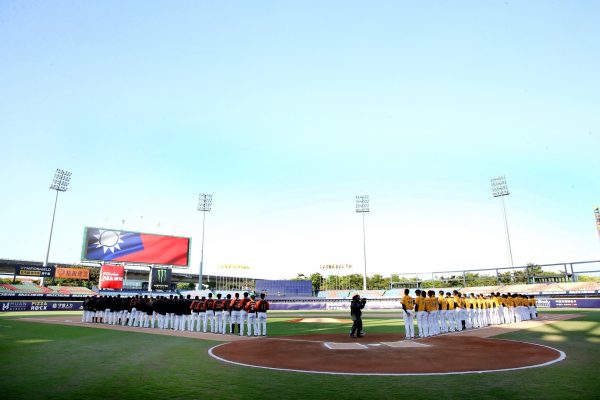
Taiwan has few embassies and no seat at the United Nations. On a good night at the ballpark, however, it can hold the world’s attention.
That was what happened on November 24, 2024, when Taiwan defeated Japan 4-0 in a sold-out Tokyo Dome and won the WBSC Premier12. It was Taiwan’s first title at a top-level international baseball tournament. Captain Chen Chieh-hsien supplied the decisive hit, a three-run home run, while four Taiwanese pitchers limited Japan to four hits. The loss ended Japan’s 27-game international winning streak.
Back in Taiwan, the result was treated as more than a sporting success. President Lai Ching-te and Vice President Hsiao Bi-khim described the players as national heroes, and crowds welcomed the team home with a parade through central Taipei. Taiwan soon climbed to second place in the WBSC men’s world ranking, behind Japan. It retained that position after the 2026 World Baseball Classic.
Yet the name engraved on the trophy was not Taiwan. It was Chinese Taipei. The name symbolizes the political conditions under which Taiwanese athletes enter international competition.
Taiwan has formal diplomatic relations with only 12 partners and is excluded from bodies such as the United Nations and the World Health Organization. International sport therefore offers something that conventional diplomacy often cannot: a stage on which Taiwan can appear before a global audience as one team representing one society.
The opportunity comes with strict limits. Taiwanese athletes may compete, but generally under a name, flag, and anthem created specifically for international sport. Baseball thus gives Taiwan visibility but only up to a point.
Baseball arrived in Taiwan as part of Japanese colonial rule. Japan, which governed the island between 1895 and 1945, promoted the sport among the local population as a means of education and assimilation. In “Colonial Project, National Game,” historian Andrew Morris traced the process by which Taiwanese players gradually took possession of a game introduced by the colonial authorities.
One of the defining episodes came in 1931. A team from the Chiayi Agriculture and Forestry School reached the final of Japan’s national high school championship at Koshien. Its players included Han Taiwanese, Indigenous Taiwanese and Japanese students, making the team unusual even within the colonial system that had produced it. They lost the final, but their run became part of Taiwan’s sporting memory. The story was retold in the 2014 film “Kano” and continues to serve as an origin story for Taiwanese baseball.
After World War II, and especially after the Republic of China (ROC) government was forced out of mainland China, baseball in Taiwan acquired a different political purpose. The Kuomintang government presented victories abroad as proof of the strength and vitality of the ROC. A 1968 win by a team of Indigenous Bunun children over a visiting Japanese youth side is still commonly credited with starting Taiwan’s baseball boom. The story is less straightforward than the popular version suggests: later research uncovered the use of ineligible players and legal problems involving team officials. Even so, the game became an important national legend, complications included.
The success that followed was real enough. From 1969 to 1996, Taiwanese teams won 17 Little League World Series championships, including five consecutive titles between 1977 and 1981. In August 2025, a Taipei elementary-school team defeated Las Vegas 7-0 to claim Taiwan’s 18th title and its first in 29 years. In the interim, Taiwan established the Chinese Professional Baseball League, which began play in 1990.
Over the course of a century, baseball’s significance for Taiwan has changed, even if the sport itself remains essentially the same. From a Japanese colonial project, baseball became a Kuomintang political showcase and, eventually, a popular symbol of Taiwan itself. But even if everyone knows they represent Taiwan, Taiwanese teams have to use alterative names in international competition.
Under the International Olympic Committee’s 1979 Nagoya Resolution and the subsequent 1981 Lausanne Agreement, Taiwanese athletes were allowed to compete as Chinese Taipei. They would use a designated Olympic flag and anthem rather than Taiwan’s official national symbols. The compromise kept Taiwanese athletes inside the Olympic system, while removing the name Taiwan from their uniforms and from official results.
Yet sports is actually among the more inclusive international arenas for Taiwan. In 1971, U.N. General Assembly Resolution 2758 transferred China’s seat at the United Nations from the Republic of China government in Taipei to the People’s Republic of China in Beijing. Taiwan’s subsequent exclusion from international institutions extended far beyond the resolution’s original wording, as the Council on Foreign Relations has argued.
Because sport remains one of the few global events open to Taiwan’s participation, the language used there has acquired unusual importance. The name Chinese Taipei is not just a label devised for tournament organizers. As Ying Chiang and Tzu-Hsuan Chen showed in their work on Taiwanese sport nationalism, the name has itself become part of the dispute over Taiwanese identity.
The pressure became especially visible in 2018, when civic groups proposed a referendum on whether Taiwan should apply to enter the 2020 Tokyo Olympics under the name Taiwan. The International Olympic Committee warned that changing the existing arrangement could put Taiwan’s Olympic participation at risk. Prominent athletes, worried that they might lose the chance to compete, publicly opposed the proposal.
Before voters had even cast their ballots, the consequences had begun to appear. In July 2018, the East Asian Olympic Committee voted 6-1 to withdraw Taichung’s right to host the 2019 East Asian Youth Games. Beijing had requested the decision, which came after the Taiwanese city had already spent about NT$676 million preparing for the event.
The possibility of Olympic exclusion was enough to influence the debate inside Taiwan. When the referendum took place in November, it failed, 5,774,556 votes to 4,763,086.
A 2024 Institute for Security and Development Policy brief noted that similar pressure continues because China holds considerable influence in many of the organizations that decide who may host and participate in international events. Results on the field do not remove that pressure, but they do give Taiwan a larger audience.
At the 2026 World Baseball Classic, Taiwan defeated South Korea 5-4 in extra innings, its first WBC victory over its regional rival, and routed Czechia 14-0. It still failed to reach the quarterfinals, however. Taiwan, South Korea, and Australia finished pool play with identical 2-2 records, leaving Taiwan outside the qualifying places after the tiebreaker was applied.
For the purposes of baseball diplomacy, however, elimination did not make the tournament meaningless. Taiwanese players and supporters had once again appeared in front of an international audience. The country was visible even though its official sporting name remained Chinese Taipei.
The contradiction was especially striking in 2024. At the Premier12 final in Tokyo, Taiwanese supporters filled the stadium with flags and chants of “Taiwan Bravo.” On the field and in the official records, their team was Chinese Taipei; in the stands, there was little doubt about the name the supporters preferred.
Earlier that year, the Paris Cultural Olympiad had included a Taiwanese pavilion presented under the name Taiwan. According to the Institute for Security and Development Policy, this was the first use of that name in an Olympic-related setting since 1968. The apparent explanation was procedural: the pavilion belonged to the cultural program rather than the official competition, so the Olympic naming rules did not apply in the same way.
Winning a baseball tournament will not persuade Beijing to change its position on Taiwan’s international participation. It cannot substitute for formal diplomatic recognition or U.N. membership. But when Taiwanese players take the field and supporters wave their flags, foreign audiences encounter a team whose public identity is clearer than its official designation suggests. Every international tournament reminds audiences of the gap between the name on the scoreboard and the society the team represents.
That is both the strength and the limitation of Taiwan’s baseball diplomacy. The sport cannot resolve the political dispute or replace formal diplomatic recognition. What it can do is keep Taiwan visible on one of the few global stages still open to it.
