

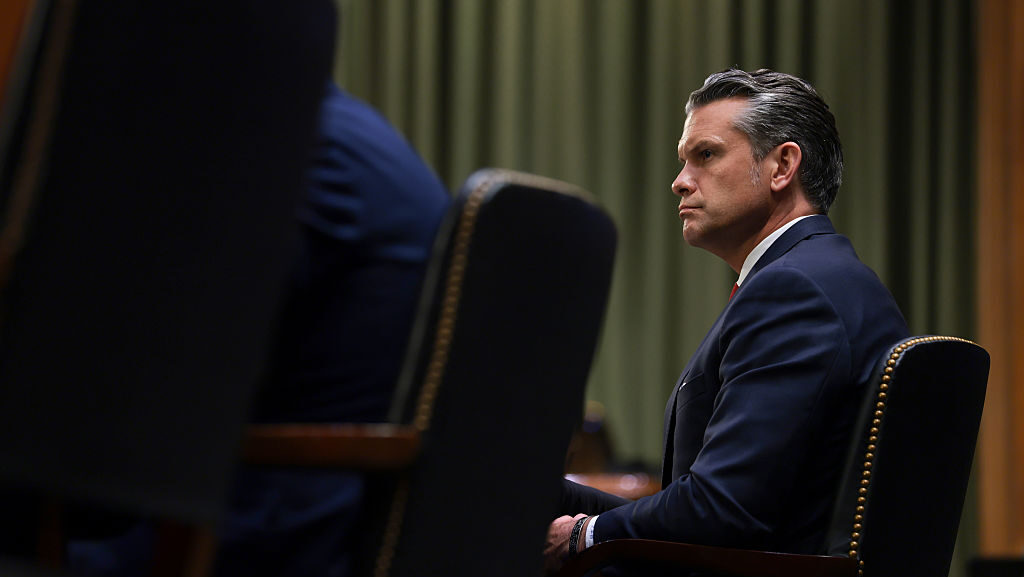
WASHINGTON — Facing down senators’ questions about an Iran spending request, Defense Secretary Pete Hegseth said that he expects “certain aspects” of the Iran war to cost $37.5 billion through the end of September.
During a hearing on Capital Hill today Hegseth did not detail just what is excluded from that total but said by the end of fiscal 2026, or Sept. 30, it would cover military pay, operation and maintenance, and other “anticipated costs.” That figure is up from the $25 billion price tag given in late April and the $29 billion offered a month later for costs incurred so far.
It’s tens of billions of dollars less, however, than the $67.1 billion the Trump administration has requested in defense funds it says it needs related to the Iran conflict as part of a larger, nearly $90 billion supplemental request. The administration has said that money would pay for everything from restocking munitions to drone purchases to classified programs.
Hegseth, alongside Chairman of the Joint Chiefs of Staff Gen. Dan Caine, testified before the Senate Appropriations Committee today in support of the supplemental, repeatedly saying that it — plus the Trump administration’s unprecedented $1.5 trillion defense budget request — represented a “generational” investment in the military.
Some lawmakers, however, pushed back during the hearing, saying that the Pentagon had not been forthcoming with its Iran war plans or what, exactly, the supplemental would fund that is directly related to the conflict.
“I think that the supplemental doesn’t include funding to repair damage to our bases or to our military infrastructure in the region, and I have not heard that we’ve gotten the full extent of any of those damage estimates,” Sen. Jeanne Shaheen, D-New Hampshire, said during the Senate Appropriations Committee hearing today.
Hegseth did say the supplemental request was “connected to the real world realities of this budget cycle.” He also suggested that without it, funds would be pulled from elsewhere and some training, for instance, would have to be “curtailed if we do not get our budget needs met and met urgently.” (Earlier this month the Pentagon requested congressional approval to reroute roughly $4.3 billion from fiscal 2026 coffers to pay for “higher priority items,” including increased personnel and operational costs around the globe.)
For his part, Caine said he “can’t answer the question on what [the conflict] will cost, because the enemy gets a vote.”
“What I’ll commit to you is [as] this plays out, we’ll make sure that Congress is informed,” said Caine, who warned that the Pentagon urgently needed to partner with industry to boost defense production.
“If we don’t, as a team, figure out how to properly fund the department, then you know we’re not going to get the munitions, and there’s going to be a lack of shared risk between the federal government and the private sector,” Caine said.
Today’s hearing comes nearly five months after the US and Israel launched wide-scale attacks on Iran in late February. Those attacks, and counter attacks, have ebbed and flowed over the months before Washington and Tehran inked a memorandum of understanding in mid-June that broadly laid out a roadmap for pursuing a permanent peace deal within 60 days.
However, the MOU’s overly broad language led to disagreements over the reopening over the Strait of Hormuz and the passage of commercial vessels through the critical waterway. After Iran fired on ships moving through the strait, the US launched regulatory attacks, leading Iran to target US bases in the region.
On Monday, Pentagon Press Secretary Sean Parnell announced on social media that “nearly” 100 US service members had been injured since July 7, though roughly 96 percent had since returned to duty. Three US service members were also killed over the weekend — two on an airbase in Jordan and one inside Iraq during a “controlled detonation” of an Iranian drone.
Part of lawmakers’ concerns today stemmed from the influx of dollars in the building, including $152 billion in 2025 reconciliation spending which the Pentagon is rushing to get under contract by the end of September or risk an 8.3 percent cut to the remaining balance.
Several Democratic senators tasked with reviewing and approving the reprogramming and supplemental spending requests asked Hegseth today why the department needs more money when it received nearly $1 trillion to cover fiscal 2026.
“You’ve barely spent half of the $150 billion in reconciliation funding, and if you still have $75 billion available, why are you asking the American people to absorb the cost of a war?” Shaheen asked.
Sen. Dick Durbin, D-Ill., agreed, saying the Pentagon’s request “does not make a lot of sense.”
Hegseth said roughly $75 billion remains unobligated today but projected that 95 percent would be under contract by Oct. 1 to pay for a myriad of defense investments including the Golden Dome air defense plan.
He also said the supplemental request “is not a substitute” for other funding measures and is needed to rebuild the military.
While today’s hearing was intended to home in on funding for the Iran war, Hegseth is also trying to ferry though the department’s $1.5 trillion request for fiscal 2027 that includes $1.15 trillion in the base budget and an additional $350 billion in reconciliation spending.
The reconciliation pot includes funding for administration priorities like Golden Dome missile defense and critical munitions, but there is growing bipartisan cynicism that such a bill could be passed, especially with looming midterm elections.
