

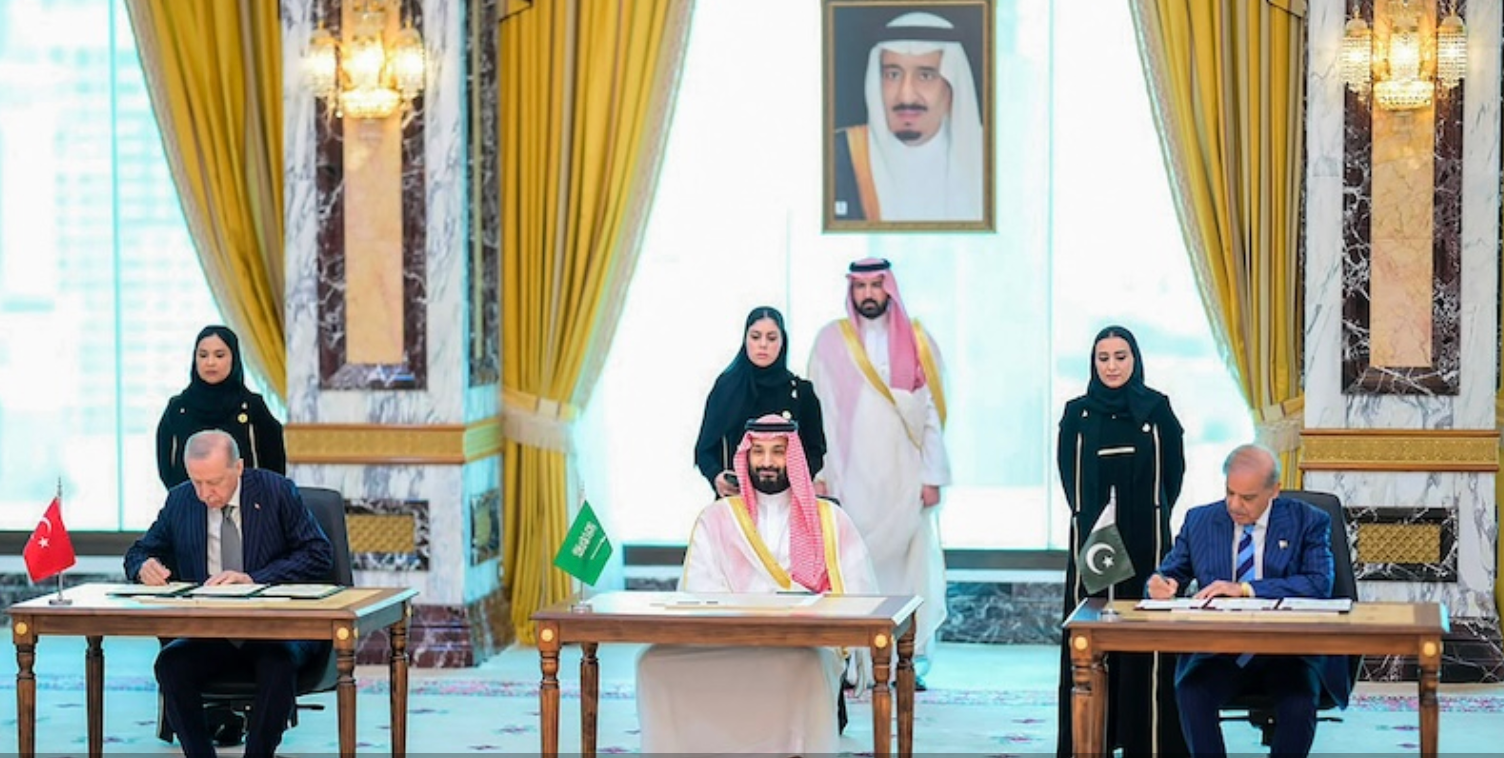
Turkey, Saudi Arabia and Pakistan have signed a defence agreement committing each country to come to the aid of the others in the event of an armed attack, marking one of the most significant shifts in the region’s security landscape in recent years.
The agreement was signed in Mecca by Saudi Crown Prince Mohammed bin Salman, Turkish President Recep Tayyip Erdogan and Pakistani Prime Minister Shehbaz Sharif after months of negotiations.
In a joint statement, the three leaders said the agreement reflected their determination to strengthen security co-operation.
“The Agreement aims to bolster collective deterrence against all forms of aggression and stipulates that an armed attack carried out against any one of the three states shall be considered an attack against all of them,” the statement said.
“The Agreement also provides for the development of defence cooperation among the three states in all its dimensions.”
Officials have released few details of the arrangement, but Turkish sources said it would cover a broad range of military co-operation and intelligence sharing.
One Turkish official told Reuters that the agreement was defensive in nature, was not directed against any particular country and could eventually be opened to other states.
The deal brings together three countries that have each emerged as important military powers in their own right.
Saudi Arabia possesses vast financial resources and is among the world’s largest purchasers of military equipment. Turkey has Nato’s second-largest army and a rapidly expanding domestic defence industry. Pakistan is the only Muslim-majority state to possess nuclear weapons.
The agreement also reflects changing political dynamics across the region.
Relations between Saudi Arabia and Turkey deteriorated sharply during the aftermath of the Arab Spring, when the two countries found themselves backing rival political movements and opposing sides in conflicts across the Middle East.
Those tensions have eased considerably over the past several years as both governments have sought closer economic and security ties.
Pakistan, meanwhile, has maintained longstanding relations with both countries and has increasingly assumed the role of an intermediary between Tehran and Washington during the current crisis.
The agreement comes as fighting involving Iran continues to unsettle the region, threatening energy supplies and commercial shipping routes through the Strait of Hormuz and the Red Sea.
Saudi Arabia and Pakistan had already strengthened military co-operation through a bilateral defence agreement signed last year. The Mecca agreement marks the first occasion on which all three countries have been brought together under a single framework.
“The agreement will change the balance of power in the region,” one source familiar with the discussions said.
“If successfully implemented, the deal will enhance the stability and security of people living in this part of the world.”
Officials in all three countries stressed that the agreement was intended as a deterrent and was not aimed at any particular state.
