

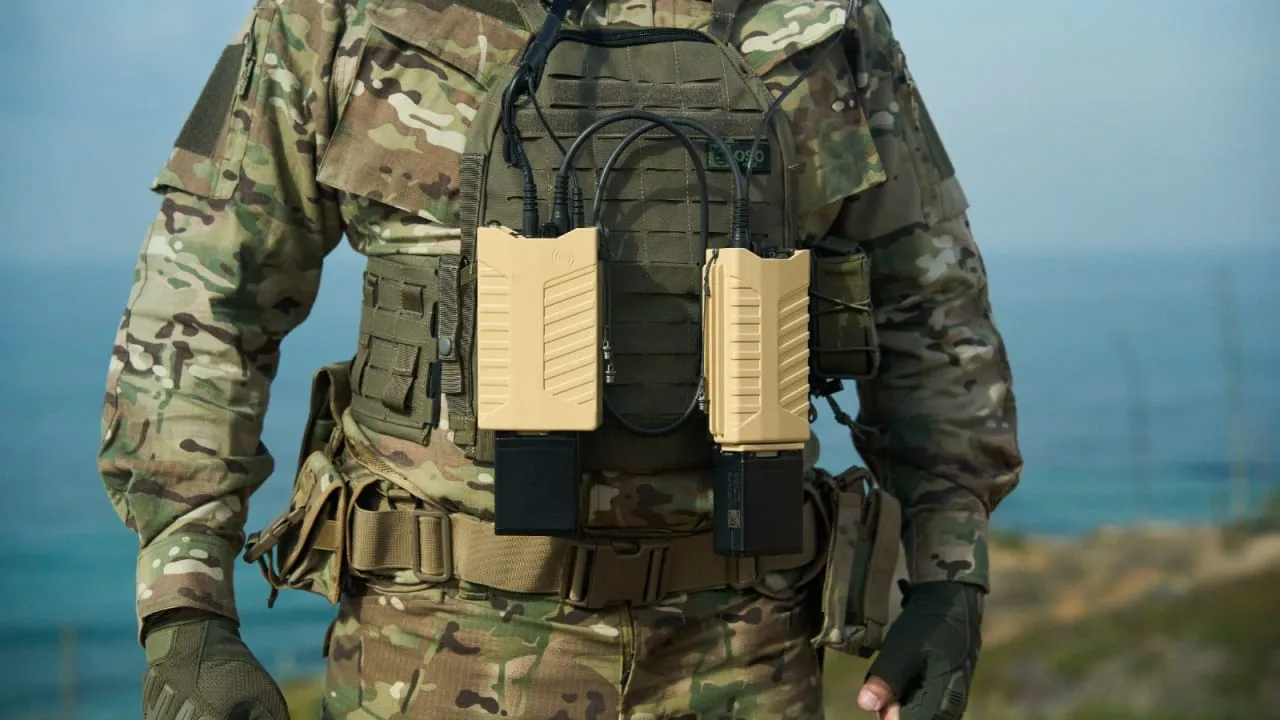
Wearable counter-drone technology is being deployed by Ukrainian and Israeli forces and tested by the US Army as militaries adapt to the growing threat from autonomous weapons.
General Dan Caine, chairman of the US Joint Chiefs of Staff, has warned that American forces should expect to be “hunted by autonomous systems, jammed across the spectrum, and tracked in real time”.
The warning comes as militaries are increasingly looking to equip individual soldiers with protection against drones on the battlefield.
Autonomous Guard’s wearable counter-UAS technology has been used by Ukrainian troops and Israeli forces operating in Gaza, while the US Army has trialled the system during exercises in Europe.
Designed to be carried by individual soldiers, the equipment uses radio-frequency detection to warn troops when drones are approaching their position.
The company says its wearable kit can detect hostile drones at distances of up to two kilometres and jam them from as far as three kilometres away. It also indicates the direction of an approaching drone, giving soldiers time to seek cover or reposition before they are detected.
The technology reflects a rapidly changing battlefield in which relatively inexpensive drones can be used to locate, track and attack individual soldiers, vehicles and military positions.
The scale of that threat has been demonstrated in Ukraine, where reconnaissance aircraft and first-person-view (FPV) attack drones have become a central part of operations on both sides of the frontline.
For units requiring greater coverage, Autonomous Guard also offers the Sky Spotter Pro, which the company says can detect drones at distances of up to five kilometres, falling to around three kilometres in more difficult terrain.
The system is also designed to locate the operator controlling an enemy drone, potentially allowing troops to respond to the source of the threat.
Information about friendly drones can be loaded before an operation, helping forces distinguish their own aircraft from hostile platforms and reducing the risk of friendly drones being mistakenly targeted.
The technology has been supplied to US Army units operating under US European Command (EUCOM) and other combatant commands, as well as Ukraine’s Armed Forces.
US forces tested the equipment during a large-scale exercise in Germany in July involving the 2nd Cavalry Regiment, which is stationed at Rose Barracks in Vilseck and supports US and NATO operations in Europe.
The growing use of portable counter-drone equipment comes as senior US commanders assess how lessons from Ukraine should shape preparations for future conflicts.
Speaking at the Air, Space and Cyber Conference in Maryland in September, Caine called for the US military to adapt rapidly to the changing technological threat.
“We have to transition the joint force to be prepared to fight and win our future wars by generating and delivering lethality at scale with an agile, optimised, high-low mix of combat capabilities to give the young members of the 2.8 million-member all-volunteer joint force the tools that they need before they need them,” Caine said.
The increasing autonomy of drones presents an additional challenge.
FPV drones equipped with AI-enabled computer vision can increasingly continue towards a target even when GPS signals or the communications link with their operator are disrupted, making some conventional electronic warfare measures less effective.
The proliferation of inexpensive precision weapons has also transformed the risks faced by troops operating close to the frontline.
Referring to the Russia-Ukraine war, Caine said the life expectancy of a new Russian recruit on the frontline in certain areas was as little as 20 to 30 minutes.
“Think about that. This is what happens when low-cost precision [weaponry] is fielded fast, adapted quickly, and scaled across the battlefield. The price of lethal exchange is decreasing day over day,” he said.
The changing threat is putting greater pressure on militaries to provide counter-drone protection that can accompany troops rather than relying solely on larger, fixed systems.
Wearable detection equipment can provide an additional layer of warning for dispersed units, while portable jammers give soldiers a way to respond when a drone approaches their position.
Caine said speed in identifying threats, making decisions and responding would become increasingly important as artificial intelligence is integrated more deeply into military operations.
“In the future fight, advantage will go to the side that can see first, who can understand first, decide first, and act first, and along the way be a learning organisation,” Caine said, adding that “AI is here now and it’s already changing the way militaries see, sense, decide and act.”
