

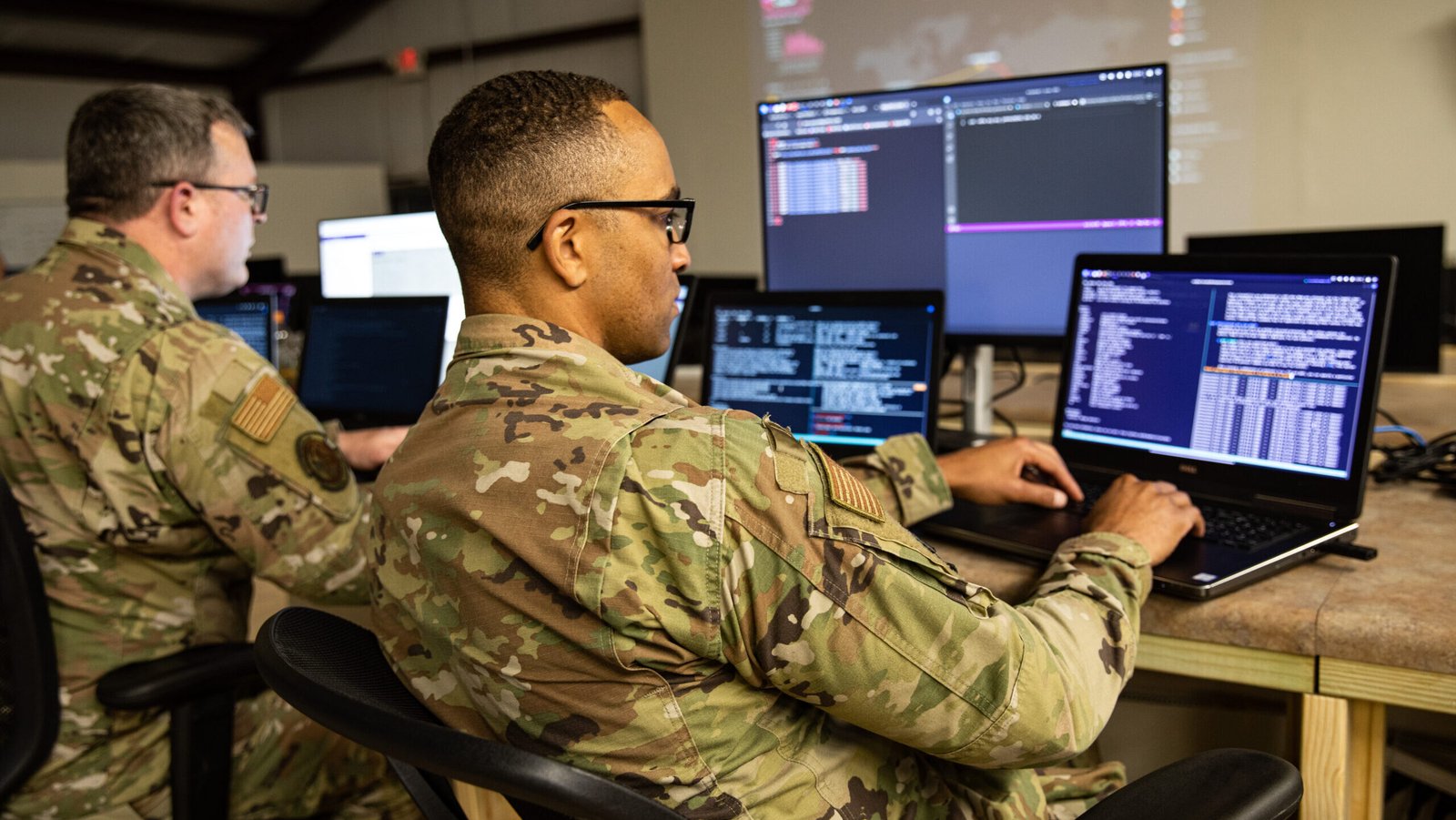
AUGUSTA, Ga. — Army Cyber Command (ARCYBER) established a Joint Integrated Fire Cell (JIFC) during Operation Epic Fury, modeled off a similar construct in the run-up to Operation Absolute Resolve in Venezuela, according to the command’s top general.
Described by Vice Adm. Heidi Berg, commander of the Navy’s Fleet Cyber Command, as “instrumental” during the raid to capture Venezuelan leader Nicolás Maduro, the JIFC was akin a cyber version of a combined air operations center. It effectively served as a central hub to coordinate cyber effects at the timing and tempo of the commander.
Fleet Cyber Command established the JIFC during the Venezuela mission, and ARCYBER —which is responsible for conducting cyber operations on behalf of US Central Command — studied that operation, made some tweaks and replicated the construct for Epic Fury, according to Lt. Gen. Christopher Eubank, who helms ARCYBER.
“What I think the JIFC did for me was more seamlessly integrate Joint Force Headquarters [JFHQ] to Army Cyber, so that the Joint Force Headquarters through the JIFC could leverage the capacity of the Army Cyber headquarters to get after things they needed help with,” Eubank said in an interview with Breaking Defense at the annual TechNet Augusta conference last week. “In my joint hat, if my deputy there said, ‘hey, sir, I need intel support,’ we were able to, through the JIFC, surge intel support into the JIFC so that the JFHQ could actually continue to work outside of that mission set.”
Each service’s cyber component commander also heads a Joint Force Headquarters-Cyber, the component under US Cyber Command that’s responsible for conducting cyber operations. And each JFHQ-Cyber is assigned to different combatant commands to provide planning, targeting, intelligence, synchronization, and command and control over cyber capabilities.
The creation of these JIFCs for two major named operations signifies that they are likely to become a mainstay for future operations. In Venezuela, officials acknowledged the use of cyber and non-kinetic effects, with The New York Times reporting that US cyber operations turned out the lights in Venezuela, interfered with air defense radars and disrupted hand-held radios.
Brandon Pugh, principal cyber advisor for the Army, noted that senior military leaders have become far more candid about the role of offensive cyber effects in current operations.
“Historically we’ve kind of shied away from that topic,” Pugh said in an interview at the conference, adding that the openness comes as cyber capabilities have proven remarkably useful.
“We’re seeing this not just be an isolated and siloed capability that only rests in Georgia or in Maryland,” he said. “It is one element of how we fight against our adversaries, and I argue a key element. It can not only enable other types of objectives in conflict, but it can bring about its own objectives.”
For many years, cyber operations were limited due to restrictive US legal authorities. But since 2018, with new authorities from the executive and Congress, cyber forces have been able to operate more.
Being able to run real world missions has helped Eubank’s command grow too, he said.
“Over the past five months, the teams have really been able to hone their skills based on the work they’re doing inside of a live environment and I think we’re getting better and better every day because of that,” Eubank said.
ARCYBER Reorganization
Eubank said his command is in the midst of a reorganization to operate more like a corps structure, which will help ARCYBER support regular Army units better.
“It’ll help us in what we present to the combatant commanders and then to our corps and our” Army component commands, Eubank said.
The reorganization will also give the command greater capacity, going from 20 to 22 cyber protection teams, for example.
More granularly, ARCYBER is moving from what the military refers to as table of distribution allowances (TDA) to a table of organizational equipment (TOE). In practical terms, TOE equates to standardized units with standardized equipment and overall more standardized structures, while TDA units are typically non-deployable and have more flexibility to change their structures based on evolving mission needs.
The change to TOE “puts the headquarters in a main command post, contingency command post formation, just like a corps, so we war fight better,” Eubank said. “We have brigades and battalions, and then below that we go to a team-like structure. This change is going to allow us to put in teams, company commanders, battalion commanders, brigade commanders.”
