

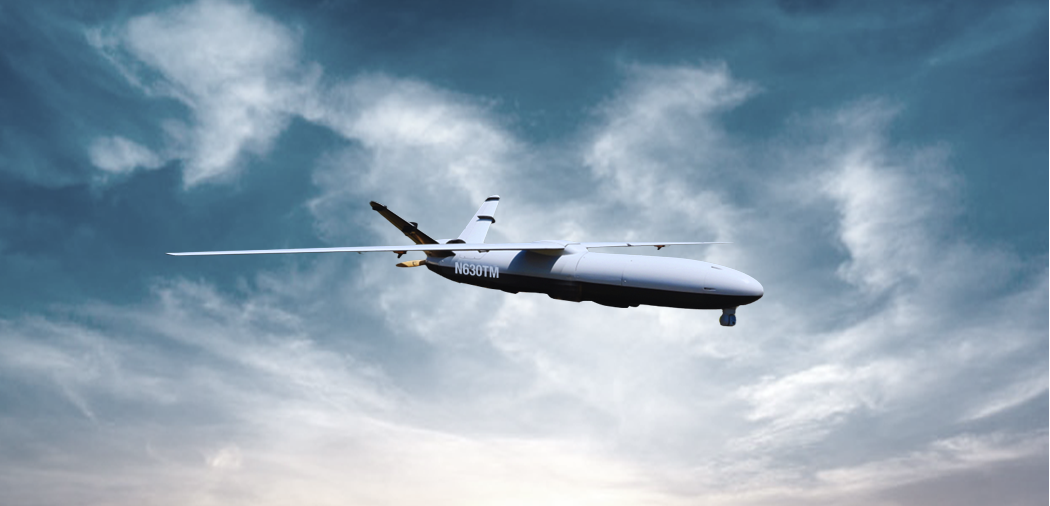
WASHINGTON — The small firm Ideal Aerosmith is pivoting to defense, debuting an in-house developed attack drone in a bid to capitalize on surging interest in low-cost munitions.
Founded in 1938, North Dakota-based Ideal Aerosmith — not to be confused with the name of your favorite playlist — has undergone a few “instantiations” throughout its decades-long history, David Markert, the company’s senior vice president and general manager of government systems, told Breaking Defense in an Oct. 2 interview. The firm has been “defense adjacent” in more recent years, Markert said, manufacturing test equipment for navigation systems.
But about three years ago amid rising demand for defense tech, Ideal Aerosmith decided to pursue military customers directly, according to Markert. The company chose a low-cost, one-way attack drone, now dubbed “Troublemaker,” and publicly unveiled the system Thursday as a chief platform to market to prospective customers.
Ideal is now entering low-rate production for the Troublemaker, according to Markert, who said the company has a “Department of the Navy sponsor” for the system when asked about current contracts. He said the company has built 26 of Troublemakers so far, and is manufacturing the drones at a rate of two per week. With sufficient demand, he added the company could build up to 20 Troublemakers weekly within existing infrastructure.
“We felt that was a sweet spot in the market,” Markert said of a one-way attack drone. “And as the market turned away from exquisite systems to low-cost, affordable mass, it seemed like the ideal time to go after that. Given our engineering pedigree [and] our precision manufacturing, it gave us a pretty solid base to transfer some of those skills over to building drones.”
With a 15-foot wingspan, the Troublemaker is classified as a Group 3 system and can be launched from a catapult or truck. The company says the drone can fly in swarms, boasts a range of over 750 nautical miles (863 miles), has an endurance time exceeding 10 hours and can carry a payload of 30 pounds for missions spanning attack to reconnaissance.
Markert said the company views the Troublemaker as filling a different niche compared to other strike options, particularly amid surging interest in low-cost cruise missiles. He argued key differences, like the ability to reuse the drone — which can be recovered via a skid landing — and the system’s ability to launch without the need for more specialized infrastructure or platforms, such as aircraft.
“We looked at the air launch or the palletized launch,” he said. “There’s a ton of guys in that low-cost cruise missile space. We’re differentiated from that because we’re in the drone space, and in our definition of that, drones give you post-flight options that missiles don’t give you.”
Troublemaker is not the company’s only planned defense product. Markert said Ideal is also working on other systems with greater range and payload capacity. But for the time being, there are more immediate concerns, like the effects of a continuing resolution (CR) that began Oct. 1 and freezes new-start programs while holding funding at prior-year levels.
Ideal has thrown its hat into the ring for relevant solicitations, Markert said, but added that “clearly, the CR has impact.”
“How much of an impact it has, we don’t know at this point. We’re kind of keeping our fingers crossed and holding our breath that this stuff was funded under the [fiscal 2026] budget,” he said.
