

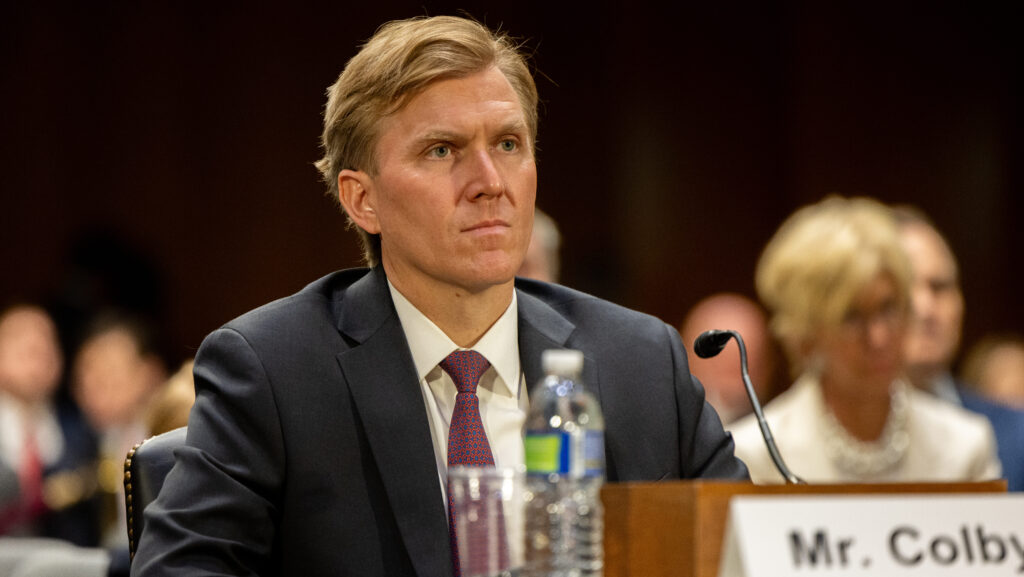
WASHINGTON — Key members of the Senate Armed Services Committee took aim at the Pentagon’s new National Defense Strategy (NDS) today, when one of its architects, Undersecretary of Defense for Policy Elbridge Colby, appeared before the committee to defend it.
The most notable criticisms came from Chairman Sen. Roger Wicker, R-Miss., who specifically called the document out for numerous “flaws,” which, he said, ranged from not mentioning Taiwan in the document, to deemphasizing Europe, to simply not addressing US competitors working together.
“In effect, it obfuscates the threat posed by the Chinese Communist Party, and they are our pacing threat,” Wicker told the Pentagon’s policy head.
“Any clear eyed assessment of the military situation in Europe,” he later added, “makes it clear we cannot fully delegate the Russia problem to our European allies. In my view, the NDS essentially ignores the implications of the war in Ukraine to US security.
The NDS, which lays out how the Defense Department will follow the guidance of the NSS, is traditionally considered a foundational document for the Pentagon. But in a contrast with past releases, the department rolled it out with an unusual lack of fanfare: it emailed the document with no warning at almost 7:00 pm on a Friday in late January.
The document places the homeland as the department’s number one priority and created ambiguity for analysts and lawmakers alike.
Colby said that is, in part, by design, as the Trump administration’s goal was to be “strong and clear, but quiet.”
“I don’t think anybody can doubt our focus on making sure that we support the NSS [National Security Strategy] presidential direction to have the ability to deny aggression along the first island chain,” he added.
Wicker, for his part, did acknowledge that the NDS talks widely about the first island chain, which “seems to be a way of talking about Taiwan without mentioning it.”
On Europe, Colby acknowledged Wicker’s concerns but said the intent was to emphasis the role that wealthy allies and partners in the region should play.
“We recognize our interests in Europe… The basic logic here, senator, is not to ignore or downplay, but rather to array our overall strategy in a way that works with the warp and woof of our allies,” Colby told Wicker.
While Wicker pointed to a number of other problems he has with the new NDS, he pointed to the “most troubling” one as silence on the threat of nuclear weapons, noting that the lack of language in the NDS around those systems could be inferred as the US “ignoring the existential dangers that China, Russia and North Korea.”
Sen. Deb Fischer, R-Neb., also homed in on the nuclear weapon angle, asking if more information would be forthcoming in a Nuclear Posture Review — a strategy document which traditionally follows the NDS and covers the modernization of the US nuclear triad to counter threats from foreign adversaries.
In response, Colby revealed that there would be no Nuclear Posture Review forthcoming.
“One thing about this [NDS] strategy is that it’s designed to move the bureaucracy and the organization in a certain direction,” Colby later told Fischer. “It’s not designed to kind of do things just because we’ve done them. But rest assured, nuclear forces are at the top of our priority list.”
Threading the needle
While Democrats also pointed to perceived problems with the NDS today, they also used the hearing to draw out inconsistencies between the newly published document and this weekend’s US-Israel attack on Iran.
Specifically, several democratic senators pointed towards the Middle East not being listed as a chief priority, and two lines that says, “No longer will the Department be distracted by interventionism, endless wars, regime change, and nation building. Instead, we will put our people’s practical, concrete interests first.”
“The NDS is a flawed proposal and is now, in many respects, already obsolete,” said the top Democrat on the committee, Sen. Jack Reed of Rhode Island. “As we sit here today, the president has engaged the United States in major combat operations against Iran.”
“President Trump has unilaterally started a conflict that is rapidly spreading throughout the Middle East,” Reed later added. “The end state is unknown. Even administration officials cannot say clearly what objectives they are trying to achieve, nor what happens when those objectives are met. In the meantime, there will be immense costs for the Department of Defense, in readiness, in opportunity, and most importantly, in American lives.”
Committee Democrats, including New Hampshire’s Jeanne Shaheen, Massachusetts’s Elizabeth Warren and Arizona’s Mark Kelly picked at similar lines of questioning, while also trying to drill down on the rationale behind the Iran attack and the objectives.
Throughout his testimony, Colby pointed to the fact that Iran is mentioned in the NDS, there is a standalone section about Iran, and asserted that the objectives of the military campaign are focused on degrading the Islamic Republic’s ability to hit US bases in the region, as well as partners and allies, either via missiles or seapower.
Colby also said Secretary of State Marco Rubio told the “truth” yesterday when he told reporters and lawmakers that the “imminent threat” and reason to strike Iran first was because “we knew that if Iran was attacked, and we believed they would be attacked, that they would immediately come after us, and we were not going to sit there and absorb a blow before we responded.”
Shortly after the Senate hearing wrapped up, though, Trump refuted both Rubio and Colby’s assertion, instead saying there was a fear that Iran would attack first.
“Based on the way the negotiation was going, I think they were going to attack first and I didn’t want that to happen,” he told reporters in the White House. “So, if anything, I might have forced Israel’s hand.”
