

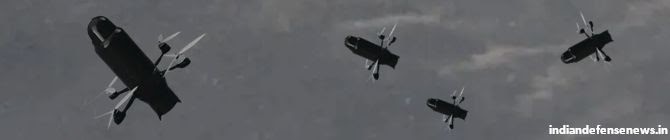
India has achieved a significant breakthrough in counter-drone technology with the successful testing of the autonomous swarm interceptor ‘YAMA’. Developed by Bangalore-based private firm Flying Wedge Defence and Aerospace, this innovation promises to bolster the nation’s defences against the proliferating threat of drone swarms in modern warfare.
The ‘YAMA’ autonomous interceptor is designed specifically to neutralise flying warheads and hostile drone swarms.
The ‘YAMA’ system, tested under the company’s FWD program, represents India’s first indigenous autonomous swarm interceptor. Named after the mythological figure Yamaraj, the god of death, it symbolises its role in swiftly neutralising airborne threats. This development underscores the growing role of private enterprise in India’s defence sector.
Drones have transformed contemporary battlefields, serving as pivotal tools for surveillance and precision strikes. Conflicts such as the Russia-Ukraine war, last year’s India-Pakistan skirmish, and tensions between Iran and the United States-Israel alliance have highlighted their dominance. These engagements have driven unprecedented global demand for effective anti-drone solutions.
A notable incident during the Iran-US-Israel confrontation illustrated the asymmetry in drone warfare. An Iranian drone, valued at just 20,000 dollars, evaded a US Patriot interceptor costing 4 million dollars. This event signals a paradigm shift, where victory may hinge on affordable, efficient defences rather than expensive high-end systems.
In response to this evolving landscape, Flying Wedge Defence and Aerospace has engineered ‘YAMA’ to counter flying warheads and hostile drone swarms with remarkable precision. The system’s low unit cost of approximately 10,000 dollars enables interception at up to 100 times less expense than traditional methods, making it a game-changer for cost-sensitive militaries.
The successful trial, captured in a video released by the company, showcased ‘YAMA’ interceptors engaging and destroying drone swarms mid-air. Officials described the performance as exemplary, affirming that such low-cost, high-efficiency technology can significantly enhance India’s layered air defence architecture.
Headquartered in Bangalore, Flying Wedge joins a cadre of innovative private firms contributing to India’s self-reliance in defence manufacturing. This milestone aligns with national initiatives like ‘Make in India’ and ‘Atmanirbhar Bharat’, fostering indigenous capabilities in cutting-edge military hardware.
The rise of drone swarms poses unique challenges to conventional air defences, which are often optimised for larger threats like aircraft or missiles. ‘YAMA’ addresses this gap through autonomous swarm tactics, where multiple interceptors coordinate to overwhelm and eliminate targets en masse.
Experts anticipate that ‘YAMA’ will integrate seamlessly into India’s broader counter-unmanned aerial systems (C-UAS) framework, complementing assets from public sector undertakings like DRDO. Its scalability and affordability could enable mass deployment along vulnerable borders and critical infrastructure.
As regional adversaries ramp up their drone inventories—evident in recent Pakistan-India border incidents—’YAMA’ equips Indian forces with a proactive edge. The technology’s precision minimises collateral damage while maximising threat neutralisation, a vital attribute in densely populated theatres.
The private sector’s involvement, exemplified by Flying Wedge, accelerates innovation cycles unburdened by bureaucratic delays. This test not only validates ‘YAMA’s’ technical viability but also paves the way for rapid production scaling to meet Armed Forces’ demands.
Looking ahead, further trials and user evaluations will refine ‘YAMA’s’ algorithms for diverse scenarios, including electronic warfare environments. International interest is likely, positioning India as an exporter of advanced C-UAS solutions amid global drone proliferation.
This development reaffirms India’s strategic pivot towards asymmetric warfare capabilities. By prioritising cost-effective interceptors, the nation counters low-cost drone threats without straining defence budgets, ensuring robust deterrence in an era of hybrid conflicts.
India TV News
