

More countries want to develop military spaceplanes and “bodyguard satellites,” like those of the United States and China, to protect orbital assets against growing threats, according to a new report.
Last year alone, France’s direction générale de l’armement, Germany’s Federal Ministry of Defence, Japan’s Ministry of Defense, and the Indian Space Research Organisation have all either tested components, defined strategy, or made sales pitches for space vehicles, according to “Global Counterspace Capabilities,” released this week by the Secure World Foundation.
“We’re seeing everyone wants a spaceplane,” said Victoria Samson, the organization’s chief director of space security and stability. “India is continuing to work on it; French government officials have spoken quite glowingly about this; the Germans are extremely enthusiastic.”
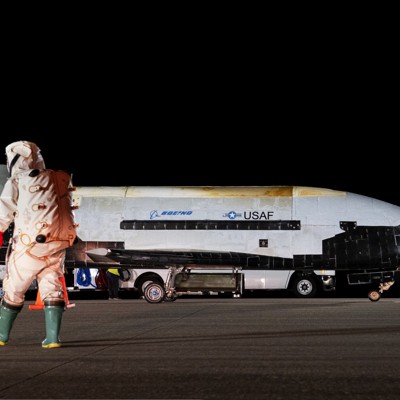
Yet it’s not clear what the secretive vehicles are meant to do. The U.S. X-37B Orbital Test Vehicle has flown eight highly classified missions since 2010, and Russia and China have speculated that it is “some sort of orbital bomber or secret weapons testing platform,” the report said. Even less is known about the Chinese Reusable Experimental Spacecraft, which made the first of its four known flights in 2020.
Other nations are publicly pitching planned spaceplanes of their own.
French Gen. Philippe Koffi, the DGA’s strategic lead for air, land and naval combat, said in September that a spaceplane could “recover critical assets, conduct reconnaissance, and intervene against threats in orbit.” That was three months after Paris-based Dassault Aviation announced an agreement with DGA to develop a demonstrator spacecraft called VORTEX with plans for a first flight in 2028.
France is also planning to demonstrate its own patrol-guard satellites through several concepts, including one known as YODA.
“The YODA program is also framed as an early technology demonstrator program of later and bigger versions of inspector satellites that would be able to protect French military satellites by 2030,” the Secure World Foundation’s report states.
In November, Germany’s Federal Ministry of Defence released its own Space Safety and Security Strategy, which called for building “highly agile low-signal surveillance and bodyguard satellites and reusable spaceplanes.” Earlier in the year, Maj. Gen. Michael Traut, the head of German Space Command, laid out a need for satellites that could protect or even inspect other assets.
“What if we could launch or have some nice little satellites up there, which are agile and go after some satellites which we feel need to be inspected–some sort of space police?” he told Aviation Week.
India has been working for at least three years on a design for its own spaceplane, which “looks very similar to the US’ X-37B and China’s Reusable Experimental Spacecraft,” the Secure World Foundation’s report said. In 2024, India was testing Pushpak, a 21-foot-long prototype, for autonomous landings. Last April, India opened a facility to test Pushpak landing gear.
“While the program has been described as developing technologies for a reusable launch vehicle and not as a counterspace capability, the possibility has been raised that the spaceplane could spend up to a month in space, conducting experiments and releasing payloads; if it does eventually develop that capability, then it may have a latent counterspace capacity,” the report said.
In September, the Indian government said it wanted to develop its own “bodyguard” satellites after a close call with a neighboring countries orbital assets in 2024.
Similarly, this past year, Japan’s Ministry of Defense debuted a program to develop “bodyguard satellites” to protect its space assets with plans to build and test a capability by 2029.
In recent years, China has launched satellites equipped with robotic arms and other means to monitor or interfere with orbital assets, the report said.
The U.S. military has not said whether it has bodyguard satellites of its own.
Last year, the Space Force’s X-37B launched for its eighth mission to test quantum sensors and laser-based communications with commercial satellites. Lt. Gen. Gregory Gagnon, the head of Space Force Combat Command, told reporters at the Air and Space Force Association’s conference in Colorado earlier this year that China is trying to keep up the pace with its own reusable spacecraft.
“That’s the most advanced spaceplane in the world,” Gagnon said. “It’s not the only spaceplane in the world. The Chinese are on sortie four for their spaceplane. We’re on sortie eight. So, what I try to remind everyone is, even though we’re running fast, there’s someone else on the track running just as fast.”
