

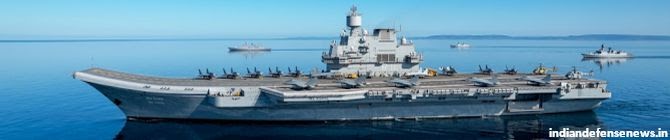
India’s naval modernisation trajectory continues to emphasise carrier aviation
as a central pillar of maritime power projection, with the third aircraft
carrier project—INS Vishal (IAC-III)—emerging as a defining element of this
vision.
As of April 2026, the Indian Navy and Defence Research and Development
Organisation (DRDO) have advanced the design phase of the 65,000–70,000 ton
vessel, refining concepts around CATOBAR operations, manned–unmanned teaming,
and integrated propulsion.
While formal construction approval remains pending, the project is
strategically positioned to ensure India sustains a three-carrier fleet into
the 2030s, counterbalancing regional developments, particularly China’s rapid
naval expansion.
The INS Vishal concept represents a decisive departure from the STOBAR
configuration of INS Vikramaditya and INS Vikrant, embracing CATOBAR launch
systems that would enable heavier aircraft, airborne early warning platforms,
refuelling assets, and long-endurance unmanned combat aerial vehicles.
DRDO’s demonstrators for electromagnetic launch systems, tested with UAVs up
to 400 kg, mark a significant step toward eventual EMALS integration, though
scaling to full aircraft capability remains a technological challenge.
DRDO’s R&DE (Engineers) has validated electromagnetic tech at small
scales, supporting MUM-T for UAVs on the 65,000-ton carrier. Full EMALS
integration faces delays from US export restrictions and costs, mirroring
challenges for China’s Fujian. The Navy prioritises operational readiness over
unproven systems for 2030s commissioning
The air wing envisaged for Vishal includes 30–35 fixed-wing aircraft and
around 20 helicopters, with UAVs capable of endurance missions lasting up to
36 hours, underscoring the Navy’s emphasis on networked, persistent
surveillance and strike capabilities.
The propulsion debate surrounding INS Vishal has been settled in favour of
Integrated Full Electric Propulsion (IFEP), powered by gas turbines.
Nuclear propulsion, once considered, was abandoned in 2017 after Bhabha Atomic
Research Centre (BARC) assessed that developing a 500–550 MW maritime reactor
would require 15–20 years.
This decision reflects a pragmatic balance between ambition and feasibility,
aligning with current Indian naval engineering capabilities while avoiding the
delays inherent in nuclear integration.
Nonetheless, India’s Technology Perspective and Capability Roadmap (TPCR) 2025
continues to list nuclear-powered carriers as a long-term aspiration beyond
2035, leaving open the possibility of future projects once indigenous reactor
technology matures.
Budgetary constraints and technology dependencies remain the most significant
challenges.
Access to EMALS technology, potentially through US–India cooperation, is not
guaranteed, and the capital expenditure required for a supercarrier of
Vishal’s scale is considerable.
Reports in 2025 suggested a temporary pivot toward a repeat Vikrant-class
carrier (IAC-II) to consolidate industrial expertise and maintain fleet
strength.
Yet, by 2026, renewed momentum behind IAC-III design work signals India’s
determination to pursue a larger, more capable carrier, even if construction
timelines extend into the next decade.
The Ministry of Defence’s prioritisation of a balanced fleet—combining
carriers, submarines, and surface combatants—will shape the pace of progress.
Strategically, INS Vishal embodies India’s intent to project power across the
Indian Ocean and beyond, reinforcing deterrence and operational reach.
Its conventional propulsion choice ensures near-term viability, while CATOBAR
and EMALS integration would elevate India’s carrier aviation to a new level of
sophistication. The vessel’s scale, endurance, and emphasis on unmanned
systems reflect a forward-looking approach to maritime warfare, integrating
lessons from global carrier operations with indigenous innovation.
Commissioning in the 2030s would mark a milestone in India’s naval evolution,
positioning the Navy to operate seamlessly alongside major powers while
safeguarding national interests in an increasingly contested maritime domain.
Comparative table of India’s two current carriers and the future INS Vishal:
| Feature | INS Vikramaditya | INS Vikrant (IAC-I) | INS Vishal (IAC-III, Proposed) |
|---|---|---|---|
| Origin | Modified Kiev-class (ex-Admiral Gorshkov, Russia) | Indigenous design, built at Cochin Shipyard | Indigenous design, under development |
| Commissioned | 2013 | 2022 | Targeted for 2030s |
| Displacement | ~45,000 tons | ~45,000 tons | 65,000–70,000 tons |
| Propulsion | Steam turbines (oil-fired boilers) | Gas turbines (GE LM2500) | Integrated Full Electric Propulsion (IFEP) with gas turbines |
| Launch System | STOBAR (Ski-jump + arrestor wires) | STOBAR | CATOBAR (likely EMALS) |
| Air Wing | ~30 aircraft (MiG-29K fighters, helicopters) | ~30 aircraft (MiG-29K, helicopters, future TEDBF) | 30–35 fixed-wing aircraft + 20 helicopters, UAVs with endurance up to 36 hours |
| Key Aircraft | MiG-29K, Kamov Ka-31 AEW | MiG-29K, Kamov Ka-31, HAL Dhruv, future TEDBF | Heavier jets, AEW&C, refuelers, UCAVs |
| Role | Interim carrier to maintain capability | First indigenous carrier, proof of concept for Indian shipbuilding | Supercarrier for power projection, advanced manned–unmanned teaming |
| Strategic Context | Acquired to bridge gap after INS Viraat | Demonstrates indigenous capability, strengthens Indian Ocean presence | Designed to counter China’s expanding carrier fleet, ensure three-carrier force |
| Nuclear Propulsion | No | No | No (nuclear option deferred to post-2035 roadmap) |
This comparison highlights the evolutionary leap from Vikramaditya’s Russian-origin STOBAR platform to Vikrant’s indigenous STOBAR design, culminating in Vishal’s ambitious CATOBAR super-carrier concept. Vishal’s larger displacement, advanced launch systems, and emphasis on unmanned systems mark a significant step toward parity with global carrier powers.
IDN (With Agency Inputs)
