

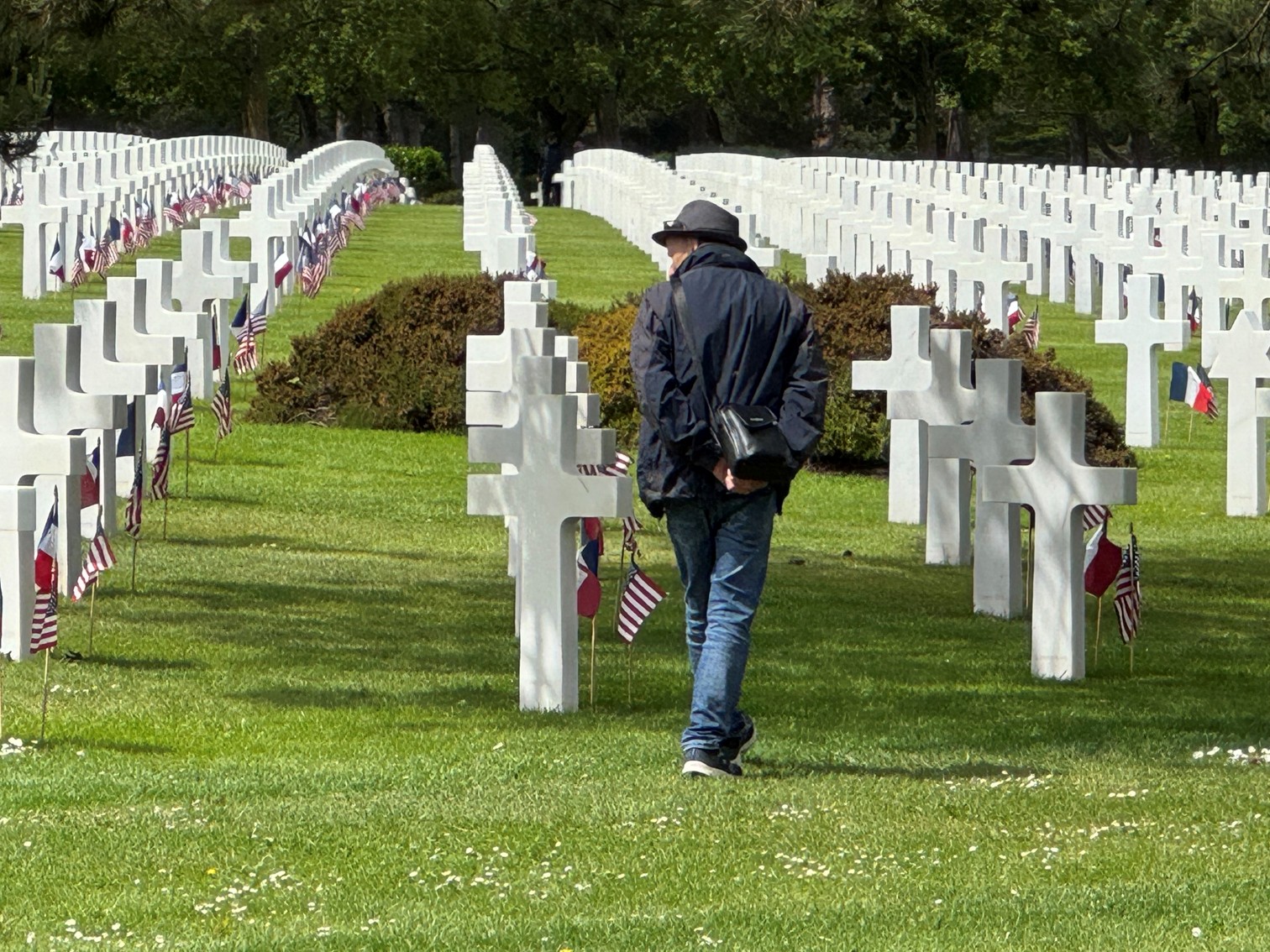
There is a name on a cross in a sea of crosses on a hillside in Normandy. Each of those names was once on the lips of loved ones as they called out to ardent young men who had their whole lives in front of them. Their names echoed on the nearby cliffs and beaches below, shouted by their brothers in arms in a hellscape of terror as they stood together against a gale-force of tyranny that had very nearly swept the world.
The scene at the Omaha Beach landing that greeted 1st Lieutenant Jimmie Monteith Jr. and the 1st Infantry Division’s first wave assault was one of utter chaos and horror. Everything in the sequencing of the attack that could go wrong had gone worse. Unanticipated cloud cover blinded high-altitude allied bombers targeting the German defenses near the beach. Adolf Hitler’s “Atlantic Wall” of fortresses and bunkers stretching from Norway to the northern coast of Spain remained intact and deadly.
On Omaha a well-camouflaged lattice work of enemy pillboxes, bunkers and artillery positions were still dug into the steep bluffs, the Germans looking down on more than 200 yards of open beach through gun scopes. Stormy weather and an unexpectedly strong tidal current swept many of the landing craft off course, including those carrying tanks meant to offer cover and supporting fire to the landing party. Many of the tanks that made it to the beach on the first wave were quickly destroyed by German anti-tank guns.
As soon as the landing craft ramps dropped, their floors already awash in the vomit of seasick soldiers, whole squads were eviscerated by the concussive impact of machine gun fire. Others stumbled out of the boats and immediately sank to the bottom weighted down with heavy equipment and drowned. Nearly half of the men in some boats died before ever making it to Omaha Beach, and many of those who made it to the sand cowered behind cross-beamed tank barriers for precious cover, frozen in shock by the scene of carnage. Many of their friends lay shot or blown to bits at their feet.
“So here we are, all seasick, ahead of everyone else, no bomb craters to get in, and heading straight into machine gun fire,” Private First Class John Robertson would later recall. “That was my definition of Hell.”
Young Monteith understood that staying on the beach meant almost certain death, but charging ahead seemed suicidal. Yet he repeatedly exposed himself to withering fire to rally his men to assault across the open beach. He gathered the survivors who reached cover at the foot of the bluff and led them through minefields and up the hillside where they assaulted a German bunker and captured the critical high ground, opening a route to the bluff and unhinging the interlinked enemy defenses. Montieth perished in the assault and received a posthumous Medal of Honor for his courage and inspiring leadership when it was needed most. He was 26 years old.
Seven other US service members received the Congressional Medal of Honor, the nation’s highest award for valor, for their actions during the D-Day assault and Normandy campaign that followed. They include Private First Class Charles N. Deglopper, a glider infantryman with the 82nd Airborne Division, who even after suffering wounds advanced on a German unit firing his BAR machine gun in order to give his buddies time to withdraw from a bridge across the Merderet River, dying in the effort; Lt. Col. Robert G. Cole, 101st Airborne Division, drew his .45 pistol and led a successful bayonet charge to relieve members of his pinned-down battalion, and was killed months later; Sgt. Frank Peregory, of the National Guard’s 116th Infantry, attacked a German machine gun position with grenades and a bayonet, killing eight enemy soldiers and capturing 35 others, before being killed on June 14; Corporal John D. Kelley, 79th Division, singlehandedly attacked a German pillbox outside of the critical port of Cherbourg, taking it out on his third attempt, before being killed in action months later; and Brig. Gen. Theodore Roosevelt, Jr., assistant commander of the 4th Infantry Division and son of the 26th US President, who despite poor health submitted four requests to be allowed to land with the first wave assault on Utah Beach, where he exposed himself repeatedly to enemy fire to rally his men against the Germans. He died of a heart attack little over a month after D-Day.
Lt. Carlos C. Ogden, 79th Division, advanced on an enemy unit alone after it pinned down his company. Armed only with an M-1 rifle and hand grenades he captured a big German 88-mm gun and a machine gun despite being shot in the head. He survived the ordeal and ended the war as a major. Staff Sergeant Walter Ehlers, 1st Infantry Division, fought his way off Omaha Beach in the second wave, and later destroyed several German machine gun nests and carried a wounded fellow soldier to safety despite suffering his own serious wounds. Ehlers survived the war, but lost his brother Roland Ehlers who was killed on Omaha Beach on D-Day. Remarkably, the Normandy American Cemetery above Omaha Beach is the final resting place of 39 pairs of brothers, as well as a father and son, Col. Ollie Reed and Lt. Ollie Reed Jr.
The eight Medals of Honor bestowed for actions during the D-Day campaign are meant to shine a light on extreme valor. I know from research on my own book “In the Company of Heroes: The Inspiring Stories of Medal of Honor Recipients from America’s Longest Wars in Afghanistan and Iraq,” that the nation’s highest award for valor serves most importantly as a spotlight illuminating episodes of collective courage under fire. Turn the prism on those narratives even a fraction and you will see reflected within thousands of other stories that culminated in a choice to overcome fear rather than take the safe way out, each a brush with eternity. Many ended with a white cross on the bluff above Omaha Beach.
Gen. Omar Bradley, the US Army commander who directed the D-Day assault from the deck of the nearby cruiser Augusta, had it right when he later wrote that “every man who set foot on Omaha Beach that day was a hero.”
That goes for the entire allied force that fought for three months in Normandy to pave the way for the liberation of Paris and the final reckoning with Adolf Hitler’s murderous Nazi regime in Berlin. They suffered staggering losses in those short few months that totaled more than 225,000 dead, wounded or missing. That number includes 134,000 Americans, 91,000 British, Canadians and Poles, and an estimated 18,000 French civilians killed during the Normandy campaign. Nearly ten thousand of the US war dead are interred at the Normandy American Cemetery, and the names of more than 1,500 others whose remains were never recovered are etched on a circular “Wall of the Unknown” under the inscription “Comrades in arms whose resting place is known only to God.”
D-Day was a rare inflection point in history, an audacious and in many ways desperate gambit: an amphibious assault across storm foamed seas against an entrenched and battle-hardened foe, the brutal conquerors of the European continent. There would be no coming back from failure. If the allies were repulsed on June 6, 1944, the receding tide would carry the last best hope for democracy and self-rule back out to sea along with the blood of thousands that foamed the waters red that day.
The German high command knew it too: “The first twenty-four hours of the invasion will be decisive,” Field Marshall Erwin Rommel, commander of the German defense, presciently declared before the attack. “The fate of Germany depends on the outcome. For the Allies as well as for Germany, it will be the longest day.”
Yet that longest day determined much more than the immediate fate of two opposing armies. There was a far higher ideal that hung precariously in the balance, and both sides knew it in their souls: one side fought for conquest, the other for liberation.
An inscription on the wall of the Normandy American Cemetery speaks to the essence of that contrast: “If ever proof were needed that we fought for a cause and not conquest, it could be found in these cemeteries,” noted the late Gen. Mark W. Clark, former Chairman of the American Battle Monuments Commission. “Here was our only conquest: All we asked…was enough soil in which to bury our gallant dead.”
That was the inheritance those service members risked and sacrificed everything to pass down, the founding principal that US forces traveled under the banner of liberators against regimes of oppression. The trust in a powerful nation’s limited ambition that ideal engendered was bolstered by the post-World War II Marshall Plan for the reconstruction of Europe, including the defeated foes of Nazi Germany and Fascist Italy. It underwrote formation of NATO, the most successful military alliance in history. They were the foundation stones of the World America Built, one that has lasted more than eighty years and produced one of the most prosperous periods in human history, as well as the most peaceful among major powers. For all the terrible geopolitical mistakes and dead ends pursued by fallible leaders in Washington, D.C. over those decades, rarely did allies have serious reason to doubt fundamental American intentions. There can be no coming back from squandering that kind of inheritance.
Today the forces of empire lust and ultranationalism are loosed again upon Europe, with hundreds of thousands already killed in a brutal war of conquest. Another autocratic hegemon arises in the east to challenge our allies in the Indo-Pacific. War toxins have spread to poison the Middle East. Doubts have arisen about America’s intensions and trustworthiness that have not darkened allied counsels in over half a century.
As you pass through the tunnel of the visitor’s center at the American Cemetery a woman’s voice intones from a speaker the name of each US service member who endured everything and gave their last full measure of devotion in the assault on Omaha Beach in the cause of freedom. Outside each of their names can be found on a sea of white crosses on a green hillside in Normandy.
Listen closely to the sound of “Taps” as it plays each day at the furling of the American flag on that bluff, and you can still hear their voices on the wind. They have important news to pass along.
James Kitfield is the author of “In the Company of Heroes: Inspiring Stories from Medal of Honor Recipients in America’s Longest Wars in Iraq and Afghanistan,” and a three-time recipient of the Gerald R. Ford Award for Distinguished Reporting on National Defense.
