

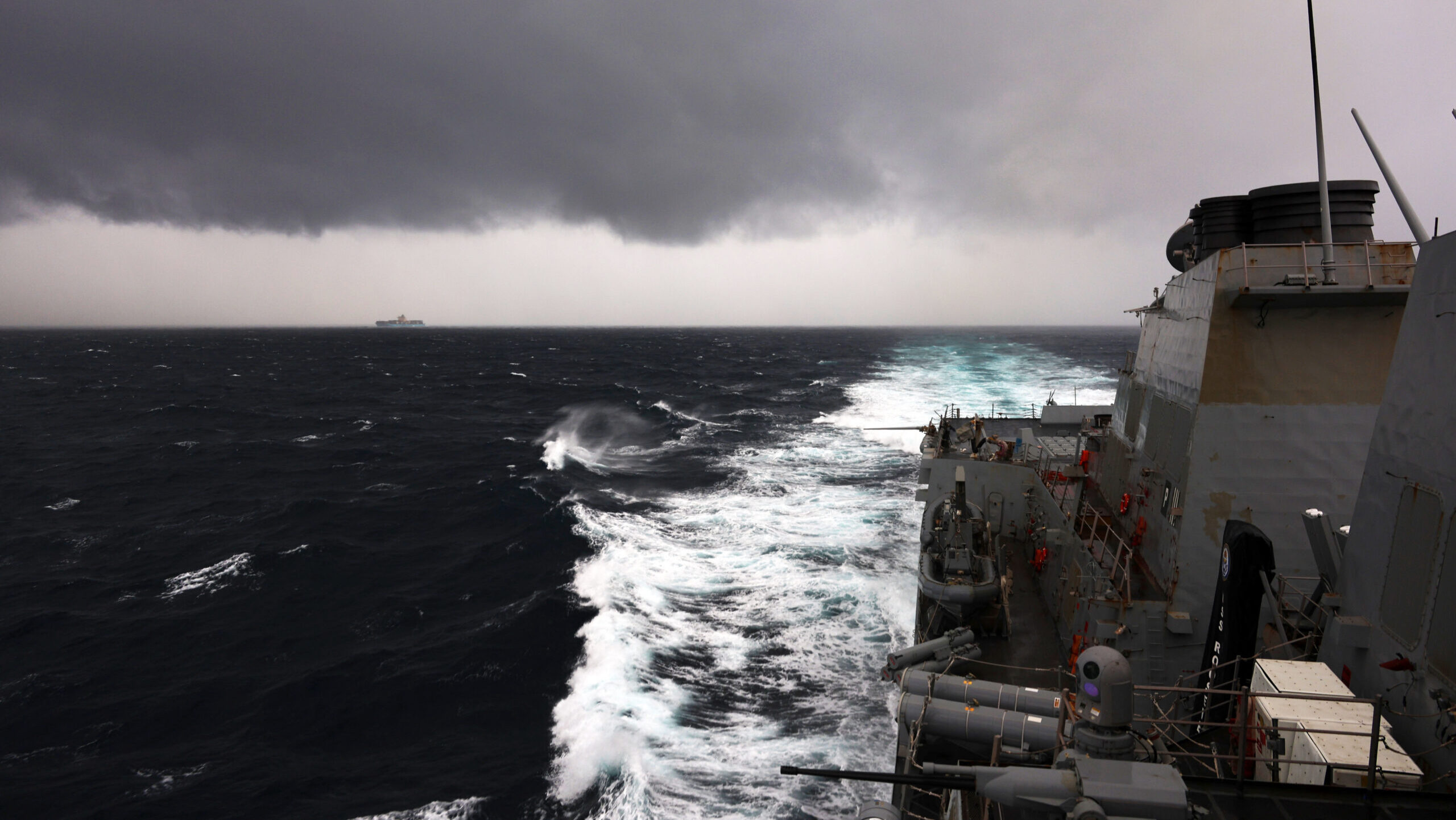
The collapse of negotiations between the US and Iran can be traced to a single point of failure: the inability of the US military to keep the Strait of Hormuz open in the face of Iranian opposition.
The challenge has been long anticipated. The Navy has been thinking about it for 45 years, ever since it escorted tankers through the Persian Gulf in the 1980s and successfully thwarted Iranian efforts to control traffic. As a junior Marine officer, I participated in amphibious planning exercises to capture islands in the Strait. Yet, when the moment came for the Navy to implement its plans, nothing happened.
So why can’t the world’s most powerful military secure the Strait against a country that has no navy? The answer lies partly at the political level, but partly also in a long-term failure to acquire the capabilities needed for this kind of operation, despite knowing that it was strategically critical and likely to occur.
The stakes are worth restating. If the Strait was secure, oil and natural gas would flow, with prices soon declining and shortages disappearing. The US and world economies would rebound.
The United States could probably live with the rest of the current status quo: It has greatly damaged the Iranian nuclear program, military forces, defense industry and particularly Iran’s ability to manufacture ballistic missiles. Much of Iran’s leadership has been killed, depriving it of experience and some internal cohesion. The 24,000 US and Israeli strikes have undoubtedly done major damage that is not yet visible. With assured passage through the Strait, the US would not need to allow a reconstruction fund, sanctions relief, or return of frozen assets. Time would be on our side.
Instead, the two sides have resumed strikes against each other and reinstated their respective blockades. Thus, any traffic requires approval, or at least acquiescence, by both parties, and both are signaling an unwillingness to change their stance. In theory, this is when the US military, and especially the Navy, should be stepping up in a big way and yet the situation is a stalemate. How did we get here?
In the early days of the conflict, the Navy may have lacked sufficient assets in theater, as shown by the later movement of 4,500 Marines into the region. Political assumptions about a short conflict or the lack of Iranian reaction may have constrained military preparations. Later, the administration’s fear of casualties may have limited naval operations. Opening the Strait would be a major combat operation involving Navy destroyers escorting cargo ships, Army helicopters attacking speed boats, Air Force and Navy fixed-wing aircraft overhead to strike Iranian missile batteries and perhaps Marines seizing islands.
However, blaming the political establishment alone is too easy. Much criticism must also fall on the military, particularly the Navy, which has “Keep[ing] the seas open and free” in its mission statement — but has not given senior decisionmakers acceptable options because of historical, glaring gaps in capability that it has not addressed.
Specifically, the service has long ignored mine warfare and instead depends on allies for this capability. Dozens of Navy professional articles have bemoaned its weakness in mine clearance, pointing to previous failures in Korea (1951), the Persian Gulf (1985) and Desert Storm (1990-1991). For examples, see here, here, here, here, here, and here, and that just scratches the surface.
And yet, the last of the Avenger class of mine countermeasure vessels (MCM) has retired, while the replacements (mine clearance modules on LCVs) have been few, delayed and plagued with problems. The problem is not money. Even the large Navy budgets of fiscal 2026 and 2027 contain no ships for this neglected mission. Indeed, the Navy’s 30-year shipbuilding plan does not even mention the mission.
In addition, the Navy has long neglected convoy operations and contending with asymmetric adversaries in constricted waters, preferring to focus on sea control against other navies in the open ocean. The shipbuilding plan has tens of billions for carriers, battleships, destroyers and submarines but never mentions these kinds of missions. Compounding the problem, the last two classes of frigates intended for this mission had been unsatisfactory (LCS and the Constellation class). The current frigate plan relies on the Coast Guard’s Homeland Security cutter as a baseline — sensibly using an existing design but taking risk with a platform designed for a very different mission.
The administration may argue that any criticism demeans the sacrifices of naval personnel. That’s untrue; they have acted with skill and determination. The failure is at the highest level, not on the deckplates. The sailors running these missions deserve help.
The Navy needs to rebuild its countermine capabilities, and adjusting the Pentagon’s FY27 budget proposal would be a start. Maybe that involves refinement of minesweeping packages on the LCS. Maybe it involves a new class of ships. The Navy has used some uncrewed vessels for minesweeping, an approach with great potential but that needs deployment at scale. Ultimately, the Navy needs something like in-stride minesweeping capability, the ability to clear a channel in hours or days, not weeks or months. It’s also clear that an implication of current US policy is that the United States must retain some of these capabilities itself and cannot always rely on allies and partners.
The Navy also needs to rediscover its skills at convoy escort. During the world wars, the US Navy was a master at this. Those skills have apparently atrophied. As part of this effort, the Navy needs to test and settle on its doctrine. Traditionally, escorts have sailed with the convoy, providing close-in protection. That worked for the one small convoy that the Navy ran under Project Freedom, but the Navy’s new concept is to create a safe corridor from a distance, without tying warships to particular groups of cargo ships. That sounds great. Will it work?
Finally, the Navy, like the other services, needs to develop mechanisms to counter drones. Firing $5.3 million SM-3s at $30,000 Iranian Shahed drones is not sustainable. Ashore, adding a counter-drone battery is relatively straightforward. Integrating it into a ship’s fire control system is complicated, but necessary.
This is not just a Middle East issue. If Iran succeeds in establishing the principle that neighboring countries can control constricted waterways, other straits worldwide might come under national control, and the whole world would suffer, including the United States.
Since the beginning of the republic, the United States has stood for freedom of navigation in the world’s oceans. Its first overseas conflict (1801-1805) was against the Barbary pirates in North Africa, whose attacks imperiled that freedom. Abandoning the principle would badly damage our commerce and affect every American. The administration needs to fix both the military and political pieces of the problem.
Mark Cancian is a retired Marine colonel now with the Center for Strategic and International Studies (CSIS).
