

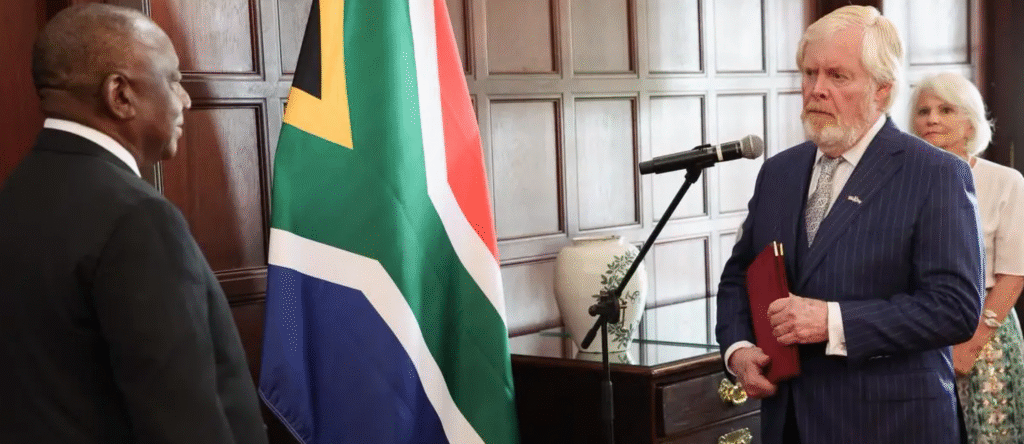
By Andre Pienaar
How a principled conservative is building the relationship between the United States and South Africa by speaking truth to power.
When Leo Brent Bozell III presented his letters of credence in Pretoria on 23 February 2026, he inherited one of the most strained bilateral relationships in the American diplomatic portfolio. The post had sat vacant for more than a year. South Africa’s own envoy to Washington had been expelled. Trade preferences were under threat. The South African Government had been named a national security threat to the United States in one of the first executive orders signed by President Trump. Into this crisis, the White House sent not a career diplomat but a principled conservative communicator — and seven months on, the choice looks shrewd.
A life spent arguing in public
Ambassador Bozell, 71, was born in Washington DC into one of the great intellectual families of American conservatism. His uncle was William F. Buckley Jr., founder of National Review; his father, L. Brent Bozell Jr., was a speechwriter and author; his mother, Patricia Buckley Bozell, was an editor. One of ten children, he took his degree at the University of Dallas and cut his teeth at the National Conservative Political Action Committee before founding, in 1987, the Media Research Center — today the largest conservative media watchdog in the United States, with a stable of outlets that includes NewsBusters, MRCTV and CNSNews.
Over four decades, he built a reputation as a relentless and fearless advocate: a syndicated columnist whose work appeared in the Wall Street Journal, the Washington Post and USA Today; the author of six books; a regular presence on American television; and, in 2010, the founder of ForAmerica, a grassroots movement the New York Times later credited as one of the unexpected forces behind President Trump’s 2016 election win. In 1995, he launched the Parents Television Council, campaigning for decency standards in broadcasting. He lives his commitment to family values: he and his wife Norma have five children and seventeen grandchildren.
Ambassador Bozell’s experience now matters in Pretoria. He does not come from the world of cautious diplomatic communiqués. He comes from the world of principled argument, evidence and persuasion — and he brings these consummate skills to a bilateral relationship that had been suffering from a shortage of candour.
Confirmed with a clear mandate
Nominated in March 2025 and confirmed by the Senate on 18 December 2025, Bozell told the Senate Foreign Relations Committee that he was taking up the post “at a challenging moment”. He set out his priorities clearly: to register American objections to South Africa’s slide from non-alignment towards Russia, China and Iran; to press Pretoria on its case against Israel at the International Court of Justice; to oppose expropriation without compensation; and to work with the South African Government so that all its citizens can live free from the threat of violence. Few ambassadors arrive with so explicit a brief and mission, and fewer still have discharged it so visibly.
Listening first, then speaking plainly
Bozell’s critics predicted a bull in a china shop. What South Africa got instead was an envoy who spent his first weeks on the road. By mid-March, he had travelled to Johannesburg, Durban, Cape Town and Hermanus, met government officials, business leaders and local communities, and made a point of visiting the Apartheid Museum and the District Six Museum — places he described to the BizNews conference not as tourist stops but as reminders that South Africa’s history is “lived memory” of sacrifice, struggle and unfinished work.
In that same speech, he framed the relationship in terms any investor would recognise. South Africa is Africa’s largest economy and the biggest US trade and investment partner in sub-Saharan Africa. More than 500 American companies are invested in South Africa. Bozell’s message was that this partnership is valued, and precisely because it is valued, it deserves honesty about the obstacles standing in its way: property rights, crime, corruption and unfair business practices. “Listening will be essential,” he said. “But so will clarity.”
Rural safety as a test of good faith
Nowhere has Bozell’s approach been more evident than in rural crime prevention and safety. Rather than issue statements from the embassy, he has gone to see the problem for himself. On 23 September, he visited AfriForum’s community-safety command centre in Centurion to study its neighbourhood-watch and farm-watch operations. He disclosed that he had personally put a rural safety plan before President Ramaphosa, backed by an American offer of financial assistance. His frustration that the offer had gone unanswered was expressed openly, but the substance was constructive: the United States, he was saying, is prepared to help South Africa protect its farming communities and is waiting for a partner.
The emphasis on rural safety is neither sentimental nor racist, as America’s adversaries have claimed. At President Ramaphosa’s meeting with President Trump in 2025, members of Ramaphosa’s delegation, ranging from Ernie Els, the golfer, to Zingiswa Losi, the president of the COSATU trade union, shared personal anecdotes about their own trauma of having suffered violent rural crime. Common Sense’s research shows that a farmer in South Africa is seven times more likely to be murdered than someone who lives in a South African city.
Primary agriculture accounts for about 2.8 per cent of South Africa’s GDP — some R182 billion in 2024 — but once agro-processing and the wider food value chain are counted, the sector’s footprint rises to a vital 14 per cent of the economy. It is one of the few parts of that economy still creating work: Statistics South Africa’s labour force survey put farm employment at about 944,000 in the second quarter of 2026, up 4.3 per cent on a year earlier. Agriculture grew in a quarter when the economy as a whole shrank. This is one of the few sectors that is close to the ANC’s National Development Plan target of one million jobs in agriculture. It is a critical contribution to employment in a country where unemployment has climbed to 33.6 per cent.
The food security and economic stakes extend beyond South Africa’s borders into the southern African region. The country is harvesting its largest maize crop on record, around 18 million tonnes. South Africa’s carry-over stocks and export channels are what keep Lesotho, Zimbabwe, Malawi and Mozambique fed through a lean season that forecasters expect to be severe, with an El Niño likely to bring late and below-average rains from October. Every farm abandoned to violence, every hectare left unplanted for want of security, is a subtraction from regional food security and supply. Ambassador Bozell’s insistence that rural safety is a “top-shelf priority” is not an ideological preoccupation but a hard-headed reading of where South Africa’s economic and strategic value lies as a source of stability in a region facing a ferocious Islamist insurgency on its doorstep in northern Mozambique.
A bridge-builder in the mould of a negotiator
The clearest sign that Bozell is playing a longer game came in his wide-ranging interview with Business Day on 21 September. Confirming the selective US visa restrictions on South African officials and warning that the time for dialogue without outcomes was over, he nonetheless pointed to a way through the impasse — singling out former President Thabo Mbeki as a veteran statesman and master negotiator who commands respect in both capitals. It was a notable gesture: an American ambassador, appointed by a Republican president, publicly extending credit to an ANC elder as the man best placed to move from stalemate to “actionable agreements”. It signalled that Washington’s pressure is a means to a deal, not an end, and that Bozell is looking for interlocutors rather than enemies to solve pressing issues.
Why it matters
Bozell is speaking truth to power to create the conditions for a real and sustainable settlement. On the evidence of his first seven months, he is doing this fearlessly and with impact. He has articulated American concerns with precision and clarity, kept the door open to the business community that binds the two economies together, and shown a willingness to look past personalities and problems to actively find solutions and leaders who can deliver.
South Africa has had American ambassadors who were more soothing. It has rarely had one who has had more impact. In a relationship that matters to the global economy — to its sea lanes, its minerals and its role as a source of stability in Africa — a plain-spoken, principled ambassador who knows how to communicate based on facts and evidence may prove to be exactly what was required.
