

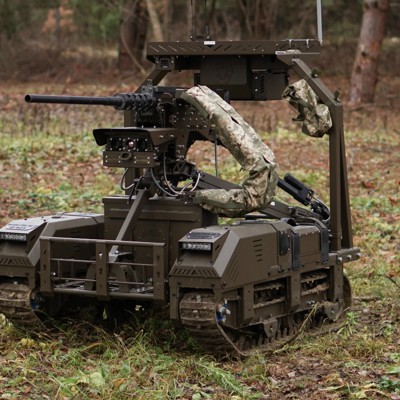
A single remote-controlled Ukrainian ground combat vehicle defended a “key intersection under constant adversary attack” for 45 days last summer, according to a 3rd Army Corps spokesperson who called it “Ukraine’s first fully robotic defensive operation of a position.” It likely won’t be the last.
The robot—a Droid TW 12.7 armed with a machine gun—and its operator, some 10 kilometers away, “disrupted every attempted breakthrough and prevented enemy infiltration,” with no loss of Ukrainian life, the spokesperson said in a recent interview.
As the United States and other militaries work to catch up, Ukraine is putting remote-controlled air and ground systems to uses the world has never seen.
“Drones in the air provided continuous surveillance” for the operation, the officials said. “They detected enemy movement and transmitted information in real time. Once a threat was confirmed, the operator received the signal and engaged the target with the machine gun.”
Olena Kryzhanivska, a defense analyst who was first to report on the operation, writes that Ukrainian ground robots now perform 80 percent of logistics tasks on the front lines— from carrying explosives into enemy positions to evacuating the wounded. The Ukrainian Ministry of Defense hopes to bring that up to 100 percent.
Kryzhanivska writes that unmanned ground vehicles, which can cost $10,000 to $30,000, will soon take a much larger role in combat.
“There is an expectation that we might see the first encounter between Ukrainian ground drones and Russian ground drones.”
But practical challenges stand in the way of the fully roboticized front line, the Ukrainian army spokesperson said.
“Battery charge is a major factor. There is never enough of it. The main solutions are either installing higher-capacity batteries on the systems or equipping each platform with two to four batteries. The same applies to ammunition load. There is never enough,” one said.
Another hurdle is the amount of training it takes to produce a ground-robot operator.
“Planning and executing an operation with an [unmanned ground vehicle or UGV] is significantly more difficult than, for example, operating a UAV, because the number of obstacles is substantially higher,” an official said, adding that it requires a deeper understanding of terrain, navigation, and other nuances that also bedevil self-driving cars. “It is a misconception to think that any UAV pilot can simply sit down and successfully carry out an operation with a UGV.” .
As autonomy improves, a single soldier might be able to control multiple robots on different missions. But Ukraine limits what its lethal robots can do.
“Ukrainian forces are still operating in the territories that are populated by civilians. There are children. They are elderly. So just giving ground robots that ability to make decisions, to engage, to strike and kill, that would be a very dangerous development, and Ukrainians are against that,” Kryzhanivska said.
The Ukrainian officials emphasized that humans will remain part of the decision-making process.
“Everything that happens in war must be controlled and coordinated by a soldier. The missions performed by our systems carry a high level of responsibility,” one said.
Still, new concepts of “predictive intelligence” could enable ground drones to make more decisions as part of a network of sensors and intelligence nodes. They might, for example, predict where or how enemy forces might move in order to get into position.
It’s a concept that Lt. Col. Eric Sturzinger, who leads research and engagements at the Army’s Artificial Intelligence Integration Center, is exploring via the Tactical Joint Embedding Predictive Architecture, or JEPA—a framework to enable drones to predict how adversaries might plan an attack, potentially making ground robot operations even more effective.
