

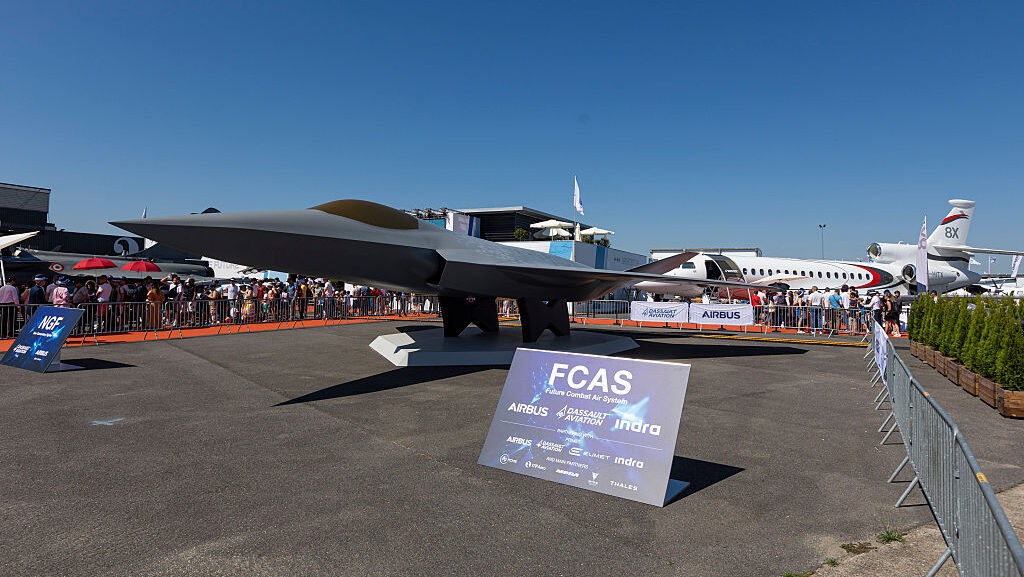
BERLIN — After the collapse of the Future Combat Air System (FCAS) fighter effort, Airbus and a cohort of seven other leading German defense and aviation companies have formally banded together as “Team Gen 6,” saying they “stand ready to take on the responsibility for a 6th-generation fighter aircraft.”
Led by the European giant, Autofug, Diehl Defence, Hendsoldt, Liebherr, MBDA Germany, MTU Aero Engines and Rhode and Schwarz signed a positioning paper at the Berlin Air Show committing to the new effort.
The plans for a Next Generation Fighter, the centerpiece of the long-troubled French-German-Spanish FCAS project, were scrapped earlier this week, though German officials told Breaking Defense they would salvage the combat cloud portion of the project and other tech.
“While the development of the overarching ‘System of Systems’ is progressing as before, the 6th-generation fighter aircraft integrated within it requires a new, agile industrial setup,” Airbus said on social media announcing Team Gen 6. The team-up was previously reported by The Financial Times.
Beyond the German firms, Airbus added that Spanish involvement in the new industrial partnership is also “forming up” based on interest from Indra, GMV, Grupo Oesia, Sener and ITP Aero.
The announcement came just hours after Jean-Brice Dumout, head of airpower at Airbus Defence and Space, told reporters at the show here that the company is “naturally ready to support whatever happens” as Berlin weighs its options. On Wednesday, German Defense Minister Boris Pistorius floated ideas like procuring additional F-35 fifth generation jets, joining an existing international sixth generation project like the Global Combat Air Programme (GCAP), moving forward with an Airbus-led plan — possibly an early reference to Team Gen 6 — or settling on a mystery fourth option.
Dumout said, “We have to consider safeguarding areas [FCAS technology pillars] where it works, and looking at how we reshape the ones very, very tightly linked to the plane, but this is very hard to say, and we seek at the moment to get set guidance from our government, which is important. … There has to be demonstrated industrial feasibility of what’s being asked, not only technical, but from an industrial setup. … We have put a number of options on the desk of our ministers of defense.”
Dumont argued that despite NGF falling by the way side, “we have not wasted our time,” stressing that technologies linked to the doomed plane can be reused.
“We need another way to go to the same goal with … a faster mindset,” he explained.
