

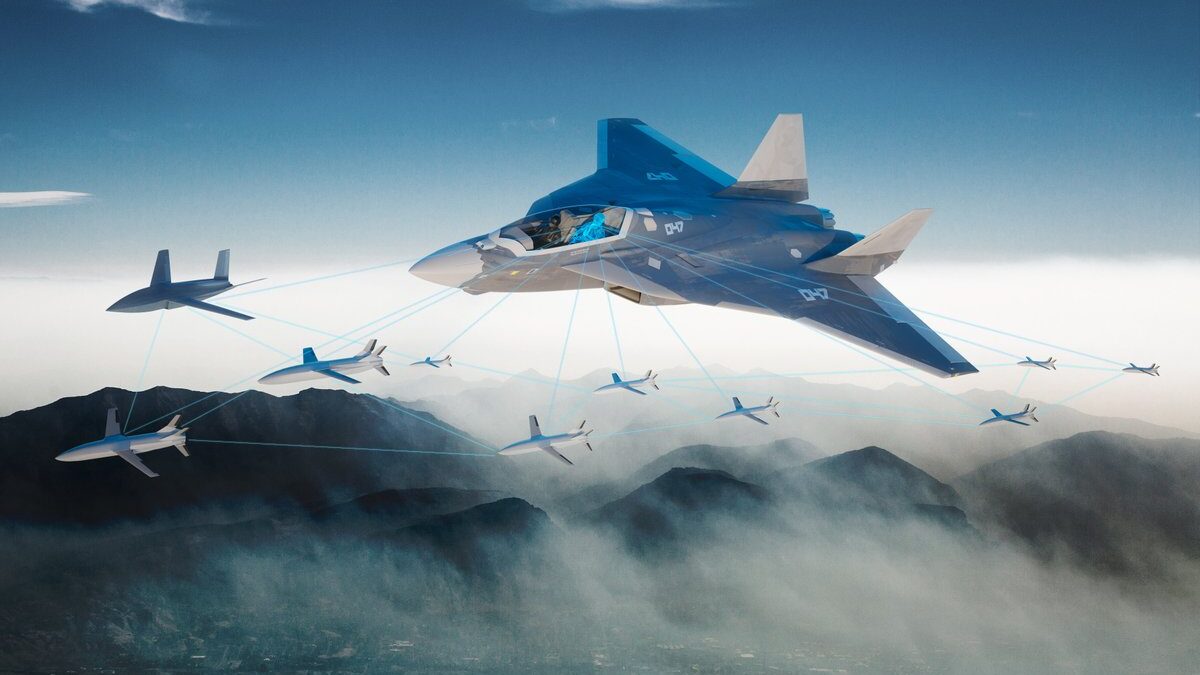
MILAN and BARI, Italy — Though the sixth-generation FCAS fighter jet may be dead before it got off the ground, Germany and France plan to salvage the tech side of the joint effort and cooperate on “realistic” projects in the future, according to German officials.
In a statement to Breaking Defense late Monday, the German government officials confirmed media reporting that leaders in Berlin and Paris have acknowledged the “reality” that plans for the long-troubled fighter must be scrapped, as industrial partners just could not see eye to eye.
“[French] President [Emmanuel] Macron and [German] Chancellor [Angela] Merkel have reached the shared conclusion that the companies involved in building a joint fighter jet cannot reach an agreement,” the officials said. “Chancellor Merkel has therefore advised President Macron not to pursue the construction of a joint fighter jet any further.”
However, the officials said the two European powers would attempt to salvage what it called the “core” of the broader project: the next-gen data-sharing “system of systems” aspect.
“This is, in a sense, the nervous system that connects aircraft, drones, and other components into an integrated whole,” the German statement said.
It’s unclear what other components of the plan, such as envisioned drone wingmen and engine projects, could also be salvaged, but the statement said leaders will hold discussions next month.
“At the Franco-German Ministerial Council meeting in Germany this July, both defense ministries are set to draft a joint, up-to-date work plan for defense industry cooperation, focusing on a few realistic and relevant projects,” the statement said.
RELATED: FCAS may survive, but next-gen fighter negotiations all but dead, industry source says
The French Ministry of Defense referred Breaking Defense’s questions about FCAS to the president’s office, which has not commented publicly. The government of Spain, also party to the FCAS project, has not commented on the fighter’s dissolution.
Since its launch in 2017, the €100 billion ($115 billion) FCAS project has encountered a number of setbacks. Without naming them, the German statement appeared to reference long-standing issues between French company Dassault and Airbus, which have centered primarily around project leadership, workshare distribution, and conflicting perspectives on the future jet’s design.
Breaking Defense reported in March that the manufacturers were attempting a last-ditch effort to align on a common approach regarding the aircraft, officially known as the New Generation Fighter (NGF). Airbus has previously supported an alternative two-fighter-jet approach, leaving France to build its own separately, as it requires an aircraft capable of carrying nuclear weapons.
The defense minister for Belgium, which has “observer” status on the FCAS program, previously criticized European leaders for pursuing parallel future fighter jet projects, the FCAS and the UK-Italy-Japan team-up for the rival Global Combat Air Programme, known as GCAP, saying it showed lack of European coordination.
After news of FCAS’s demise broke, Theo Francken said on social media it should be a “painful wake-up call” to European capitals to collaborate and integrate more closely, overcoming individual national interests.
