

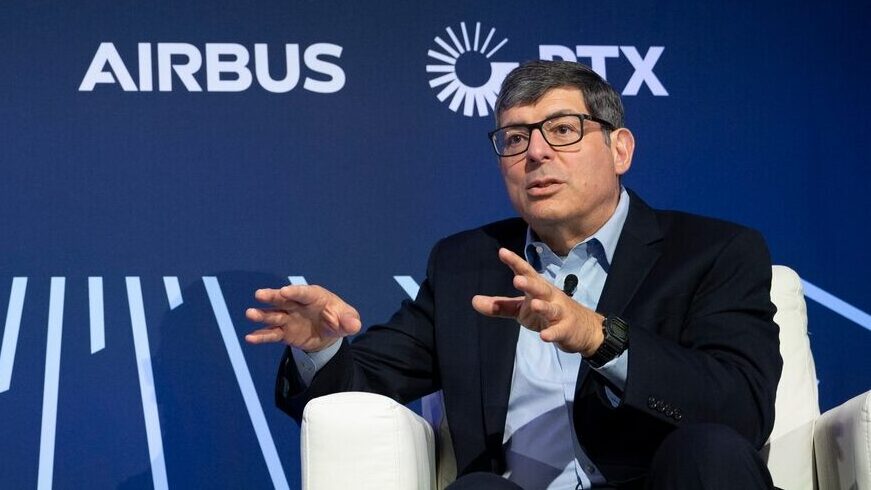
DENVER ― The National Reconnaissance Office (NRO) is expanding its research and experimentation projects designed to allow analysts to track back how artificial intelligence (AI) algorithms come to conclusions when used to analyze data, according to the spy satellite agency’s outgoing director.
“We must understand how we got to the product,” Chris Scolese told the US Geospatial Intelligence Foundation’s annual GEOINT Symposium here on Wednesday. “AI ‘explainability’ is a major concern for us. It’s still an open area of research.”
NRO is already using and intends to expand use of AI for a number of different mission sets, Scolese explained.
First, it is applying AI and machine learning to increase the autonomy of its spy satellite fleet, and to “orchestrate” the fleet as it expands from handfuls of satellites to include a “proliferated” constellation of satellites in low Earth orbit (LEO) being operated by SpaceX.
“As the size of our constellation grows, we will exceed the capacity of what human operators can effectively manage. This demands we build more autonomy into our systems. Of course, we’ve used automation to address a variety of needs for years and are now expanding our efforts, employing AI/ML capabilities,” he said.
“We’re using it to increase the autonomy of spacecraft, enabling onboard processing and real-time recognition for situational response, simplifying the tasking process and optimize mission planning across the constellation,” Scolese elaborated.
For designing new satellites and for on-orbit operations such as checkout after launch and tasking, verification that the AI bots are doing their job correctly is “relatively easy,” Scolese said, because tests can be run to double check the outcomes.
Validating the bots’ outcomes is more difficult when using AI for the “more complex” job of analyzing sensor data gathered up by NRO and commercial partner satellites, he said, as is making that analysis easier for consumers in the administration and the military to use.
“How do we fuse data sets? How do we bring that information together? This is where it is much more difficult to go off and test because you’re often doing it in real time. So, for that, we need really need to understand our algorithms,” he said.
“We need to be able to look inside the black box of AI and verify the prediction and outputs of models are correct. Understanding how the model arrived at this prediction is essential,” he stressed.
To better understand AI, Scolese said that NRO is using something called the “Ultra-Dense Environment,” which is “a series of GPUs” that allows personnel to test out AI models and capabilities developed by NRO itself as well as industry partners.
He further encouraged companies to come forward to help the agency to figure out how to do the necessary validation and testing.
Scolese has served for the past seven years as the first politically appointed head of the NRO, and soon will step down ― with the White House last last month nominating Roger Mason, an executive at defense contractor V2X, to take his place.
During his tenure, Scolese has overseen what he called “one of its greatest transformations since its creation” over the past several years.
This includes delivering “new capabilities that provide more accurate measurements across a greater set of collection modalities,” and improving “resilience through the proliferation and diversification of our systems, both in space and on the ground, making it much harder to impact our systems, and more importantly, making it much harder to hide malign activities from observation,” he said Wednesday.
Further, Scolese added, NRO has “responded to the need for faster delivery of capability” by “adjusting” processes, and increasing the use of commercial capabilities. He said the office has “tackled the challenges of processing exponentially growing data volumes, spanning diverse phenomenology and temporal scales … to deliver intelligence products in operationally required formats, mats with unprecedented speed.”
