

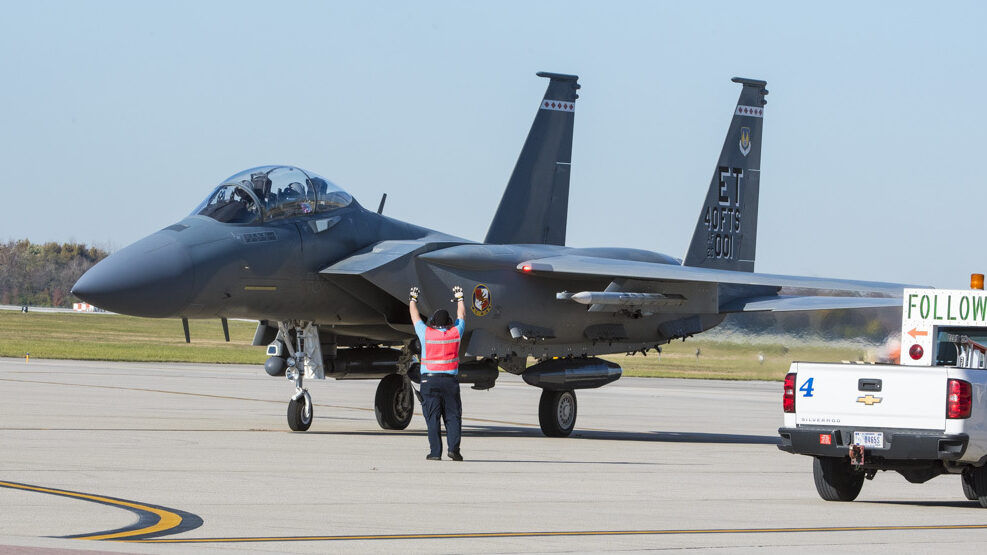
WASHINGTON — The Air Force now plans to buy a total of 267 F-15EX Eagle II fighter jets in the coming years, more than doubling previous projections of the fleet, amid a massive surge in military spending under the Trump administration.
The Air Force’s fiscal 2027 budget, publicly revealed at the Pentagon today, is seeking 24 F-15EXs, a service spokesperson told Breaking Defense. But in the years to come, the Air Force plans to buy dozens more copies of the Boeing-made fighter to build out F-15EX units and “begin to recapitalize the aging F-15E fleet,” the spokesperson said.
Previously, the Air Force planned to buy 129 of the jets. F-15-maker Boeing declined to comment on the Air Force’s plan for a larger fleet.
The extended run of the aircraft means the service can count on hot production lines for at least two fighters in the foreseeable future — the other being the F-35. Previously released budget documents said the Air Force would request a total of 38 F-35As in FY27. Last year, the Air Force’s FY26 budget requested just 24 copies of the stealth fighter.
Facing budgetary ceilings, particularly those imposed by legislation like the Fiscal Responsibility Act, Air Force officials for years have struggled to balance the maintenance of aging platforms and investing in modern systems. The way out of that dilemma appears to simply be far more money.
Compared to final FY26 levels, the Air Force expects its overall budget to rise roughly 25 percent to $267.7 billion, according to a spending breakdown shared with reporters today during a Pentagon press briefing. Within that number, the Air Force expects to bump up its procurement by roughly 30 percent, and research and development by 27 percent. (All figures include reconciliation dollars the Defense Department is requesting alongside the base budget, and exclude non-blue or “passthrough” spending that technically goes to agencies outside the Pentagon.)
“FY 2027 moves beyond the trade-off between modernization and readiness,” Air Force Secretary Troy Meink was quoted as saying in the Department of the Air Force’s budget presentation today. “We are funding both as concurrent priorities to ensure the force is ready for today’s and tomorrow’s challenges.”
The greater investment is shown in some key accounts. For example, the Air Force’s flying hour program would rise by nearly $1.8 billion for a total budget of $9.9 billion. Similarly, weapon system sustainment — which officials have long complained has historically been raided to pay for other priorities — would grow by $3 billion to $22.6 billion, according to figures shared during the Pentagon press briefing.
The added sustainment investment “directly increases the availability of US Air Force spares, which means faster repairs and results in more time in the air for our pilots,” Maj. Gen. Frank Verdugo, the Air Force’s deputy assistant secretary for budget, said during the briefing.
BRRT To The Future
Like prior years, the Air Force is requesting permission to scrap a range of aging aircraft in FY27, though as always, it’s possible lawmakers reject some of those proposals.
According to an Air Force spokesperson, the list of divestments the service is seeking are as follows:
- 23 U-2s
- 20 KC-135s
- 16 C-130Hs
- 49 A-10s
- 20 F-15Es
- 6 F-16s
- 14 T-6s
- 1 T-38
Despite the slated FY27 divestments for the A-10, on Monday Meink announced the Air Force plans to keep other Warthogs around, a surprising reversal of fortune for the plane that service officials have tried to mothball for years. The jet has recently seen action in Iran, where one was reportedly lost to enemy fire.
The Air Force spokesperson said in a statement to Breaking Defense that the service “is extending some A-10s until 2030 to preserve combat power until the Defense Industrial Base ramps up combat aircraft production.”
One active-duty squadron at Moody Air Force Base will operate until 2029, the spokesperson said, while another at Moody will be extended until 2030. A reserve squadron at Whiteman will similarly operate until 2030 as well. The spokesperson told reporters today that squadrons are expected to have roughly 18 aircraft.
“Long live the Warthog,” Defense Secretary Pete Hegseth posted on X on Monday.
NGAS, E-7 Shifts
The FY27 budget further disclosed a new funding line for air refueling. The Air Force spokesperson said the service moved money into the new program, called Advanced Tanker Systems, from a previous line that dedicated dollars to researching an advanced tanker dubbed the Next Generation Air-refueling System (NGAS).
The shift “concentrate[s] on mission systems versus platforms,” said the spokesperson, who added officials continue to investigate options based on an ongoing analysis of alternatives for the NGAS aircraft “that will enable resilience and persistence of aerial refueling in a future, highly contested conflict.”
Separately, the spokesperson said that the FY27 budget does not include funding for the E-7 Wedgetail radar plane, but that officials are “evaluating options to resource the E-7 program in FY 2027 to deliver Rapid Prototyping aircraft and continue engineering and manufacturing development activities.”
Air Force officials last year attempted to end the E-7 program, citing survivability and cost concerns. Lawmakers subsequently rejected that move, prompting the Air Force “to continue development and transition to an engineering and manufacturing development phase,” the spokesperson said.
“The aircraft acquired for the EMD phase will allow the Air Force to mature the system design, conduct risk reduction, and perform comprehensive test and verification activities in accordance with Congressional intent,” they added.
