

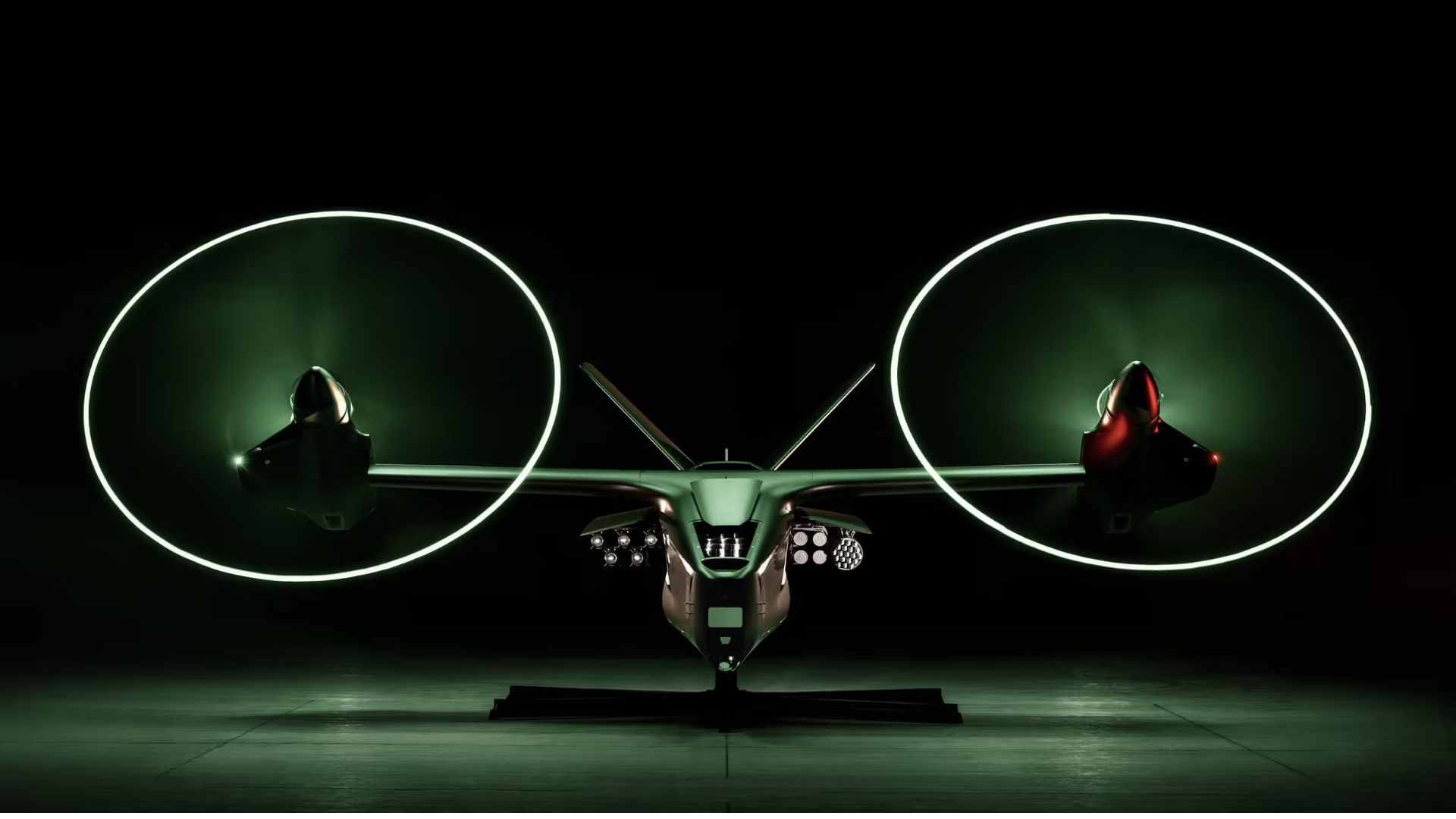
Anduril unveiled Thunder, a Group 5 autonomous tiltrotor built with Archer Aviation to fly as a loyal wingman for the AH-64 Apache, at Farnborough 2026.
Anduril Industries unveiled Thunder, a Group 5 autonomous attack rotorcraft designed to fly alongside crewed attack helicopters, at the 2026 Farnborough International Airshow on 20 July.
The tiltrotor was developed in partnership with Archer Aviation and pitched as a loyal wingman for the Boeing AH-64 Apache and the future Bell MV-75 Cheyenne II, extending the manned-unmanned teaming concept from the fighter force into Army attack aviation.
Anduril’s pitch answers a near-surface fight where loitering munitions and cheap air defences have made crewed attack helicopters increasingly vulnerable, a shift accelerated by the drone war in Ukraine.
Follow The Markets Forming Around The Next Wave Of Defence Systems
Track where emergent vendors are moving, how new categories are taking shape, and which operational needs are driving interest in loitering munitions, C-UAS, and low-cost guided munitions.
What Thunder is: a Group 5 tiltrotor built with Archer Aviation
Thunder is a hybrid-electric tiltrotor that rotates its rotors between a vertical position for take-off and a forward position for cruise, giving it a Cheyenne’s range with an Apache’s payload, according to Anduril senior vice-president Shane Arnott.
It is the military edition of an autonomous rotorcraft that Anduril and Archer Aviation developed jointly, and the aircraft was shown at Farnborough as a full-scale model rather than a flying prototype.
Anduril frames the design around what it calls affordable mass – fielding enough aircraft cheaply enough that losing one need not cripple a unit the way losing a roughly $18-million crewed Apache would.
How Thunder teams with the AH-64 Apache and MV-75 Cheyenne II
The core concept is teaming rather than replacement, with Thunder flying as an uncrewed wingman that absorbs the most dangerous parts of a mission while keeping human crews farther from the threats most likely to kill them.
Anduril says pairing three Thunder with each Apache would give a Combat Aviation Brigade a threefold increase in available munitions without placing additional pilots in harm’s way, at a fraction of the cost of an all-crewed formation.
Arnott told reporters the Army could fly three to six Thunder with a single Apache, commanding rather than piloting each system, with the aircraft also teaming with the next-generation MV-75.
Payloads, Lattice autonomy and the Fury lineage
Thunder carries its weapons in two configurable payload bays, and Anduril lists a single aircraft as able to carry 10 missiles, 16 launched effects or 76 rockets, spanning the AGM-114 Hellfire and APKWS-class effects, plus counter-drone munitions.
Flight behaviour runs on the company’s Lattice for Mission Autonomy software, which handles formation behaviours, separation management and flight logic so Thunder stays predictable around crewed aircraft.
Anduril describes Thunder as an armed-reconnaissance tiltrotor developed from lessons on its Fury programme, the YFQ-44 that first flew in October 2025. The company has completed multiple test flights with full-scale surrogate aircraft and is targeting a first flight in 2027.
Thunder, FAMM and Anduril’s affordable-mass strategy
The reveal comes weeks after Anduril won the US Air Force’s Collaborative Combat Aircraft production award with the FQ-44, and Thunder pushes the same wingman logic from fighters toward the Army, Marine Corps and US Special Operations Command.
It also fits a wider Anduril push into mass-produced systems, from the FAMM cruise-missile framework the Pentagon signed with CoAspire and Zone 5. The same affordable-mass logic runs through the Barracuda-500M line Anduril is standing up with Poland’s PGZ.
Investor Bill Ackman publicly backed the aircraft after the unveiling, a marker of the attention Anduril’s autonomous line now draws as armies absorb the lessons of the near-surface fight.
Drone Market Intelligence
Track Where New Defence Suppliers Are Finding Demand
From loitering munitions and C-UAS to low-cost precision weapons, follow the capability areas where newer vendors are winning attention and where militaries are redefining their requirements.
Featured & Trusted By
