

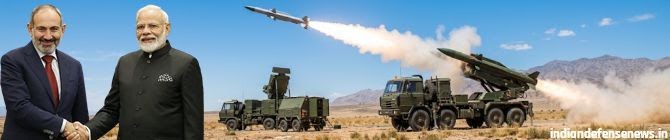
Armenia has signed nearly $2 billion worth of defence deals with India since 2020, making New Delhi its most important arms supplier as Yerevan seeks to counter the Azerbaijan–Pakistan–Turkey defence nexus.
Deliveries of Akash missile systems, Pinaka rocket launchers, Swathi radars and anti-drone technologies are already underway, with expanded training and joint research deepening the partnership.
Armenia is bolstering its defence ties with India to address growing threats from Azerbaijan, which is strongly supported by Pakistan and Turkey. This strategic shift has seen Yerevan procure advanced Indian systems and expand military cooperation through training exchanges and high-level visits.
The move underscores India’s emergence as a crucial defence partner for Armenia, particularly as Russia’s arms supplies have diminished due to its war in Ukraine.
In 2022, Armenia became the first international buyer of India’s Akash surface-to-air missile system in a $720 million deal. The Akash system provides medium-range air defence against aircraft, helicopters and drones, with radar-guided tracking and multi-target engagement capability. Deliveries began in 2024, significantly enhancing Armenia’s ability to counter aerial and missile threats.
Armenia has also acquired the Pinaka multi-barrel rocket launcher system, a long-range artillery platform capable of precision strikes and rapid, high-volume fire. This system provides mobility and quick deployment, strengthening Armenia’s battlefield strike capabilities.
Complementing this, the Swathi weapon locating radar has been supplied to detect and track incoming artillery and mortar fire, enabling rapid counter-battery responses and improving situational awareness.
India has further delivered advanced anti-drone systems to Armenia, designed to detect, track and neutralise unmanned aerial threats. These technologies are critical for protecting infrastructure and military assets from surveillance and attack drones, which have played a decisive role in recent conflicts.
Beyond procurement, Armenia has deepened its military engagement with India through training initiatives. A three-member Armenian Army delegation visited the School of Artillery in Nashik, Maharashtra, where they were briefed on training facilities and operational methodologies, and observed a live artillery firing exercise. Such exchanges highlight the emphasis on joint training and operational integration.
High-level defence talks have reinforced this partnership. In April 2026, Armenia’s first deputy minister of defence and chief of the general staff, Lt Gen Edvard Asryan, met India’s top defence leadership in New Delhi, including Chief of Defence Staff Gen Anil Chauhan, Chief of Army Staff Gen Upendra Dwivedi, Air Chief Marshal AP Singh and Defence Secretary Rajesh Kumar Singh. Earlier, in February 2026, Gen Chauhan visited Yerevan, inaugurating defence research facilities and stressing the importance of joint training in modern warfare.
Armenia’s defence shift is driven by regional conflicts. It faced two major wars with Azerbaijan in 2020 and 2023, during which Turkish-origin systems were reportedly deployed by Azerbaijani forces.
Pakistan’s support for Baku has also grown, with Islamabad signing a deal to supply 40 JF-17 Block-III fighter jets. These developments have compelled Armenia to seek reliable defence partners and systems, with India filling the gap left by Russia’s reduced supplies.
India’s defence exports have surged globally, with Armenia emerging as one of its largest customers. The partnership not only strengthens Armenia’s security but also advances India’s strategic interests in counterbalancing the Ankara–Baku–Islamabad nexus in the South Caucasus. Joint production and research initiatives are being explored, further embedding India’s role in the region’s strategic balance.
TOI
