

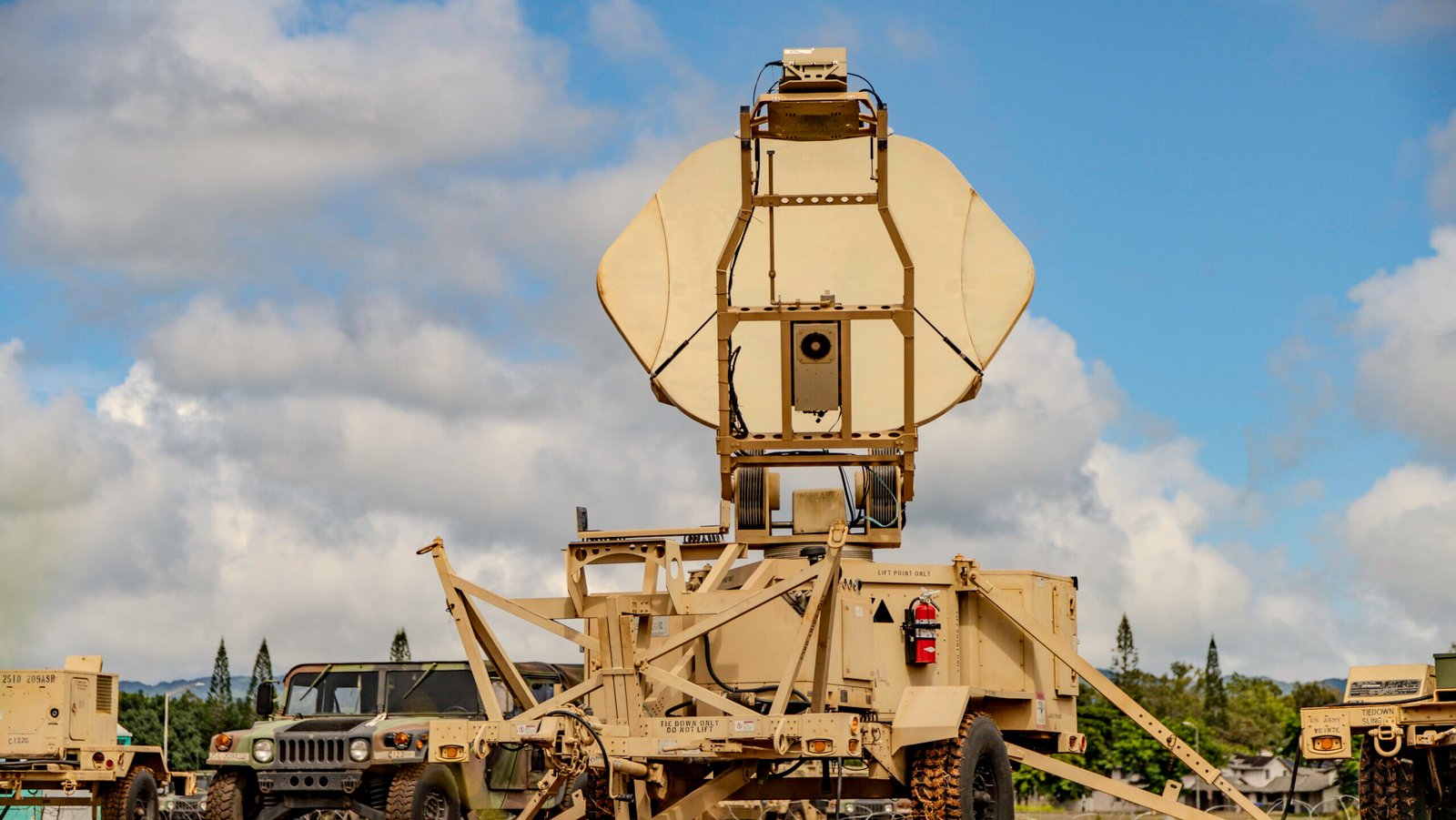
HUNTSVILLE, Ala. — The Army is seeking new kit to directly “engage” adversary satellites from the ground, particularly if and when sensing sats are used to target US forces, according to a senior Army space official.
While it may sound unusual for the land force to be involved in counter-space operations, Col. Joe Mroszczyk said it was part of the service’s expanding role in helping US Space Command (SPACECOM) achieve space superiority.
“It’s not foreign for the Army to shoot a ship at sea. Why should it be any different for the army to engage a satellite in space? It’s the same construct, and it’s a matter of our core competencies to maneuver on the land to be able to deliver effects across all domains,” Mroszczyk, director of Army Space and Missile Defense Command’s Transformation Integration Directorate – Space Superiority (TID-SS), told Breaking Defense in a wide-ranging interview on the margins of the annual Army Space and Missile Defense Command (SMD) Symposium here.
Mroszcyck would not specify exactly what the Army would use to target satellites. However, he stressed that the Army would follow US national space policy that eschews the use of destructive kinetic anti-satellite attacks that would create long-lived space debris.
The TID-SS shop is responsible for overseeing “the design, development and modernization of space-enabled, missile defeat, and high-altitude architectures, as well as synchroniz[ing] combat concepts, scientific analysis and the acquisition of new technology,” according to an Army posting on Facebook.
Mroszcyck, who took up his post in July, explained that his office serves as a sort of middleman between Army operators and acquirers at the service’s new(ish) program executive office for Counter Command and Control. The goal, he said, is to ensure that operational requirements are routinely integrated into acquisition programs as development goes along.
“There are two real expansion areas … that we’re looking at,” he said. One is “counter-surveillance and reconnaissance” focusing on an adversary’s space-based capabilities and the other is “stratospheric warfare” just a few miles down.
The Army has been working to grow its footprint in the space domain for a couple of years. Last year for the first time it listed counterspace amongst its budget priorities starting in fiscal 2027. And in June the service finalized creation of its new Space Operations Branch.
Until recently, however, Army officials, like Space Force officials, have refrained from addressing direct satellite attack ― instead focusing in public on the service’s efforts to develop electronic warfare (EW) capabilities to jam adversary satellite communications (SATCOM) receivers and command and control nodes.
While those missions are still in the Army’s space job jar, at the same time, US Space Command is looking to all of the services to be able to target adversary satellites as part of the space superiority mission, Mroszcyck said.
“Generally, space superiority is a relative measure against the enemy. We want to have an advantage overall in both how we use space capabilities, but also how we can take away their use [of space],” he said. “That goal is changing the balance in our favor. So, the Army’s job is to do that from the land, and we are expanding that.”
Closing Adversary Eyes And Ears
Mroszcyck said the Army has set a high priority on developing capabilities to “actually prevent the collection” of targeting data on US forces and facilities by adversary intelligence, surveillance and reconnaissance satellites.
“So, when we talk about ubiquitous sensing … and the the proliferation of low Earth orbit and other sensing capabilities out there from space, we want to be able to take away that advantage [for adversaries] and provide effects to protect our formations on the ground too. So, that’s a capability that we’re driving towards,” he said.
If all kinetic ASATs are ruled out ― something that isn’t quite clear under the current policy framework, given that the words “long-lived debris” are not precisely defined ― that leaves non-kinetic attacks as the only answer for directly affecting an on-orbit satellite (as opposed to the Army targeting the satellite constellation’s ground systems or communications links).
And indeed, Army Lt. Gen. Rick Zellmann, deputy SPACECOM head, told the SMD Symposium on Tuesday that he is particularly interested particular directed-energy weapons as one type of non-kinetic weapons due to their low “cost-per-shot.”
Directed-energy weapons use electromagnetic energy in different spectrum bands. These include high-energy lasers and high-power electromagnetic systems such as millimeter wave and microwave weapons.
As many ISR satellites use visible light cameras and/or infrared sensors to track terrestrial targets, one way to disrupt, disable or destroy their ability to collect imagery is through laser dazzling that would blind them. Synthetic aperture radar imaging, on the other hand, would be susceptible to high-power microwave weapons and to bombardment with high levels of radio frequency noise that would, in effect, deafen them.
Stratospheric Warfare: Balloons Of All Sizes
With regard to the TID-SS mission to conduct “stratospheric warfare,” Mroszcyk said the Army continues to experiment with both “lighter than air” high-altitude balloons and “heavier than air” fixed-wing platforms.
That said, he is bullish on balloons, explaining that they are closer to being ready for prime time — whereas large, fragile fixed-wing craft for high flying have “had some struggles.”
Mroszcyck said one of the attractions of high-altitude balloons is that they can do “everything that you would think of from space,” and thus serve as alternate capabilities when satellite services have been disrupted.
“We have validated requirements for multiple sizes of balloons,” he said, as well as some funding in the fiscal 2027 five-year budget plan “to start fielding” an initial capability with a “couple of units.”
Mroszcyck asserted that over the past five or six years, the Army has proven the value of high-altitude balloons through experimentation.
“It’s really a matter of trying to help educate the the rest of the formations and senior leaders onto the return on investment, so that we can add more to that as we go forward,” he said.
For his part, Mroszcyck said he is most excited about using balloons to launch drones carrying different sorts of payloads.
“We’ve done some experimentation with UAS [unmanned aerial systems] coming off of the balloon, and that helps us with multiple things. One of the big things that I’m trying to get them to use that for is returning the payload back to us,” he said.
“A lot of times when we launch these tactical balloons, they go and they follow the wind, and the payload goes with it. So if you’re trying to do that over the ocean in an exercise or experiment, we want to be able to get that back. It’s an investment!” Mroszcyck said.
On the other hand, he said, in a conflict the goal is to get a payload “further into the battlespace. … So, the balloon gets you 90 percent of the way, and keeps you up without having to burn energy to get up to altitude. And then the UAS can take advantage of the altitude and the duration from that altitude that you get.”
And in that scenario, Mroszcyck said, “I’m not worried about getting it back.”
