

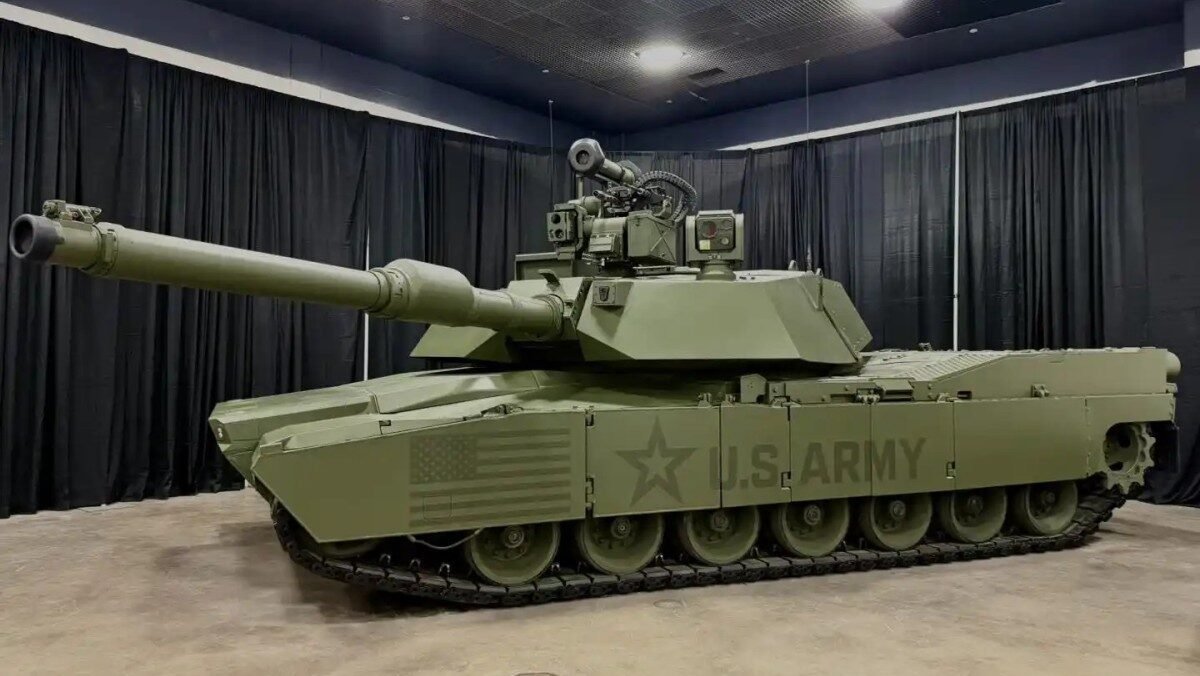
DETROIT — The commander of the first brigade to receive the Army’s new M1E3 Abrams tank and XM30 Infantry Fighting Vehicle told Breaking Defense this week what features on the new systems he’s looking forward to the most ahead of their arrival.
“I can simply say that we are extremely excited about getting the M1E3 and the XM30 for soldiers,” Col. Todd Hertling, commander of the 1st Armored Brigade Combat Team, 1st Cavalry Division, nicknamed Iron Horse, told Breaking Defense in an interview Tuesday here at the GVSETS conference. “Iron Horse will be involved in the rolling out of the technology and the platforms, and we’re extremely excited about the lethality, survivability and mobility that these systems offer.”
The M1E3 is set to replace the service’s aging M1A2 Abrams tank. As Breaking Defense reported earlier this year, the next-gen tank is significantly lighter than its predecessor, has a hybrid-electric engine that reduces fuel requirements by 50 percent and can knock out targets “at a quarter mile in about a tenth of a second,” former Army Chief of Staff Gen. Randy George said in January.
It also has an unmanned turret, which Hertling called a “game changer” because it allows the tank to be manned by a crew of three soldiers instead of four. As a result, the crew should be able to operate “with a higher degree of effectiveness and efficiency,” Hertling said.
As for the brains of the tank, it’s designed with an open systems architecture, which allows the tank to continuously receive updates and allows soldiers to plug-and-play with different kinds of software.
“This essentially allows us to fight on a cloud and to [connect] all of our systems, regardless of platform type, and this of course allows us to fight with a higher degree of situational awareness and understanding for a transparent battlefield that we may not otherwise have been able to,” Hertling said.
The M1E3 also has a 360-degree situational awareness system, “which really allows us to understand the enemy situation at distance, and then also to be more efficient and effective in destroying the enemy at distance as well,” Hertling said.
An Army spokesperson told Breaking Defense today that General Dynamics-Land Systems (GDLS) will deliver an undisclosed number of prototypes to the Army by the the end of this calendar year. Another four protypes made by Roush, an American performance car company, are set to be delivered to the Iron Brigade later this year.
Regarding the XM30, which is set to replace the Bradley IFV, Hertling said his brigade is most excited about the “increased lethality” the unmanned turret will provide and the open systems architecture. He is likewise looking forward to the 360-degree situational awareness design the XM30 also brings to bear.
The Wolf vs the Lynx
GDLS and American Rheinmetall are both scheduled to provide their XM30 prototypes to the Army this summer, as Breaking Defense previously reported. The Army could choose a winner late next spring after both the M1E3 and XM30 are operated by the Iron Horse brigade in a NTC rotation Brig. Gen. Troy Denomy, Program Acquisition Executive of Maneuver, told Breaking Defense. However, he added that the Army is keeping its options opens about how and when the down select will happen.
“We have a plan to carry two vendors as long as we possibly can. It becomes a question about resourcing the money, because you’re not paying necessarily double, but you’re kind of paying double,” Denomy said.
Denomy said his office is currently evaluating how long they can keep two vendors in the XM30 program. If there’s not a clear winner at the end of the NTC rotation, “then it may be worth not selecting at that point,” Denomy said.
“We’re absolutely trying to keep our options open as long as we can, but money matters,” he added.
GDLS is offering its Wolf variant and American Rheinmetall is offering its Lynx variant. The vehicles have many of the same features as they follow the same set of Army requirements, but both companies shared additional details this week after months of being tight-lipped about their offerings.
Both XM30 models have a 50 mm cannon as opposed to the legacy Bradley’s 25 mm cannon. Both also have an open systems architecture, an unmanned turret, enhanced compute power, exportable power and hybrid-electric powertrains. They are also both outfitted with options to attach loitering munitions and missiles, and have high explosive airbursts — tactical ammo designed to detonate midair rather than upon impact.
In terms of counter drone capabilities, the Wolf will be outfitted with AeroVironment’s (AV) Switchblade 300 loitering munition. The Lynx will be outfitted with Raytheon’s tube- or rail-launched Coyote drone. The Javelin missile can also be incorporated into the Lynx, Jim Schirmer, senior vice president of programs at American Rheinmetall, told Breaking Defense.
GDLS has about 15 other partners, including AV, SAPA and STC, Geoff Norman, director of US strategy and growth at GDLS told Breaking Defense. Meanwhile, Rheinmetall is partnering with Anduril, Textron, Allison Transmission, Raytheon and L3Harris.
Norman said the company has delivered their first prototypes to their facility in Lima, Ohio for “government acceptance,” where one will eventually go to Aberdeen-Proving Ground (APG) in Maryland for testing and the other seven will go to the Iron Brigade in Texas around October. Schirmer said Rheinmetall is sending its vehicles to APG in about two weeks.
“So I think what we’re going to see with the [X]M30 when it gets fielded, is something that really elevates our combined arms formations to a new level. It gets [soldiers] capabilities that we can’t do with Bradley because Bradley has been great, but it’s at the end of its growth,” Norman said.
Updated 8/13/2026 at 3:00 pm ET to clarify details surrounding the delivery of the M1E3 tanks.
