

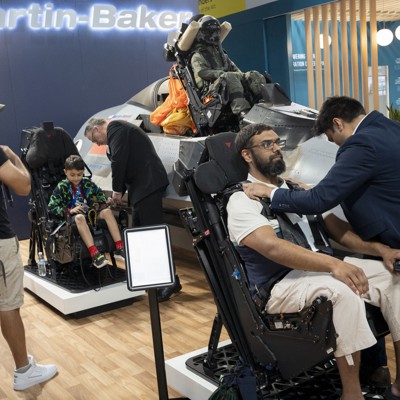
FARNBOROUGH, England—In the eight decades since Martin-Baker conducted its first in-flight test, its ejection seats have saved the lives of more than 7,800 aviators. But more recently, advancements in robotic and autonomous aircraft have Martin-Baker and fellow ejection-seat makers looking for ways to keep themselves alive and well.
“Recognizing where drones are going, we have offered our services to support the drone manufacturers, both the small and the larger ones of the future,” Steve Roberts, Martin-Baker’s head of business development, told Defense One on the sidelines of the Farnborough International Airshow here. “It could be anything. How do they get launched? We have an electronics capability in our company. There are some small drone manufacturers that don’t have that… We might be able to help them with payload destruction.”
“We have reached out to say, ‘How can we help?’” Roberts said. “There has been lots of interest, but I can’t report exactly the direction we’re going just yet.”
The end of the manned fighter jet is not yet nigh. For all the airshow announcements about unmanned systems—from autonomous tiltrotorcraft to unmanned multi-role platforms—exquisite next-generation fighter jet projects like GCAP, the F-47, and F/A-XX are still garnering investment and attention. Companies like Martin-Baker and RTX’s Collins Aerospace know that the pilots will need ejection seats to fight this generation’s wars.
For the U.S. military, Martin-Baker supplies ejection seats for the F-5, some F-16 blocks, F/A-18, and F-35 as well as the T-6, T-38, and T-45 training jets. The United-Kingdom-based company has created a community around its product by giving ties to pilots rescued by their seats, hosting regular gatherings of ejectees, and offering an exclusive watch available to aviators who’ve survived crashes.
Martin-Baker won’t be abandoning that culture anytime soon, Roberts said. Major militaries aren’t giving up on exquisite fighter jets, and those pilots will be relying on the life-saving technology.
“At the end of the day, we’re a life-saving company, that’s the ethos. So how can we provide our life-saving technology into the unmanned aircraft,” Roberts said. “We feel that in our lifetimes, unmanned may not take over, but the partially-manned aircraft will be there … and the training aircraft need to deliver the pilots of the future.”
Collins Aerospace’s ACES II and ACES 5 ejection seats are on the F-15, F-16, and F-22 fighters as well as the B-1 and B-2 bombers, per their website. Since 1978, those ejection seats have saved more than 730 lives, a company spokesman told Defense One in an emailed statement. Similar to Martin-Baker, Collins has the “Grasshopper Club” where ejectees can tour the factory and are given a pin, patch, and coin.
“We remain committed to working with our customer to ensure pilots receive the highest level of protection when their need is greatest,” the spokesperson wrote.
But Collins Aerospace—along with RTX’s other subsidiaries of Pratt & Whitney and Raytheon—are all heavily investing in developing unmanned aircraft.
In June, Collins Aerospace’s Sidekick autonomy software was down-selected for the production phase of the Air Force’s collaborative combat aircraft, or CCA, competition. At Farnborough, Pratt & Whitney announced it reached a key design milestone for its Pratt & Whitney Valox 1500, an engine designed to power CCAs. And Raytheon has been working with the Air Force to integrate its Advanced Medium-Range Air-to-Air Missiles onto CCAs.
“Together, these efforts, among others, underscore RTX’s commitment to delivering affordable technologies that can be produced at scale, rapidly fielded and critical to maximizing manned and unmanned teaming,” the company spokesperson wrote.
Martin-Baker, which began as an aircraft manufacturer, aims to share their knowledge with newer and smaller companies entering the unmanned warfare business.
“We’ve got a healthy, healthy order book going for many, many years because of these new programs that are coming on top,” Roberts said. “But certainly the new market that’s come up, both the, shall we say, the expensive unmanned and also the inexpensive unmanned, there are companies that don’t have the expertise we have in manufacture.”
