

The foreign ministers of the Association of Southeast Asian Nations (ASEAN) will hold an informal meeting with their Myanmar counterpart this weekend, for the first time in five years.
The meeting, which will take place in Bangkok on July 12, was confirmed yesterday by the foreign ministries of Thailand and Vietnam, Reuters reported.
“The meeting in Bangkok is an opportunity for ASEAN foreign ministers to directly exchange views, strengthen cooperation, and promote reconciliation dialogue in Myanmar,” Vietnam Foreign Ministry spokesperson Pham Thu Hang said in a regular press briefing yesterday.
Since the military’s seizure of power in February 2021, Myanmar has been paralyzed by conflict between the military and a host of ethnic armed groups and other resistance forces. There are now around 3.6 million displaced people within the country, according to the United Nations, most of whom have been driven from their homes since the coup.
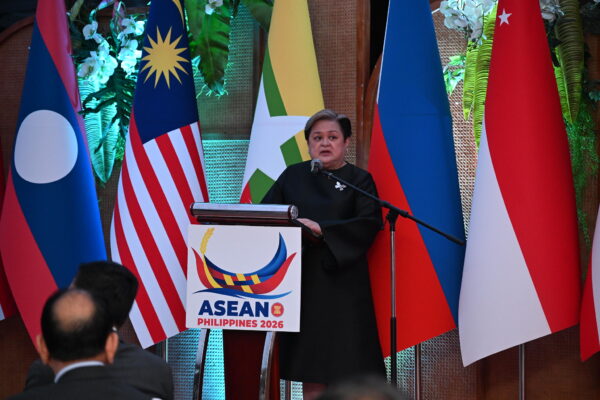
The meeting with the military-backed government’s Foreign Minister Tin Maung Swe was agreed by ASEAN’s foreign ministers at their last summit in May, when Philippine Foreign Secretary Ma. Theresa Lazaro, the current ASEAN special envoy for Myanmar, briefed her counterparts on the “evolving political and humanitarian situation” inside the country.
The 11-nation bloc has excluded Myanmar from the bloc’s summits since late 2021, due to its lack of implementation of the Five-Point Consensus, ASEAN’s roadmap for the management of the country’s conflict. The Consensus, which was agreed at a special ASEAN meeting in April 2021, calls for an immediate cessation of violence and inclusive dialogue involving “all parties” to the conflict.
Since taking office as “president” in April, following a controversial and widely boycotted election, coup leader Min Aung Hlaing has spearheaded a campaign to normalize diplomatic relations with Myanmar’s neighbors, including ASEAN. Shortly after his inauguration, Min Aung Hlaing has announced that his new “civilian” administration intends to “enhance international relations and strive to restore normal relations” with the Southeast Asian bloc.
As part of the campaign, Min Aung Hlaing has in recent months announced the release of political prisoners and the relocation of deposed leader Aung San Suu Kyi from prison to house arrest, and invited key ethnic armed groups to take part in fresh peace talks.
While this normalization campaign has been widely dismissed as a sham by resistance groups and rights organizations both within Myanmar and abroad, and ASEAN has not officially recognized the election result, it has highlighted the divisions between member states advocating greater engagement with the Myanmar military and those taking a harder line. Leading the pro-engagement camp is Thailand, which pushed for the July 12 meeting and wants to bring Myanmar back into “the ASEAN family,” as Thai Foreign Minister Sihasak Phuangketkeow put it back in February.
Over the past year, Sihasak has held several meetings with Tin Maung Swe, most recently in Naypyidaw in April, during which the two officials “stated the importance of strengthening the existing friendship and cooperation between the two countries, as well as enhancing closer collaboration at regional and international levels.”
The pro-engagement camp also includes Laos, which last week rolled out the red carpet for Min Aung Hlaing, his first official trip to an ASEAN member state in his guise as president. (The former military chief has also managed to fit in high-profile state visits to China and India.)
During this weekend’s meeting, Tin Maung Swe is likely to press the government’s case for re-engagement, and to describe how the military plans to resolve the ongoing conflict according to its own contentious “roadmap.” Whether this manages to convince more recalcitrant nations, such as Malaysia and the Philippines, ASEAN’s current chair, is unclear. Last week, Myanmar’s government denied Manila’s request to give Lazaro “brief access” to Aung San Suu Kyi, which it said was necessary if she was to fulfill her role of engaging “all stakeholders and parties to create an environment conducive to inclusive national dialogue.”
The Philippines responded by reiterating that the release of political prisoners, including Aung San Suu Kyi, was “essential to advancing meaningful political dialogue as envisioned in the [Five-Point Consensus].” Lazaro has also announced plans to continue engagements with ethnic armed groups opposed to the Myanmar military.
Given Manila’s views, it is unlikely that ASEAN will be able to muster the consensus necessary to bring Myanmar back into the fold. As such, the most likely outcome for now is a growing bifurcation, in which ASEAN continues to exclude the military-backed government from its summits, while certain member states advance their own engagement with Naypyidaw.
