

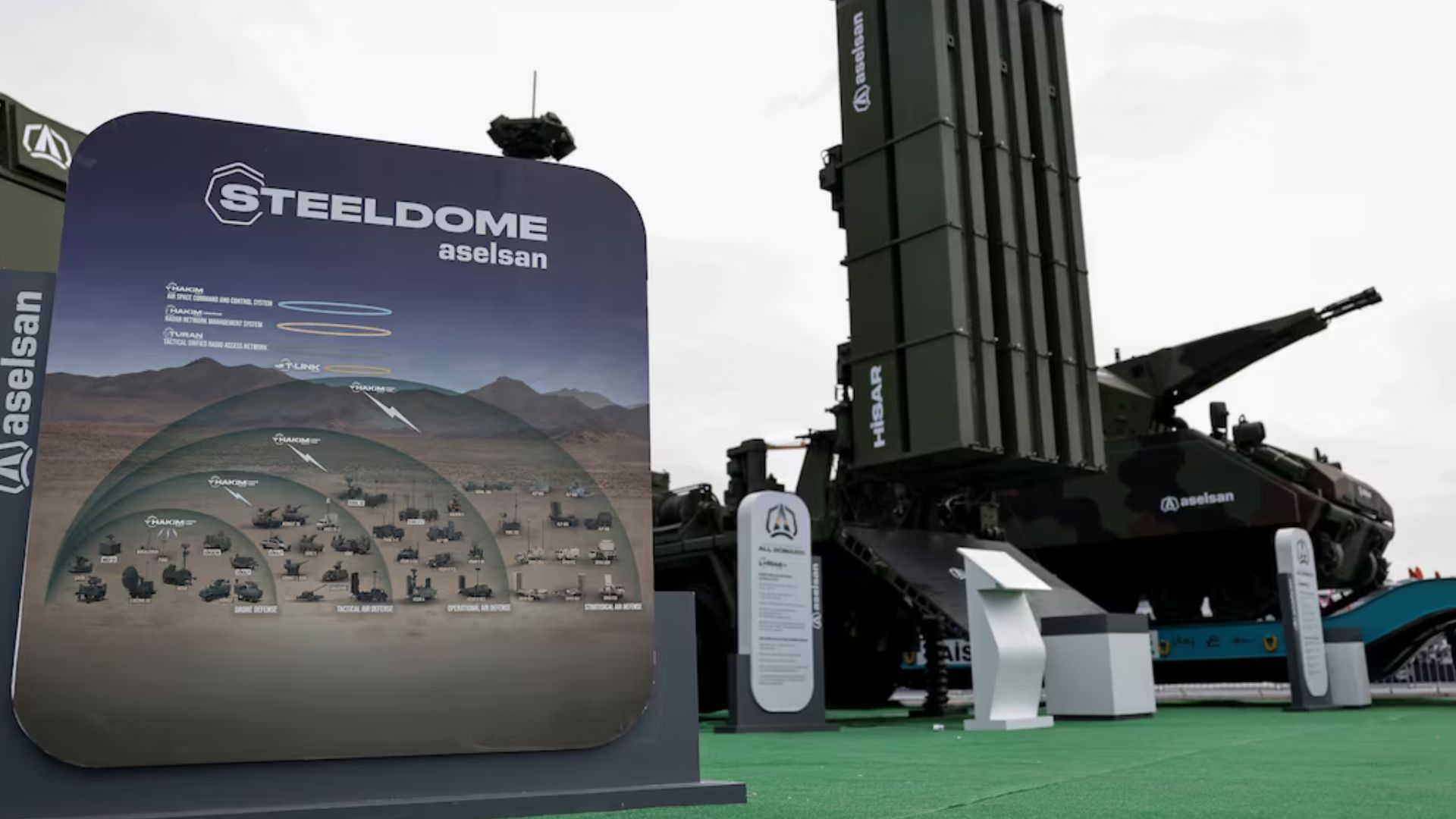
Türkiye’s Aselsan signed a €1.47 billion contract with the SSB to expand serial production for the Steel Dome (Çelik Kubbe) air defence architecture.
Türkiye’s Aselsan has signed a contract worth approximately €1.47 billion (about $1.68 billion) with the Presidency of Defence Industries (SSB) to expand serial production of air defence systems, the company announced in a disclosure to the Public Disclosure Platform on 10 July 2026.
Aselsan said the agreement is an addition to ongoing serial-production projects and is expected to increase revenue, though it did not disclose a delivery timetable or specify which systems the contract covers.
Track Where Türkiye’s Defence Industry Is Finding Demand
Follow the markets Turkish firms are targeting, how they are positioning their products, and which countries are showing interest through reporting and analysis built for serious defence readers.
The disclosure came as the SSB separately signed additional serial-production contracts with Aselsan and Roketsan for the Hisar-A and Hisar-O systems, the short- and medium-range interceptors that sit within the same architecture. Aselsan chief executive Ahmet Akyol said the company would continue producing at high volumes to reinforce the Steel Dome.
Aselsan is the lead contractor for Steel Dome, known in Turkish as Çelik Kubbe – a multi-layered, integrated air and missile defence architecture that links air defence weapons, radars, electro-optical systems, communications modules and command-and-control stations under a single network to build a common air picture in real time. Turkish officials describe it as a system of systems comparable in concept to the US Golden Dome effort and Israel’s layered defences.
The company also supplies HAKİM, described as Türkiye’s first domestically developed air command-and-control system, which coordinates the architecture’s sensors and weapons so that different air defence elements operate together against threats at varying altitudes and ranges. The network passes correlated tracks to artificial-intelligence-supported decision tools that automate threat evaluation and weapon assignment.
The architecture spans several altitude bands. At the lower tier, gun- and short-range systems such as the Korkut anti-aircraft gun and the Gürz hybrid gun-and-missile system handle close-in threats including drones and low-flying missiles.
The Hisar family was developed jointly by Aselsan and Roketsan, with warheads produced by the research institute TÜBİTAK SAGE; Hisar-A protects mobile and armoured units against low-altitude threats, while Hisar-O provides medium-altitude point and regional defence. Above them, the domestically developed Siper family extends coverage into the long-range and ballistic-missile-defence tier.
The latest award adds to a series of large air defence contracts. Aselsan signed a $1.9 billion Steel Dome deal with the SSB in September 2025 and a €780 million ($900 million) agreement in June 2026, with component deliveries expected between 2028 and 2032. The company has also invested $1.5 billion in a dedicated Steel Dome facility that President Recep Tayyip Erdoğan has described as the largest integrated air defence facility in Europe.
The volume of orders tracks rising demand for layered defences. Aselsan has reported that international orders doubled over the past year on demand fuelled by the conflicts in Ukraine and the Middle East, and the SSB has cast the expanded production as part of Türkiye’s commitment to reinforce its air defence architecture and its obligations within NATO.
The architecture first deployed as an integrated system at Exercise EFES 2026 in May, when Siper, Hisar-O, Hisar-A, Sungur and electronic-warfare layers were positioned together for a live demonstration in front of 50 national delegations.
At SAHA 2026 the same month, Aselsan unveiled six additional systems spanning electronic warfare, laser and high-power-microwave anti-swarm weapons while the SSB announced contracts for the Siper-A and Siper-4 ballistic-missile-defence layers, underscoring how far Steel Dome has evolved from a short-range shield into a full-spectrum architecture reaching from very-low-altitude drones and cruise missiles up to high-altitude ballistic threats.
Quwa Pro
Track Where Türkiye’s Defence Industry Is Finding Demand
Follow the markets Turkish firms are targeting, how they are positioning their products, and which countries are showing interest through reporting and analysis built for serious defence readers.
Featured & Trusted By
