

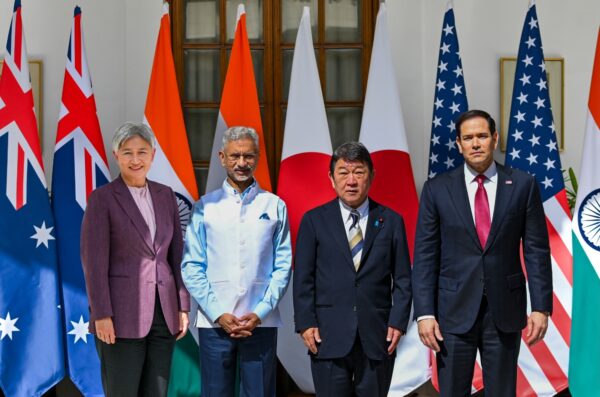
Australia’s foreign minister, Penny Wong, traveled to New Delhi this week for the latest meeting of the Quad foreign ministers. Despite concerns that the grouping would not hold amid the current realignment of worldview in the United States under President Donald Trump, the meeting made clear that the Quad could still prove useful to each of its members through a focus on economic resilience, technological coordination, and supply chain security. The bloc is increasingly concerned with regional systems, rather than conventional defense.
For Australia, this shift is particularly significant. Canberra has long argued that Indo-Pacific stability depends not only on military deterrence, but also on the protection of trade flows, energy supplies, critical technologies, and economic sovereignty. The New Delhi meeting suggests that this conception of security is becoming embedded within the Quad.
The joint statement reflected this expansive understanding of security. Maritime surveillance, cybersecurity, critical minerals, telecommunications, artificial intelligence, energy supplies, disaster response, and infrastructure resilience were all treated as interconnected components of regional order. The group now frames its role as collectively managing vulnerabilities in these domains across the Indo-Pacific.
For Australia, the major pillar of this cooperation is the Quad’s new Critical Minerals Initiative Framework. The framework aims to coordinate investment, extraction, processing, refining, and recycling of strategic minerals across Quad members and other trusted partners. Although China is rarely mentioned in Quad statements, the intention of the initiative is clear – reduced the dependence on Chinese-controlled supply chains for materials that are essential to advanced manufacturing, renewable technologies, semiconductors, batteries, and defense industries.
Australia occupies a central position within this agenda. The country possesses substantial reserves of lithium, cobalt, nickel, and other critical minerals, yet has historically exported these resources largely in raw form – with the processing usually done in China. The new Quad initiative aligns with Canberra’s ambition to move itself further into the value chain by developing a domestic refining and processing capability. Australia now wants to position itself not merely as a quarry, but as an indispensable industrial partner within a supply chain of “trusted partners.”
The other major pillar that emerged from the meeting in New Delhi was energy security. This was, of course, an awkward issue to address given that the U.S. war with Iran has played a significant role in disrupting supply chains and making petroleum more expensive. The statement on energy security highlighted new threats to shipping routes and how Indo-Pacific economies are reliant on maintaining consistency of delivery. Here Australia has a longstanding vulnerability, being heavily dependent on imported refined fuel, and having limited strategic reserves.
Australia has made sea lines of communication central to its national defense strategy. It has centered the idea of itself as a maritime nation that is chiefly concerned with fragile supply lines and maritime choke points. While the United States may be close to petroleum self-sufficiency, Japan and India are also heavily reliant on these supply lines. This was reflected in the Quad language on energy security, which treats this not simply as a domestic economic issue, but a collective strategic challenge requiring coordination between partners.
This is the logic that underpins Australia’s contemporary security arrangements, from the AUKUS agreement through to the deepening of Australia’s bilateral relationship with Japan. For Canberra, the Quad complements these arrangements through initiatives focused on specific issues, while also including India as a state pivotal to the balancing of power in the Indian Ocean. The overlapping features of the Quad with other agreements is seen as reinforcing Australia’s capabilities within a web of relationships and initiatives.
The purpose of the Quad looks to now be finding practical issues it can work collectively on, within a broader agenda of seeking to insulate the Indo-Pacific from coercion and disruption. Security is no longer viewed narrowly as the defense of territory, but now involves protecting the functioning of society itself – its trade networks, technological systems, industrial capacity, and economic autonomy.
Here it seems the Quad is heavily influenced by Australia’s move to understand its security as defending a “way of life.” Canberra increasingly sees the defense of liberal democratic society as inseparable from the resilience of the economic and technological systems that sustain it. The Quad’s evolution suggests that this understanding is now being shared more broadly across the Indo-Pacific’s leading democracies.
