

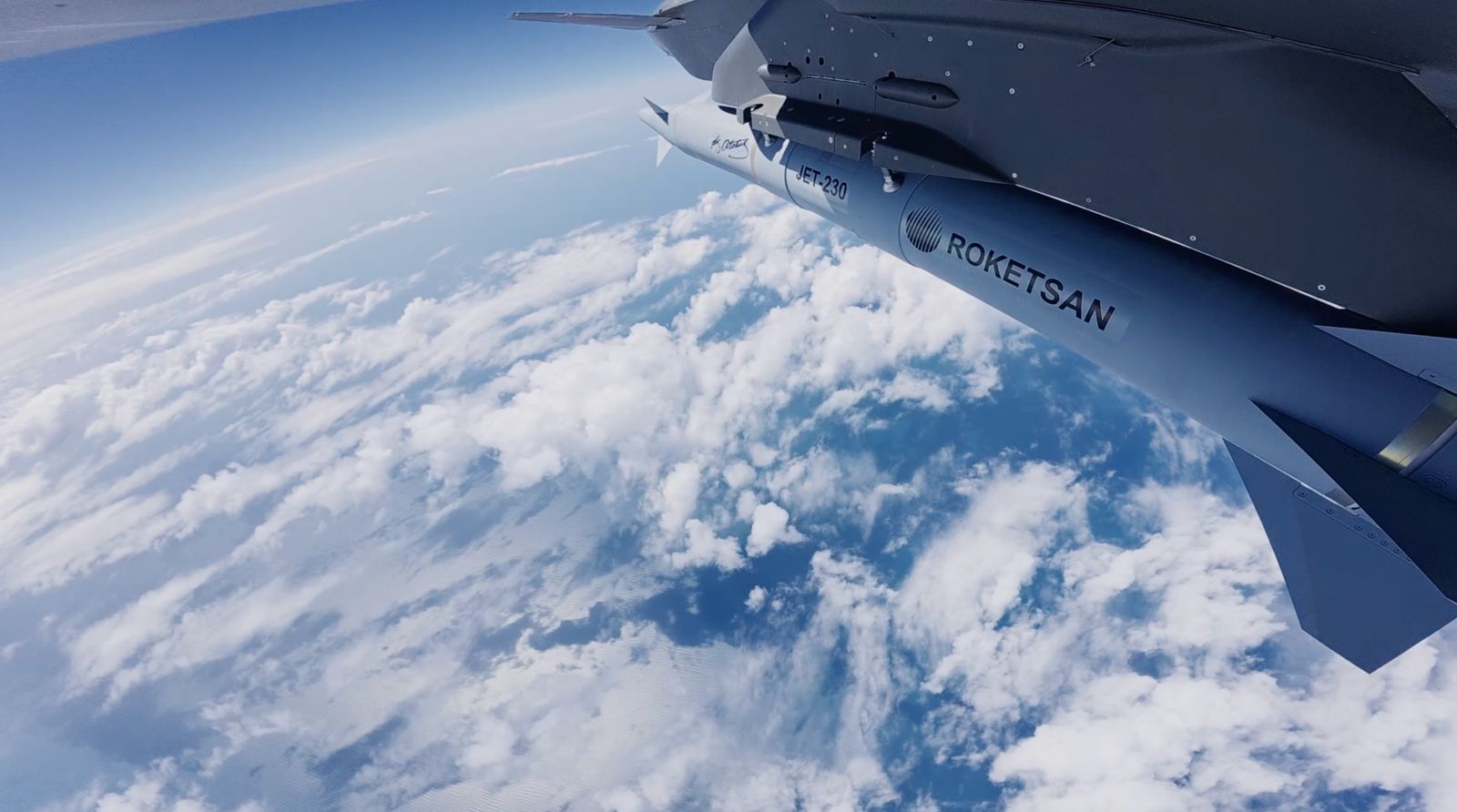
Baykar’s KIZILELMA fired a Roketsan JET-230 supersonic missile at a target over 120 km away, its first air-to-ground shot with a supersonic weapon.
Baykar announced on 13 July that its Bayraktar Kızılelma unmanned fighter fired a Roketsan JET-230 supersonic air-to-ground missile and hit a target from a range of over 120 km.
The company said the weapon struck with “Bull’s Eye” accuracy. It was the Kızılelma’s first firing of a supersonic air-to-ground weapon.
The aircraft that flew the test was S2, a serial production airframe rather than one of the prototypes that flew the program’s earlier records.
S2 left the Akıncı Flight Training and Test Centre at Çorlu, in Tekirdağ, on 8 July and transited to the 5th Main Jet Base Command at Merzifon, in Amasya.
Track The Markets, Buyers, and Signals Shaping Turkish Defence Exports
Follow how Turkish companies are presenting their products, where militaries are showing interest, and what those moves reveal about demand across regional defence markets.
On 11 July it took off carrying two JET-230s under its wings and turned towards a target over the sea.
The JET-230 is the newest member of Roketsan’s 230 mm aeroballistic family, and its advertised range is more than 200 km.
That family starts with the TRG-230, a ground-launched guided rocket fired from multi-barrel launchers at ranges of 20 to 70 km.
Roketsan converted it for air launch as the İHA-230, sold for export as the UAV-230 – a 3.4 m, roughly 225 kg missile with a 42 kg warhead, satellite-aided inertial guidance, and a quoted range of more than 150 km.
That weapon entered service with the Turkish Land Forces Command on 4 June. Fired from the turboprop Bayraktar Akıncı, it hit a target 155 km away in November 2024.
Roketsan’s own literature explains why the JET-230’s figure is higher. The missile’s reach depends on the speed and altitude at which it is released, and a jet cruising near Mach 0.9 hands it far more energy at separation than a turboprop can.
Turkish trade press flagged this in November 2024, noting that the 150 km figure should grow once the missile was fired from faster, higher-flying platforms like the Kızılelma.
That release energy is capped by the engine. The Kızılelma flies on a Ukrainian turbofan, and Türkiye is developing a domestic replacement to close the dependency.
What Baykar has not explained is the distance between the claim and the shot. A 120 km engagement sits well inside the 200 km envelope Roketsan advertises, and below the 155 km the İHA-230 already reached from a slower aircraft.
Neither company has said whether the release conditions were held conservative for a first integration firing, or whether the 200 km number depends on a launch profile this test did not fly.
The Kızılelma has an 8.5-tonne maximum take-off weight, a 1.5-tonne payload, a top speed near Mach 0.9, and a combat radius of 500 nautical miles. It carries ASELSAN’s MURAD active electronically scanned array (AESA) radar and the TOYGUN electro-optical targeting system.
Before the JET-230, the aircraft had already fired the TÜBİTAK SAGE Gökdoğan air-to-air missile along with TOLUN, TEBER-82 and LGK-82 munitions.
The Gökdoğan shot, taken off Sinop on 29 November 2025, made the Kızılelma the first unmanned aircraft to destroy a jet-powered aerial target with a beyond-visual-range missile. Baykar plans to fly the type from the amphibious assault ship TCG Anadolu and the future MUGEM carrier.
Roketsan general manager Murat İkinci said at the Dubai Airshow in November 2025 that the KIZILELMA would also carry the 300 ER and the EREN loitering munition. The 300 ER is a 900 kg air-launched ballistic missile quoted at over 500 km.
The KIZILELMA first flew in December 2022. Selçuk Bayraktar, Baykar’s chairman and chief technology officer, has said the type will enter the Turkish inventory and begin operations in 2026.
Baykar signed the KIZILELMA’s first export contract in May at the SAHA 2026 exhibition in Istanbul, with Indonesia’s Republikorp Group – 12 aircraft with options for 48 more, deliveries from 2028, and a local production facility.
The company remains the world’s largest armed drone exporter, with $2.2 billion in exports in 2025. It holds drone export agreements with a total of 39 countries.
The Pakistan Air Force (PAF) is one of those customers as it flies the Bayraktar TB2 and Akıncı, and Baykar’s KaGeM V3 and YiHA loitering-munition work at the National Aerospace Science and Technology Park has been spun into a local subsidiary, Baykar Technologies Pakistan, reportedly in talks over an assembly plant.
Quwa Pro
Understand Where Türkiye’s Defence Export Momentum Is Building
Get clearer visibility into which countries are interested in Turkish systems, how firms are competing, and where procurement attention is moving.
Featured & Trusted By
