

Britain is allowing classified information on long-range missile technology to be shared with Ukraine, as Kyiv seeks to strengthen its ability to strike deep inside Russian-held territory.
The move was immediately condemned by a senior Kremlin official, who described the plan as adding “fuel to the fire” and undermining the prospects for peace.
The British government has agreed that defence company MBDA can share classified information on UK components used in the French SCALP long-range missile, an equivalent of Britain’s Storm Shadow cruise missile.
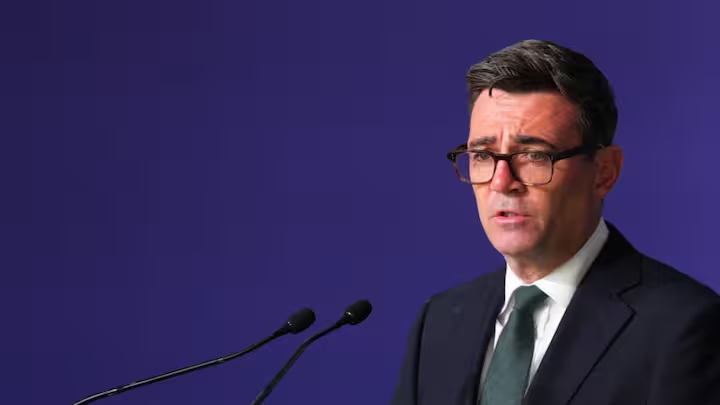
The decision emerged as Andy Burnham made his first visit to Kyiv, where he hit back at President Putin over Russian criticism of British military support for Ukraine.
The Kremlin said Britain’s decision would add “fuel to the fire” and damage efforts to bring the war to an end.
Burnham responded before chairing a meeting of the coalition of the willing, the European allies of Ukraine, on Monday: “Who started the fire? That’s the question, isn’t it?”
Speaking alongside President Zelensky of Ukraine, Burnham compared the country’s resistance against Russia to Britain’s role in the Second World War. “My nation kept the flame of European freedom alive in the 20th century,” he said. “You hold that flame in the 21st.”
Burnham continued: “Despite Russia’s outrageous threats to my country, we will continue our support for Ukraine … Ukraine has been Europe’s protector, not a drain on our security but the front line in keeping Europe safe.”
Storm Shadow is one of the most powerful long-range weapons supplied to Ukraine by Britain. The 5.1-metre missile weighs about 1.3 tonnes and has an officially stated range of more than 250km, allowing aircraft to launch it from well outside heavily defended areas.
It carries a 450kg BROACH penetrating warhead designed to destroy hardened targets, including command bunkers, ammunition stores, airfields and bridges. The missile flies at low altitude to evade air defences before using an infrared seeker to identify its target during the final stages of flight. Each missile is estimated to cost about £2 million.
Burnham had earlier said Britain needed to be “bolder” and establish closer ties with the European Union, hinting at a closer relationship on matters such as youth mobility.
He told Antonio Costa, the president of the European Council, that greater co-operation was required and called for a “step change in relations”.
A No 10 spokesman said: “The two leaders underlined the importance of being ambitious to drive a step change in relations. The UK had to be bolder in terms of getting closer to the bloc, the prime minister said. That included building on the close defence and security ties already forged between the UK and European allies to drive greater co-operation across all areas of the relationship.”
Meanwhile, President Zelensky has said a set of proposals to end the war in Ukraine has been drawn up with the United States and Europe, despite Russia vowing that it intends to keep fighting until it has toppled the government in Kyiv.
The Ukrainian president said on Sunday that Kyiv had worked with President Trump’s envoys and European officials on the plan. He said it would involve a ceasefire, a reciprocal withdrawal from the front line by Russian and Ukrainian troops and the creation of a buffer zone.
“There are several more ideas from the American side, as far as we know. They want to find the right moment to share them. We are waiting for them,” Zelensky added.
A Vatican envoy arrived in Russia on Monday, prompting speculation that he could pass on the proposals. Archbishop Paul Richard Gallagher, the Vatican’s secretary for relations with states, is due to meet Sergey Lavrov, the Russian foreign minister, on Tuesday.
However, Russia has previously rejected similar proposals and hopes of a breakthrough are low. Lavrov said at the weekend that Russia would continue waging war in Ukraine until it had brought down Zelensky’s “neo-Nazi regime”.
Lavrov told state media that a ceasefire would allow the “Nazi metastases” to spread from Ukraine. “This would be a betrayal of what our grandfathers and great-grandfathers achieved by defeating Nazism — once and for all, as it seemed to us then,” he added.
Kremlin propaganda has falsely portrayed Zelensky, who is Jewish, and his government as neo-Nazis since the start of Russia’s full-scale invasion in 2022.
Zelensky also said there was widespread opposition to the war inside Russia. “Many people in Russia want the war to end,” he said.
Two-thirds of Russians say they want to see peace talks, according to the Levada Center, which is widely regarded as Russia’s only independent pollster.
