

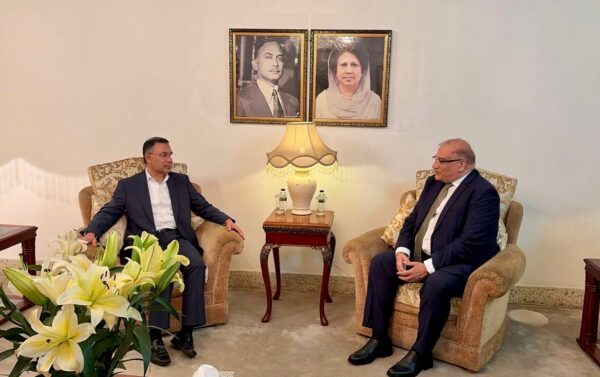
On May 8, Pakistan’s interior minister and chairman of its Cricket Board, Syed Mohsin Raza Naqvi, arrived in Dhaka for a two-day visit. His visit coincided with the Bangladesh-Pakistan cricket series, but it was not merely sports-centric. It also carried distinct political and strategic messages.
In the landscape of South Asian politics, the relationship between Bangladesh and Pakistan has historically been both complex and emotionally charged. A political betrayal — Pakistan’s refusal to transfer power, ignoring the mass mandate of the Bengalis in the 1970 election, and the memories of the genocide during the 1971 Liberation War — lingered and kept bilateral relations frosty for a prolonged period. Nevertheless, amidst the shifting realities of international politics, recent times have seen the beginnings of a new diplomatic warmth between Dhaka and Islamabad.
Soon after the fall of the Sheikh Hasina government on August 5, 2024, several Pakistani ministers, including Deputy Prime Minister Ishaq Dar, visited Dhaka. Pakistan’s Chief of Army Staff, Field Marshal Asim Munir, also met with Bangladesh Air Force Chief Hasan Mahmood Khan at Rawalpindi in Pakistan on January 8, 2026. Prime Minister Shehbaz Sharif is expected to visit Dhaka in June after Bangladeshi Prime Minister Tarique Rahman visits China. These visits are not merely acts of diplomatic courtesy; rather, they reflect the emerging geopolitical realities of South Asia.
The pertinent question remains whether this growing closeness between Bangladesh and Pakistan signals a new beginning. Or is it merely a fleeting mirage borne of strategic necessity?
Weight of History and the Realities of Bilateral Relations
Undoubtedly, the greatest source of unease in Bangladesh-Pakistan relations remains the 1971 war. Memories of the genocide perpetrated by the Pakistani forces on Bangladeshi intellectuals and masses, and the atrocities committed against women, remain deeply etched in the minds of the Bangladeshi people. Consequently, any initiative aimed at improving relations with Pakistan becomes inextricably intertwined with public sentiments. Political parties have often leveraged this history for their own ends, thereby rendering the issue of bilateral relations even more sensitive.
When the Awami League was in power in Bangladesh between 2008 and 2024, relations with Pakistan were frosty, especially due to the trial and conviction of several leaders of the Jamaat-e-Islami, which collaborated with Pakistan in the 1971 war, on charges of crimes against humanity. On several occasions, Pakistan voiced objections to the judicial proceedings, which in turn, only served to widen the rift between the two countries.
However, the political shifts in Bangladesh following Hasina’s ouster ushered in a new reality. During the interim government, there was a noticeable increase in visits to Bangladesh by Pakistani ministers and military officials, accompanied by a visible surge in diplomatic and military engagement between the two countries.
Nevertheless, the historical burden remains unresolved. Pakistan has yet to offer a full and formal apology for the genocide committed in 1971. A significant segment of the Bangladeshi population firmly believes that genuine improvement in bilateral relations is impossible without Pakistan’s acknowledgment of its culpability. Consequently, while diplomatic exchanges may have increased, the psychological distance between the two nations remains significant.
On the other hand, the reality of the modern state system dictates that, alongside emotional sentiments, strategic and economic interests are also important. Bangladesh’s burgeoning economic power within South Asia is compelling Pakistan to re-evaluate its approach to the relationship. And concurrently, as part of its multifaceted diplomatic strategy, Bangladesh seeks to cultivate ties with all key regional powers. However, the progress of these relations must be carefully calibrated to ensure that the delicate geopolitical balance with India remains undisturbed.
New Equations in Geopolitics and Security Cooperation
During his recent visit to Dhaka, Naqvi held meetings with Bangladesh’s Home Minister Salahuddin Ahmed as well as State Minister for Foreign Affairs Shama Obaid. The most significant outcome of Naqvi’s visit was the signing of an MoU on security cooperation. Under the terms of this agreement, the two nations are set to exchange intelligence and technical assistance to combat drug trafficking, money laundering, and cross-border crime.
However, given that Bangladesh shares no land border with Pakistan, how far can such cooperation go? The agreements seem to be more of a diplomatic spectacle, with little substantive impact on security.
Furthermore, Pakistan’s security apparatus has long been a subject of controversy within the international arena. Issues such as the prevalence of terrorism, its use of terrorist groups as a tool of its foreign policy, the proliferation of extremist groups, and the instability along its border with Afghanistan have cast a shadow over the country’s international image. Consequently, some analysts are skeptical as to how truly beneficial security cooperation with such a state would prove to be for Bangladesh.
In the context of the ongoing crisis in West Asia, Pakistan is striving to project itself as a significant regional power. Leveraging its position as a close ally of the United States and China and its active engagement in the Afghanistan issue, Islamabad is seeking to enhance its standing in the international arena.
Pakistan frequently exploits regional crises to secure strategic advantages. Consequently, questions persist regarding the sincerity of its sudden overtures toward Bangladesh.
Bangladesh’s foremost challenge lies in maintaining a strategic equilibrium. Dhaka aims to cultivate balanced relationships with China, India, the United States, and the Muslim world. Yet, excessive proximity to Pakistan could generate unease with India — a country that surrounds Bangladesh on three sides. It could pose risks to Bangladesh’s economic and national security interests. The current warmth in Bangladesh-Pakistan bilateral relations is less a product of mutual trust and more a function of geopolitical calculations.
New Possibilities or a Diplomatic Mirage?
Not only has Pakistan not formally apologized for the 1971 genocide, but the issue of assets owed to Bangladesh also remains unresolved. These matters are obstacles in the path of improving bilateral relations.
In addition, Pakistan lacks the robust commercial infrastructure necessary to meet Bangladesh’s import demands. Consequently, positioning Pakistan as a viable alternative to India will not be an easy task.
Nevertheless, new avenues for trade, education, technology, and cultural exchange could emerge between the two nations. There is considerable potential for cooperation in the textile, pharmaceutical, and agricultural sectors, in particular. As Pakistan seeks to reduce its economic isolation within South Asia, Bangladesh is simultaneously exploring new export destinations and investment opportunities beyond its traditional partners. This convergence of economic interests has encouraged Islamabad to court Bangladeshi investment and pursue closer commercial ties. Enhanced people-to-people contact could also help alleviate mutual mistrust to some extent.
However, the sustainability of these relations will ultimately hinge upon political goodwill. If the relationship remains confined merely to formal visits and diplomatic communiqués, it is unlikely to endure. Similarly, if Pakistan continues to maintain an ambiguous stance regarding its history with Bangladesh, it will be difficult to dispel the mistrust prevailing among the Bangladeshi people.
