

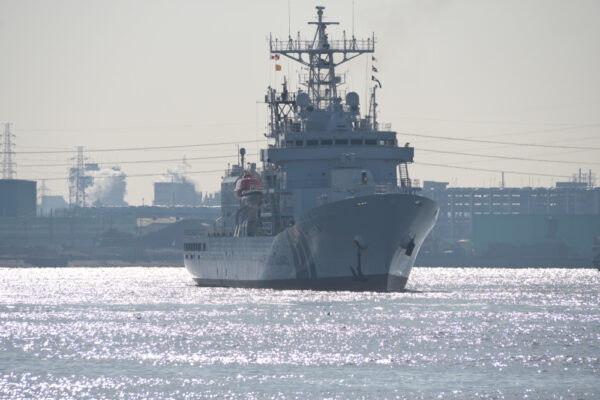
The Japanese Asahi Shimbun reported on June 9, 2026, that a China Coast Guard (CCG) vessel had been spotted navigating within Japan’s exclusive economic zone (EEZ) south of Yonaguni Island in Okinawa Prefecture, as announced at a press conference by Chief Cabinet Secretary Kihara Minoru that same day. Kihara explained that the CCG vessel had been detected by a Japan Coast Guard (JCG) patrol vessel. When the JCG queried the CCG vessel, it responded that it was conducting a “routine patrol” and asserted Chinese exercise of jurisdiction over the area. Moreover, China’s Foreign Ministry spokesperson Lin Jian confirmed at a regular press conference on June 9 that the CCG vessel had been “conducting patrols in accordance with the law,” before going on to declare that “Japan and the Philippines bypassing China to initiate the so-called maritime delimitation talks constitutes a severe violation of UNCLOS and other international laws and basic norms governing international relations. It also seriously infringes on China’s maritime rights and interests. China will by no means accept this.”
China has long made claims in Asian waters that are not grounded in the United Nations Convention on the Law of the Sea (UNCLOS), and since June this year it has been conducting “marine scientific research” (MSR) and patrols in accordance with Chinese domestic laws in Japan’s EEZ south of Yonaguni Island and east of Taiwan. The situation in these waters appears to be shifting from China merely asserting claims to a new phase of carrying out concrete activities — a gradual accumulation of facts on the water, as has been happening in the disputed parts of the South China Sea. The commencement of negotiations to delimit the maritime boundary between Japan and the Philippines has provided China with an “excuse” to advance to this new phase.
Chinese MSR conducted in Japan’s EEZ without Japanese consent violates UNCLOS and evidently constitutes a breach of international law.
Meanwhile, CCG “patrols” in Japan’s EEZ are more complex, and may not immediately be regarded as violations of international law.
Unlike territorial waters, coastal states possess sovereign rights and jurisdiction only over specific matters in the EEZ. The EEZ regime was created primarily to pursue the economic interests of coastal states. Article 56 (1) of UNCLOS stipulates the sovereign rights of coastal states over natural resources in the EEZ and places them at the core of the EEZ regime. Meanwhile, it stipulates that EEZ coastal states have jurisdiction over MSR, “the establishment and use of artificial islands, installations and structures” and “the protection and preservation of the marine environment.”
An EEZ is a maritime area where coastal states are granted sovereign rights and jurisdiction over what was conventionally considered high seas, and excepting the specific matters stipulated by UNCLOS, those areas retain the characteristics of high seas. Article 58 (1) of UNCLOS states that all countries enjoy the “freedoms of navigation and overflight” within EEZ. The same article also stipulates that the freedoms enjoyed by ships (including warships and other government vessels) are equivalent to the “freedom of the high seas” as stipulated in Article 87 (1) of UNCLOS. At the same time, Article 58(3) stipulates that any state is obliged under the EEZ to “In exercising their rights and performing their duties under this Convention in the exclusive economic zone, States shall have due regard to the rights and duties of the coastal State.”
Because of this, warships and other government vessels can exercise enforcement jurisdiction over their own vessels according to the flag state principle on the high seas, but when exercising such jurisdiction within a country’s EEZ, they are obliged to have “due regard” to the sovereign rights and jurisdiction of the coastal state of that EEZ.
The inclusion of the obligation to have “due regard” in Article 58 (3) of UNCLOS was a result of adjustments made in the convention drafting process. However, there remains ambiguity regarding which activities of EEZ non-coastal states may or may not be considered to fulfill this obligation.
Actions that fail to “have due regard” to the sovereign rights and jurisdictions of EEZ coastal states include, among other things, (1) obstructing the exercise of sovereign rights by EEZ coastal states for exploration, development, conservation, and management of natural resources and (2) obstructing the exercise of sovereign rights by EEZ coastal states for creating and using artificial islands, facilities, and structures.
Japan must carefully examine, analyze, and evaluate the specific contents of the CCG’s patrols conducted in the Japanese EEZ south of Yonaguni Island and east of Taiwan — including the purpose of those patrols and the Chinese domestic laws they purport to enforce — and, on the basis of those findings, take coherent measures against CCGs in the relevant maritime areas.
