


China has deployed more than 100 naval and coast guard vessels across the western Pacific this week, including two aircraft carriers, according to Taiwanese officials.
The mobilisation has raised concerns about Beijing’s ability to blockade Taiwan and threaten neighbouring countries, with Chinese warships operating across the East China Sea, South China Sea and Philippine Sea.
Joseph Wu, secretary-general of Taiwan’s National Security Council, disclosed the scale of the deployment on Tuesday, publishing a map showing Chinese naval forces across the region.
Wu wrote on social media: “Taiwan is staying vigilant. We won’t provoke, but we won’t bow to any pressure.”
The deployment included the Liaoning aircraft carrier strike group, which has been conducting exercises in the Philippine Sea, while the Fujian, China’s newest and most advanced aircraft carrier, was separately observed in the South China Sea.
The presence of two Chinese carriers in different parts of the region highlights Beijing’s growing ability to conduct naval operations across multiple maritime areas.
Wu had warned of the wider regional threat the previous week, when Taiwan reported 53 Chinese vessels operating in waters stretching from southern Japan to the Philippines.
“The simultaneous threat to Taiwan, Japan and the Philippines is obvious,” he said on October 28.
Taiwan’s defence minister, Wellington Koo, also expressed concern about the Chinese operations, telling reporters on October 29: “We are not happy to see any attempt to project deterrence that could undermine peace and stability in the Indo-Pacific region.”
Such deployments could allow China to isolate Taiwan, disrupt commercial shipping or restrict foreign military access without immediately launching a full-scale invasion.
Naval assets from the People’s Liberation Army’s Eastern, Northern and Southern Theatre Commands were also reported operating across the region.
The Liaoning, China’s first operational aircraft carrier, began its second round of exercises in the western Pacific this year on October 14.
It was previously tracked approximately 46 kilometres east-southeast of Balut Island, one of the Philippines’ southernmost islands, before sailing northeast on October 23.
Its escort reportedly included two Type 055 guided-missile destroyers, the Wuxi and Anshan, and the Type 052D destroyer Huainan.
China’s defence ministry has described the Liaoning’s western Pacific exercises as routine training intended to test its long-range capabilities, saying they were not directed at any particular country.
The deployment coincided with a sharp increase in Chinese military aircraft activity around Taiwan.
Taiwan’s defence ministry recorded 49 flights by People’s Liberation Army aircraft in the 24 hours to 6am on Tuesday, the highest daily figure reported this year.
By Wednesday morning, the number had fallen to 22.
Despite the wider mobilisation, considerably fewer Chinese vessels were detected immediately around Taiwan.
The defence ministry recorded six Chinese naval vessels and six other official ships near the island on Tuesday, followed by seven warships and five official vessels on Wednesday.
Wu’s figures covered Chinese deployments across the western Pacific, while the defence ministry’s daily assessments focused on waters immediately surrounding Taiwan.
The distinction matters because a potential Chinese blockade could involve naval forces positioned far beyond the island, including ships deployed to restrict access by foreign navies.
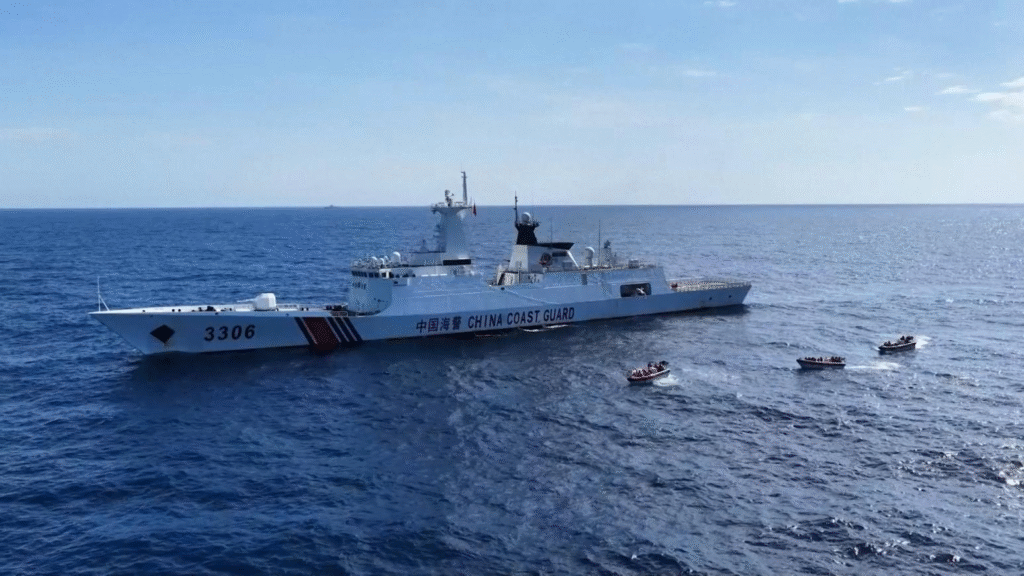
China’s use of coast guard vessels alongside warships could also allow Beijing to impose maritime restrictions without immediately resorting to open warfare.
Coast guard ships could inspect, divert or obstruct commercial vessels, backed by conventional naval forces.
The Chinese movements overlapped with Keen Sword, a major US-Japan military exercise held from October 19 to 29.
During the exercise, the American aircraft carrier USS Theodore Roosevelt operated alongside allied warships from Japan, Australia, Canada and France in the Philippine Sea, according to the US Navy’s Seventh Fleet.
The exercises demonstrated the presence of American and allied naval forces in waters that would be strategically important during any confrontation involving Taiwan.
The latest aerial activity remained below levels recorded during previous major Chinese military exercises.
Taiwan recorded 130 flights by Chinese military aircraft on December 30 last year, followed by 77 the next day.
The highest single-day figure remains 153 flights during the Joint Sword-2024B exercises in October 2024.
Beijing regards Taiwan as part of its territory and has repeatedly refused to rule out using force to bring the self-governing island under its control.
Taiwan rejects Beijing’s sovereignty claims and maintains that its future can only be determined by its people.
The United States does not formally recognise Taiwan as an independent state but remains committed to providing the island with defensive weapons.
Although the latest deployment does not indicate that a blockade is imminent, it demonstrates the range of military forces Beijing could draw upon in a future confrontation over Taiwan.
