

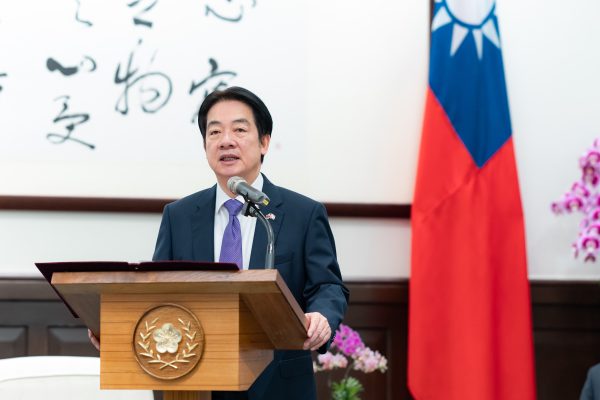
Within the span of four weeks, two planes told the story of Taiwan’s presence and absence in the world. One carried U.S. President Donald Trump to Beijing, where China’s leader Xi Jinping had every opportunity to press his case about Taiwan. The other was nearly prevented from reaching its destination: Taiwan’s president, Lai Ching-te, tried to fly to Eswatini, Taiwan’s only diplomatic ally in Africa, only to see three countries revoke overflight permission for his plane. Lai had to postpone his trip.
China is pressuring Taiwan by controlling access to and language about Taiwan – including by pressing foreign leaders to describe Taiwan in Beijing’s terms. The danger is that the world may misread Taiwan and misunderstand who is preserving peace and who is threatening it. That distorted framing was evident in Trump’s remarks following his trip to China. In an interview with Fox News, Trump said that Taiwan has “somebody there now that wants to go independent,” and implied that U.S. support encourages Taiwan to provoke Beijing. That is Beijing’s familiar narrative: Taiwan is seeking independence, Taiwan is provoking China, and Taiwan is therefore to blame for regional instability.
Yet as Trump was saying this, the People’s Liberation Army was continuing to send ships and aircraft around Taiwan, part of a grinding campaign that has become a near-daily pressure on Taiwan. In Taiwan, the goal is very clear: Taiwanese want peace, not provocation, and they want to preserve their democratic way of life.
To keep Taiwan’s voice from being heard, China is blocking Taiwan’s elected leaders from reaching out to other countries. Lai was scheduled to visit Eswatini in late April. At the last minute, however, three neighboring African countries — Mauritius, Seychelles, and Madagascar –denied his plane access to their airspace, forcing him to postpone the trip. China praised the three countries. It was a new kind of squeeze on Taiwan’s international engagement – preventing Taiwan’s leader from visiting Taiwan’s own ally.
Taiwan, however, was not deterred. Days later, Lai reached Eswatini anyway, by an unusual route and with Eswatini’s assistance – a creative act of diplomatic improvisation. Taiwanese followed his difficult journey as a reminder of how small China wants our world to become.
The same logic of control prevailed this week at the World Health Assembly in Geneva. The issue should have been straightforward: whether Taiwan’s experts and officials may share what they know about public health without Beijing’s permission. But Taiwan was again kept out of the key forum of global health governance, despite what its public health experts and officials could contribute.
Before that, in late April, China forced the cancelation of a global human rights gathering because several Taiwanese civil society organizations were set to take part.
Time and again, China forces its claim over Taiwan into international conversations, excludes Taiwan from international organizations, and denies Taiwanese leaders, officials, and even ordinary citizens access to international venues.
China wants the world to hear only one version of Taiwan’s story: Beijing’s. And much of the world is listening to this version. When world leaders repeat Beijing’s language, they narrow the space in which Taiwan can safely exist. They make it easier to treat Taiwan as a provocation and the Taiwanese people’s desire to preserve their democracy as a threat to peace. But peace cannot be built on a narrative that blames the threatened for the threat.
Trump has made an unusual suggestion in recent interviews: that he would speak with Taiwan’s leader. Taiwan has welcomed the possibility of a call, but such a conversation would certainly draw Beijing’s opposition.
Yet Taiwan has a message to deliver, one grounded in reality. Asked what he would say if he spoke directly with the American president, Lai said he would first convey the voice of Taiwanese society: Taiwan seeks to maintain the status quo and protect peace and stability across the Taiwan Strait.
For many people in Taiwan, the “status quo” means the political reality of governing themselves without China’s permission: electing their leaders, criticizing their government, debating their future, and living their democratic life. Accepting Beijing’s narrative would help China deny this reality and encourage aggression.
That is why a simple discipline matters: Before taking Beijing’s claims about Taiwan at face value, the international community should hear from Taiwan directly – from its leaders and its people. Beijing makes that difficult. But difficulty is not a reason to let China speak for Taiwan.
