

It has been almost a decade now since Beijing announced its revised Arctic strategy, particularly focused on the development of the Polar Silk Road (PSR), a segment of the Belt and Road Initiative originally conceived as an emerging “blue economic channel” connecting Europe with Northeast Asia via the Northern Sea Route.
The PSR would later be incorporated into Beijing’s 2018 governmental White Paper on the Arctic, as China sought to “understand, protect, develop, and participate in the governance” of the far north, while positioning itself as a “near-Arctic state” and regional stakeholder. While maintaining emphasis on Arctic scientific cooperation, China began to exhibit stronger interests in regional economic, and to a degree strategic, initiatives in the years following the publication of the White Paper.
However, many of China’s initial, ambitious Arctic objectives soon collided with political and logistical realities. Various planned regional investments, from railways in the Nordic region and Russia, to mines in Greenland and Canada, to natural gas co-development in Alaska, failed to materialize. Policy momentum was further stalled by the COVID-19 pandemic, and subsequently by the aftershocks of Russia’s full-scale invasion of Ukraine in 2022.
Moreover, the political balkanization of the north between Western and Russian spheres of interest further complicated Chinese plans to take a “whole of Arctic” approach to regional economic diplomacy. Beijing soon found itself in the near-impossible position of trying to maintain Arctic cooperation with Russia without slamming the door on other regional governments, especially in the Nordic region.
There was the emerging view that both the PSR and Beijing’s overall Arctic engagement were in danger of falling into abeyance as hard power-based geopolitical concerns swept through the region, and Arctic powers began to fence off their security interests. Around the time China achieved observer status in the Arctic Council in 2013, some Chinese commentators warned that the country was in danger of being shut out of the far north because the region would be “cut up like a melon” by Arctic governments who “refuse to share the cake.”
While the optimism of the last decade has given way to a new practicality, China is showing no sign of ceding the Arctic as it continues to expand its foreign policy arenas. On the contrary, Beijing has undertaken the intricate process of rebuilding its northern policies, steps which have included attempts to breathe new life into the PSR, to expand regional research agendas, to pursue greater science diplomacy, and to take advantage of deepening splits between the United States and other Arctic states within NATO, to present China as an alternative partner in developing and governing the region.
China’s Arctic comeback has been multifaceted to say the least. Earlier this month, China’s 16th Arctic Expedition, overseen by the country’s Ministry of Natural Resources, was launched, featuring the icebreakers Xuelong, Xuelong 2, and Jidi, and the support vessel Tansuo 3. The vessels are to engage in several different research projects including ice depth measurement, local biology and ecology, seabed surveys, and atmospheric testing, in the Arctic Ocean’s Gakkel Ridge, which arches from the Laptev Sea to the waters north of Greenland. The excursion is scheduled to take place until October this year and includes researchers from Russia, Germany, and other countries.
In addition to accentuating the width and depth of the expedition, Chinese media covering the launch have also frequently used the phrase “providing scientific support for Arctic governance.” It is expected this mission will build on the emerging “three dimensional” approach that China has been taking to its Arctic surveys, reflecting interests in land-based, maritime, and air/space observations. In addition to providing China the means of jump-starting its Arctic research agenda, the expedition sends a loud signal that the country is not prepared to be dissuaded from maintaining a northern presence.
At the same time, while China continues to maintain a cautious approach to its overall engagement with Moscow in the Arctic, there has been an increase in Sino-Russian scientific cooperation in recent years, such as in the study of local undersea geology.
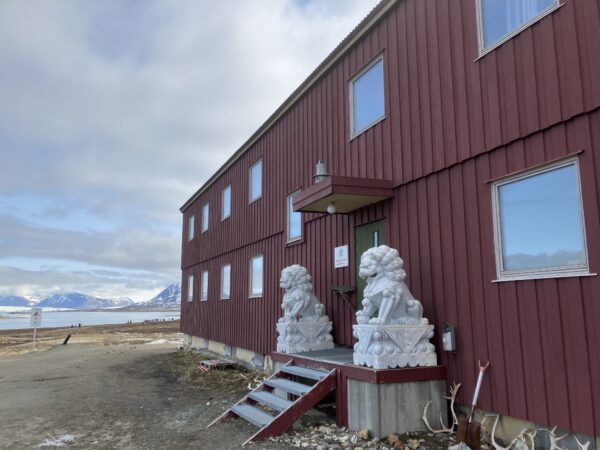
China also continues to maintain research facilities at Ny-Ålesund, Svalbard (Yellow River), and in northern Iceland (China-Iceland Arctic Research Observatory/CIAO), but both sites have undergone recent scrutiny amid concerns about dual-use research detrimental to regional security. In 2025, restrictions were placed on Chinese nationals seeking to research at Universitetssenteret på Svalbard, the only institute of higher learning on the archipelago, and a pair of iconic, Shanghai-made stone lions were recently removed from the Yellow River site in keeping with Norwegian authorities’ attempts to streamline regulations regarding the settlement’s signage, nomenclature, and decor.
An additional wildcard in China’s research agenda in Svalbard, however, is the degree to which Chinese researchers might participate in Russian plans for an alternative BRICS+ research and educational facility at Pyramiden, one of the two Russian settlements in Svalbard (the other being Barentsburg). While these facilities have yet to be opened, Chinese research organizations have expressed interest in closer cooperation with Russian counterparts in Svalbard, and in May this year a memorandum of understanding was signed in Barentsburg between representatives of Qingdao University and Russian institutions, including Murmansk Arctic University, in a move to facilitate a “permanent international scientific infrastructure” in Svalbard. Although it is unlikely that China would withdraw from the Yellow River facilities, the planned alternate Russian facilities offer a hedging option for Beijing to ensure an ongoing presence in the area.
China has also been seeking to make better use of Track II, subgovernmental organizations to both gather further regional data as well as develop platforms for enhanced science diplomacy in the far north. For example, the China-Nordic Arctic Research Center (CNARC) have provided outlets for Chinese collaboration with research centers in Northern Europe, but also an opportunity for China to advertise an Arctic agenda based on “win-win” collaboration. Recent CNARC meetings have included, in and among scientific briefings, periodic references to the “cold war mentality” plaguing U.S. Arctic policy, and the alleged Western practice of “green colonialism” affecting northern Indigenous communities.
After keeping a comparatively lower profile at the Arctic Circle Assembly (ACA) in Reykjavik for the past few years, China’s northern policies prominently featured at the Arctic Circle Rome Forum earlier this year, and are expected to do so again at the 2026 ACA conference in October.
This distinct focus on Northern Europe suggests that in addition to Chinese policymakers now drawing distinctions between the “NATO Arctic” and the “Russian Arctic,” there is now a growing acknowledgement of the “Nordic Arctic” in Beijing’s thinking. This aspect of China’s revived Arctic policy was demonstrated on the governmental level during the visits to Nordic capitals earlier this month by Chinese Foreign Minister Wang Yi. Climate change issues, environmental concerns, and the green transition were common themes during Wang’s discussions with leaders in Denmark, Finland, Norway, and Sweden. There was also a concerted effort by the Chinese delegation to rebalance relations with Stockholm, which have been icy for years over differences in human rights policies and China’s 2015 detainment of a Swedish national.
The revival last year of a misguided White House initiative to annex Greenland has also provided an opening for Beijing to, if not develop Arctic friendships with the Nordics, then at least be accepted by Northern Europe as a balancing actor in the face of Washington’s regional zero-sum policies. However, the metaphorical anchor slowing down the improvement of Chinese diplomacy with the Nordic states, including in Arctic matters, continues to be regional unease over Sino-Russian regional cooperation as well as Beijing’s neutral stance on the invasion of Ukraine.
Finally, while there is no sign that the investment aspects of the Polar Silk Road can be revived either in Western Europe or North America, Beijing is now seeking to go back to basics by touting the potential of the Northern Sea Route (NSR) as an emerging maritime conduit, now buoyed by global worries over the security of other shipping chokepoints like the Strait of Hormuz. China is joining other Asian governments in developing plans for future use of the NSR as more of the waterway becomes ice-free. In 2013, the cargo vessel Yongsheng, owned by the Chinese shipping concern COSCO, made the first successful crossing of the NSR between China and Europe. Yet since 2022, COSCO has been wary of further expanding NSR operations, mainly due to concerns about Western sanctions for providing aid to the Russian economy.
This month it was confirmed that another Chinese firm, Hong Kong-based Sea Legend Shipping, would soon commence regular NSR shipping between the Chinese port of Ningbo and Felixstowe in the United Kingdom. Eight voyages are planned between August-October 2026, and a test run of sorts was completed, with much fanfare, last autumn by one of Sea Legend’s vessels, the Istanbul Bridge, inaugurating the China-Europe Arctic Express/CAX. While it remains to be seen whether local conditions and economic demand would sustain such a schedule, the announcement itself underscores Beijing’s renewed determination to be front and center in the further opening of Arctic Ocean maritime routes.
What can be inferred from these events is that although Beijing has endured considerable setbacks in developing its Arctic strategies, there is a new focus on redefining regional goals rather than retreating from the region. Beijing’s evolving strategy reflects the reality that the far north is facing sharper geopolitical divisions; concerns about the long-term effectiveness of the Arctic Council as an effective governance mechanism, given the issue of post-2022 “institutional paralysis”; and ongoing environmental changes that create both risks and opportunities for China.
There is now a “back to the future”’ approach to Chinese regional scientific endeavors, meaning a renewed emphasis on developing research capabilities while also tying them to the idea of China as a legitimate Arctic actor, geography notwithstanding. Diplomatically, China is seeking to mend fences with some Arctic states, (the Nordics plus Canada), while keeping Russia in front as Beijing’s main regional partner despite the political costs involved.
In addressing Beijing’s “Arctic 2.0” strategy, it is essential for northern governments and the wider international community to understand how Chinese Arctic goals have changed – and which have not.
