

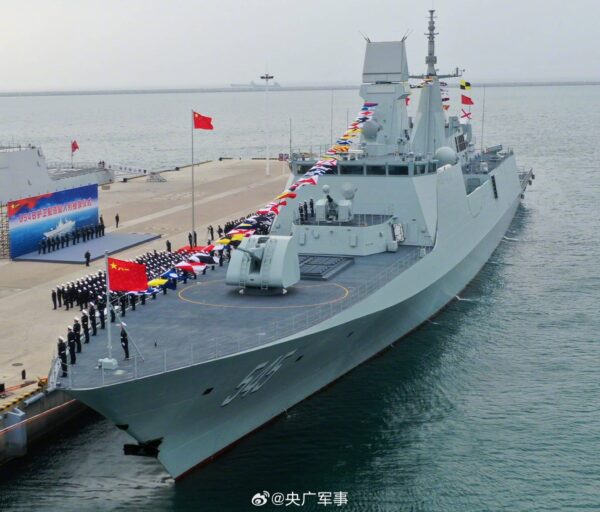
China’s newest generation frigate, the Type 054B, has for the first time been confirmed operating as part of the People’s Liberation Army Navy (PLAN) aircraft carrier Liaoning’s strike group in the Western Pacific, marking another milestone in Beijing’s accelerating blue-water naval ambitions.
Japan’s Ministry of Defense announced on May 26 that the Maritime Self-Defense Force (MSDF) had monitored the Chinese carrier Liaoning and four accompanying warships sailing about 880 kilometers southwest of Okinotorishima, the southernmost island in Japan, on May 25. The following day, Japanese forces also confirmed repeated takeoffs and landings of carrier-based fighter jets and helicopters from the Liaoning.
The deployment itself was not unusual. In recent years, the PLAN has increasingly normalized carrier operations beyond the so-called First Island Chain, stretching from Japan through Taiwan to the Philippines, as part of its broader push toward sustained blue-water operations in the Western Pacific. Chinese carriers have also begun operating beyond the Second Island Chain, although such deployments still remain rare. What drew particular attention this time, however, was the presence of the PLAN’s newest frigate class, the Type 054B, known by NATO as the Jiangkai III-class.
According to the Japanese defense ministry, the Type 054B frigate Luohe (hull number 545) was operating alongside the Liaoning, a Type 055 large destroyer, and other escort vessels. This appears to mark the first confirmed case of a Type 054B participating in a Chinese carrier strike group deployment.
This composite image, provided by the Japanese Ministry of Defense, shows the Liaoning aircraft carrier (top) and the Luohe Type 054B, frigate (bottom) during their operations in the Western Pacific, May 25-26, 2026.
The deployment comes just over a year after the Luohe entered service in January 2025, suggesting the PLAN is rapidly integrating the new platform into fleet operations and carrier strike group activities.
The Type 054B is widely regarded as the successor to the PLAN’s Type 054A frigate, which has served as one of China’s primary multirole escort warships for more than a decade. While the exact specifications of the new class remain unclear, analysts believe the Type 054B incorporates major upgrades in sensors, anti-submarine warfare capabilities, and long-range operational endurance.
Chinese military media have promoted the ship as a “new-generation frigate” featuring improved phased-array radar systems, upgraded sonar, enhanced stealth characteristics, and more advanced combat management systems. Chinese reports have also claimed that artificial intelligence-assisted battle management systems reduce air defense blind spots and improve response times during complex fleet operations.
The Type 054B is also believed capable of operating the Z-20F anti-submarine warfare helicopter, giving it improved ASW capabilities compared to earlier PLAN frigates. This is particularly important for carrier escort operations, where anti-submarine protection remains one of the most critical missions.
Another significant detail in the recent deployment was the presence of the Type 901 fast combat support ship Hulunhu. The inclusion of a large replenishment vessel indicates that the PLAN was not conducting a short-duration coastal exercise, but rather preparing for sustained blue-water operations far from mainland bases.
On May 19, Japan also confirmed for the first time that the Luohe had transited the Miyako Strait – a strategic maritime chokepoint between Okinawa and Miyako Island – into the Western Pacific. The transit represented the first known deployment of a Type 054B beyond the First Island Chain.
For Tokyo, these movements carry strategic significance. The Miyako Strait has become one of the PLAN’s primary gateways into the Pacific Ocean, and Chinese naval transits through the area have steadily increased over the past decade. But the deployment of one of China’s newest frontline surface combatants suggests the PLAN is now integrating next-generation warships into routine far-seas operations.
The latest deployment also highlights the broader transformation of China’s carrier force structure.
The PLAN currently operates three aircraft carriers. The Liaoning and the Shandong have been in service for several years, while the newest, the Fujian, which commissioned in November 2025, is still building its full operational capability. Unlike its predecessors, the Fujian is equipped with electromagnetic catapults similar to those used by the U.S. Navy’s newest aircraft carriers, potentially allowing China to launch heavier and more capable aircraft.
At the same time, China has rapidly expanded its fleet of large surface escorts, particularly the powerful Type 055 Renhai-class destroyers. The emerging combination of aircraft carriers, Type 055 destroyers, and Type 054B frigates suggests the PLAN is standardizing a layered carrier strike group structure increasingly resembling that of the U.S. Navy.
In this evolving structure, the Type 055 serves as the primary air defense and command platform, while the Type 054B appears designed to specialize in anti-submarine warfare and close escort missions.
The timing of the deployment has also attracted attention. Chinese military activity in the Western Pacific has intensified amid a series of Japan-U.S. and Philippines-U.S. military exercises around the First Island Chain and Taiwan’s surrounding waters. Taiwanese media have speculated that the Liaoning deployment may partly reflect Beijing’s effort to demonstrate counter-pressure against growing allied military coordination in the region.
More broadly, the deployment underscores how the PLAN’s modernization is no longer focused solely on increasing fleet size. China is now increasingly emphasizing integrated carrier strike group operations, sustained blue-water deployments, and multi-domain fleet coordination.
For Japan and the United States, the growing normalization of Chinese carrier operations in Japan’s surrounding waters and broader Western Pacific presents an evolving strategic challenge. As Beijing continues transitioning from a near-seas defensive force into a true blue-water navy, Chinese carrier strike groups are likely to become a far more frequent presence around Japan’s southwestern islands and across the Indo-Pacific theater.
