

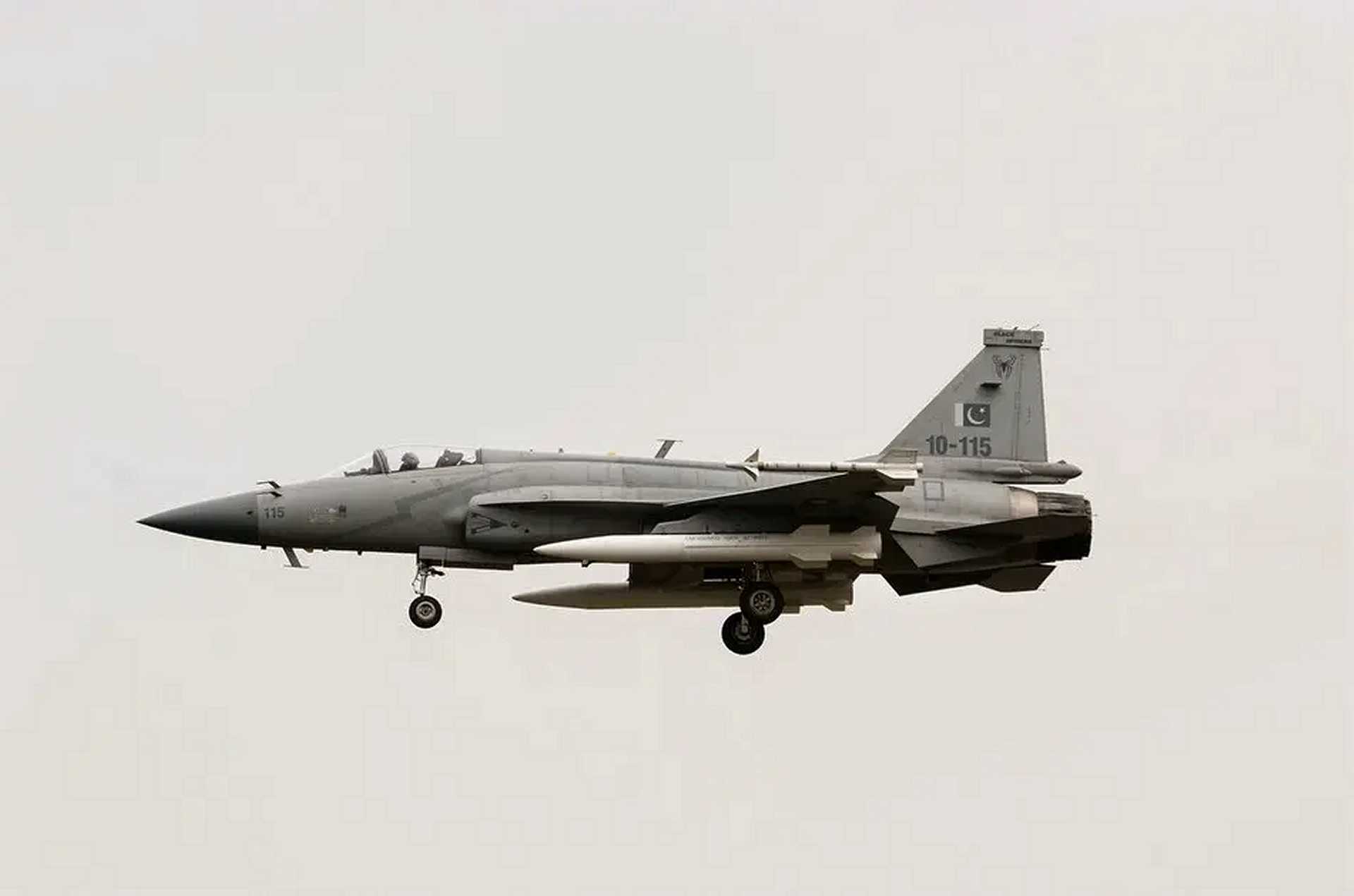
The CM-400AKG is an air-launched supersonic missile developed by the China Aerospace Science and Industry Corporation (CASIC). Derived from the SY-400 guided rocket system, the CM-400AKG is a solid-fuel, rocket-powered weapon with a quasi-ballistic flight profile – meaning it climbs to high altitude before executing a steep terminal dive at speeds of up to Mach 5. It is not a cruise missile in the conventional sense, despite being frequently mislabelled as one.
The CM-400AKG was designed as a stand-off range weapon (SOW) for the JF-17 Thunder multi-role fighter, and the Pakistan Air Force (PAF) is its primary operator. The PAF reportedly procured 60 CM-400AKG missiles from China in 2017 and 2018. Pakistan Air Force officials have described the missile as an “aircraft carrier killer” on multiple occasions, referencing its ability to engage large surface combatants at extended range with a high-speed terminal dive that compresses the defending ship’s reaction window.
The CM-400AKG reportedly saw its first combat use during the May 2025 India-Pakistan conflict, when the PAF claims to have launched the weapon against an Indian S-400 Triumf air defence system. Serbia became the missile’s second confirmed export operator in March 2026, integrating it onto MiG-29SM+ fighter aircraft.
In terms of seeker options, the CM-400AKG can be configured with either an imaging infrared/TV seeker for anti-ship and land-attack missions or a passive radar seeker for suppression of enemy air defences (SEAD) and anti-radiation missions. This dual-role flexibility distinguishes the CM-400AKG from most weapons in its class.
Specifications
| Parameter | Pre-Conflict (CASIC Marketing) | Post-Conflict (PAF Claims, 2025) |
|---|---|---|
| Designation | CM-400AKG (export) | — |
| Manufacturer | CASIC | — |
| Type | Air-launched quasi-ballistic missile (anti-ship / anti-radiation) | — |
| Derived From | SY-400 guided rocket | — |
| Length | 510 cm (5.1 m) | — |
| Diameter | 400 mm | — |
| Weight | 910 kg | — |
| Warhead | 150 kg blast fragmentation OR 200 kg penetration | — |
| Range | 100–240 km | 400 km |
| Terminal Speed | Mach 4–4.5 | Mach 5 |
| Terminal Locking Range | — | 30 km |
| Propulsion | Single-stage solid-fuel rocket motor | — |
| Flight Profile | High-altitude cruise → steep terminal dive (quasi-ballistic) | — |
| Guidance | INS + GNSS + IR/TV seeker (CEP 5–10 m) OR INS + GNSS + passive radar seeker (CEP 5 m) | Passive radar mode confirmed for SEAD |
| Launch Platforms | JF-17 Thunder, J-10CE, MiG-29 | — |
| Service Entry | 2012 (claimed); PAF procurement 2017–2018 | — |
| Operators | PAF, Serbian Air Force, PLAAF | — |
It is worth noting the significant discrepancy between CASIC’s pre-conflict marketing specifications and the PAF’s post-conflict claims. CASIC marketed the CM-400AKG with a range of 100–240 km and a terminal speed of Mach 4 to 4.5. In September 2025, PAF officials told AirForce Monthly that the missile has a range of 400 km, a terminal speed of Mach 5, and a terminal locking range of 30 km.
Whether this gap reflects a newer variant, previously undisclosed specifications, or post-conflict overstatement remains unclear. The pre-conflict figures are based on CASIC’s own marketing materials at the 2013 Dubai Airshow and the 2016 Zhuhai Airshow, as reported by Jane’s and Flight Global. The post-conflict figures come from PAF sources in a period when both sides had institutional incentives to emphasise the capabilities of their own systems.
Development History
SY-400 Guided Rocket Lineage
The CM-400AKG is a derivative of the SY-400 (Shenying-400) guided rocket system, also manufactured by CASIC. The SY-400 is a precision-guided tactical rocket – essentially a large, fin-stabilised solid-fuel projectile with GPS/INS guidance – designed for ground-launched surface-to-surface use. CASIC adapted the SY-400’s airframe and propulsion system for air-launched delivery, creating the CM-400 family.
This lineage explains the CM-400AKG’s distinctive flight profile. Unlike ramjet-powered cruise missiles such as the CM-302 or BrahMos, which sustain level supersonic cruise throughout their flight, the CM-400AKG is propelled by a single burn of its solid-fuel rocket motor. It climbs to high altitude, coasts, and then dives steeply toward its target – accumulating kinetic energy in the descent. This is a fundamentally different weapon class from a supersonic cruise missile, and the distinction has real implications for how defenders must respond.
Zhuhai 2012 and JF-17 Integration
CASIC unveiled the CM-400AKG at the 2012 China International Aviation and Aerospace Exhibition (Zhuhai Airshow), presenting it as part of the JF-17 Thunder’s “complete” weapons package. At the time, it was claimed that the missile had already entered service with the PAF.
However, in 2014, Jane’s published images of a PAF JF-17 carrying two – possibly mock-up – CM-400AKGs, suggesting that integration testing was still underway. The weapon’s actual operational entry into PAF service appears to have occurred sometime after the 2017–2018 procurement, when the Pakistan Ministry of Defence Production (MoDP) confirmed the purchase of 60 CM-400AKG units.
Dubai 2013 — AVIC Details Performance
At the 2013 Dubai Airshow, AVIC (the broader Chinese aviation conglomerate) played a looped video inside its exhibition stand that, for the first time, detailed the CM-400AKG’s performance claims. According to Flight Global’s reporting from the event, the video listed a range of 100–240 km, a 150 kg blast warhead or 200 kg penetration warhead, a diameter of 400 mm, and a weight of 910 kg. The video also revealed claims for the accuracy of each seeker option: 50 m CEP for INS/GNSS alone, and 5–10 m CEP with the terminal seeker active.
Interestingly, the AVIC video noted that the CM-400AKG uses “high launching” to achieve “higher aircraft survivability” – a reference to the weapon’s high-altitude release point, which allows the launching aircraft to remain above the engagement envelope of most ship-borne point-defence systems.
At the 2013 Paris Air Show, officials from Argentina’s Fábrica Argentina de Aviones (FAdeA) revealed that the CM-400AKG’s performance was a major reason for their interest in co-producing the JF-17.
Post-Conflict Specification Updates
Following the May 2025 conflict, PAF officials disclosed significantly upgraded performance figures. The most detailed public account appeared in AirForce Monthly’s November 2025 issue, authored by veteran defence journalist Alan Warnes. The PAF claimed a range of 400 km, a terminal speed of Mach 5, a terminal locking range of 30 km, and a confirmed passive radar mode for SEAD missions.
These figures – particularly the 400 km range – substantially exceed the pre-conflict CASIC marketing specifications. One can speculate that the PAF may have received a newer or upgraded variant, that CASIC’s marketing materials deliberately understated the missile’s capabilities (a common practice in Chinese arms exports), or that the PAF’s claims reflect wartime rhetoric rather than verified performance. The matter remains unresolved as of May 2026.
Flight Profile and Classification
The CM-400AKG is frequently described in media reports as a “supersonic cruise missile” or “hypersonic missile.” Neither label is technically precise. The weapon is powered by a solid-fuel rocket, not an air-breathing engine. It follows a quasi-ballistic trajectory, not a sustained-altitude cruise. And whether it qualifies as “hypersonic” depends on how strictly one defines the term – its terminal speed of Mach 4.5 to 5 approaches but does not necessarily exceed the conventional Mach 5 hypersonic threshold throughout its flight envelope.
The correct classification is an air-launched quasi-ballistic missile with a solid-fuel rocket motor. After release from the aircraft at high altitude, the rocket motor fires and propels the weapon upward. The missile then coasts on a ballistic-like arc before diving steeply toward its target in the terminal phase, reaching its highest speed during the descent.
This flight profile is fundamentally different from that of a sea-skimming supersonic cruise missile such as the CM-302 or BrahMos, which approaches at extremely low altitude to minimise radar detection. The CM-400AKG approaches from above, at high speed, on a steep angle.
The implications for a defending air defence system are significant. A sea-skimming cruise missile requires engagement by surface-to-air missiles with low-altitude tracking capability and close-in weapon systems (CIWS) optimised for horizontal engagements. A steep-diving quasi-ballistic weapon requires engagement by systems capable of tracking high-angle, high-speed targets – a problem more akin to terminal ballistic missile defence. The defending radar has less time to track and engage a target that appears over the horizon at a steep angle and high velocity.
In this vein, the CM-400AKG and the CM-302 can be seen as complementary within Pakistan’s arsenal. The CM-302 – ship-launched, sea-skimming, Mach 3 cruise – attacks from the horizontal plane. The CM-400AKG – air-launched, steep-diving, Mach 5 terminal – attacks from above. A defending fleet facing both simultaneously would need to address two entirely different intercept geometries.
Operators
Pakistan Air Force
The Pakistan Air Force (PAF) is the CM-400AKG’s primary and longest-standing operator. The PAF procured 60 CM-400AKG units in 2017 and 2018, as confirmed by the Pakistan Ministry of Defence Production (MoDP) yearbook.
The CM-400AKG’s primary launch platform is the JF-17 Thunder, the lightweight multi-role fighter co-produced by Pakistan Aeronautical Complex (PAC) and China’s AVIC subsidiary Chengdu Aircraft Industry Group (CAIG). The JF-17 can carry two CM-400AKGs on underwing pylons. In January 2024, video footage confirmed that the Chengdu J-10CE – the PAF’s newer medium-weight fighter – can also carry the CM-400AKG, broadening the weapon’s platform base within the PAF.
The CM-400AKG gives the PAF a stand-off range strike capability that substantially exceeds what was previously available from the JF-17’s weapons suite. Before the CM-400AKG, the JF-17’s primary anti-ship option was the C-802A – a subsonic (Mach 0.9), turbojet-powered cruise missile with a range of 180 km. The CM-400AKG offers higher speed (Mach 4–5 terminal versus Mach 0.9), comparable or greater range (100–400 km depending on the figures one accepts), and a steep-dive attack geometry that presents a far more difficult intercept problem.
The PAF also has the GIDS Range Extension Kit (REK) and Taimoor air-launched cruise missile (ALCM) in its SOW arsenal. However, the CM-400AKG occupies a distinct niche as the PAF’s highest-speed air-launched anti-ship and anti-radiation weapon.
Given that the PAF procured 60 units in 2017–2018 and reportedly expended a significant number during the May 2025 conflict, one can expect a follow-on order. The weapon’s reported performance during the conflict – regardless of the contested kill claims – would likely reinforce the PAF’s confidence in the system and drive further procurement from CASIC.
Serbia
In March 2026, images published by defence analyst Danube Intel showed a Serbian Air Force MiG-29SM+ carrying two CM-400AKG missiles, marking Serbia as the first European country to operate the weapon. Serbian President Aleksandar Vučić subsequently confirmed the acquisition on national television, stating: “We have a significant number of those missiles, and we will have even more.”
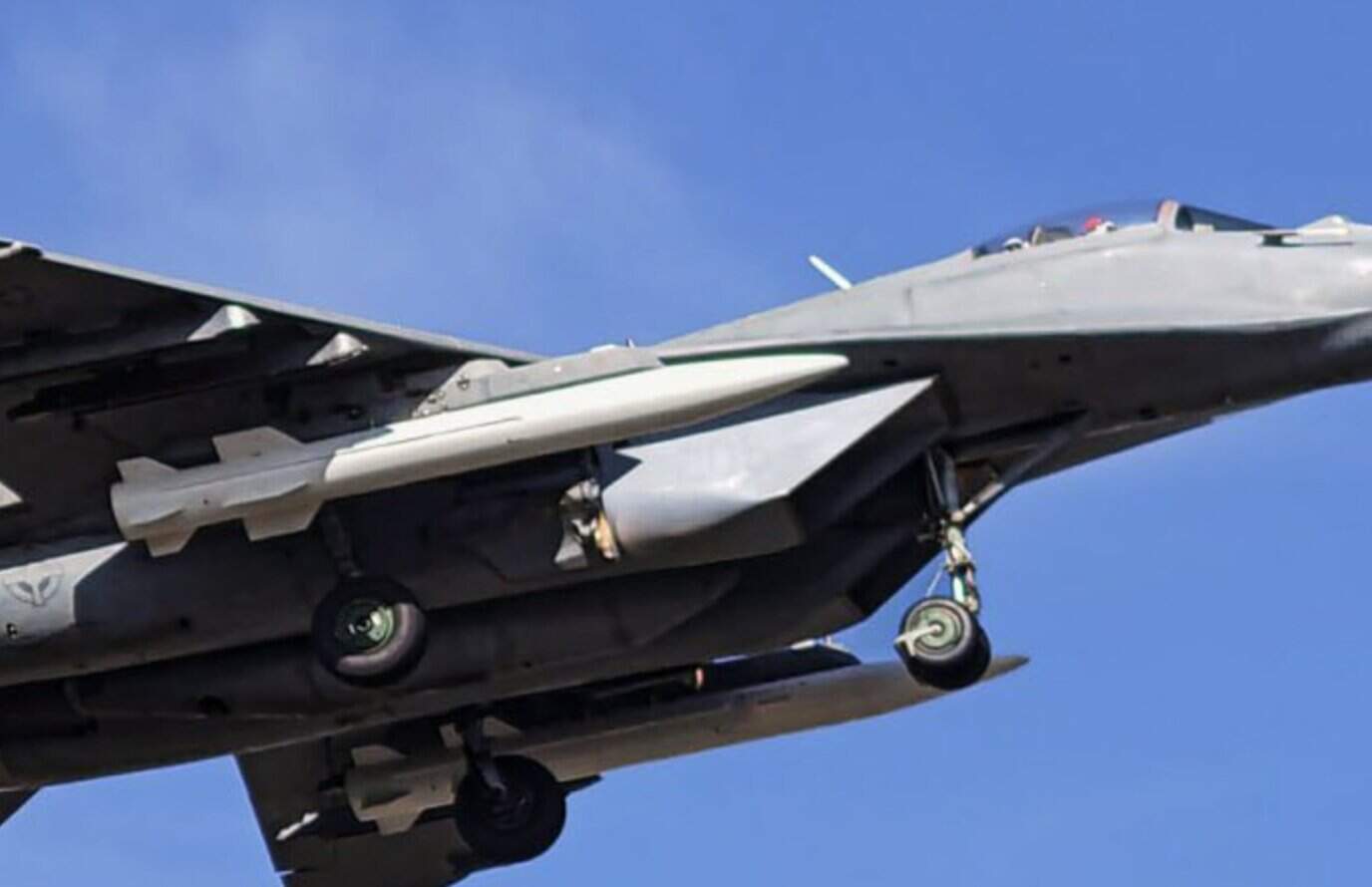
The integration was enabled by universal pylons supplied by the China National Aero-Technology Import & Export Corporation (CATIC), which allow Chinese-manufactured weapons to be mounted on Russian-designed aircraft. Serbia operates approximately 14 MiG-29 fighters, which have been moderately upgraded to the MiG-29SM+ configuration. Alongside the CM-400AKG, Serbian MiG-29s have reportedly also been fitted with Chinese LS-6 precision-guided glide bomb kits and Soviet-Russian Kh-31 anti-radiation missiles.
According to The Diplomat, the CM-400AKG acquisition fits a broader pattern of Chinese defence sales to Serbia. In recent years, Belgrade has also acquired the FK-3 medium-range SAM, HQ-17AE short-range SAM, and CH-92A armed drones from China. The 2023 Sino-Serbian free-trade agreement has further facilitated these purchases by reducing tariffs on Chinese defence products.
For CASIC, the Serbian sale demonstrates that the CM-400AKG can be integrated onto platforms beyond the JF-17 – including Soviet-designed airframes – which potentially opens a wider export market among MiG-29 and Su-30 operators globally.
China (PLAAF)
The People’s Liberation Army Air Force (PLAAF) is listed as a CM-400AKG operator, though limited public information is available regarding the PLAAF’s specific employment of the weapon. The CM-400AKG was originally developed as an export system, and the PLAAF’s own strike aircraft fleet has access to a broader range of air-launched weapons – including the YJ-12 air-launched supersonic ASCM and the KD-21 (air-launched YJ-21 hypersonic ASBM) – that exceed the CM-400AKG’s capabilities.
CM-400AKG in the May 2025 India-Pakistan Conflict
The May 2025 India-Pakistan conflict marked the CM-400AKG’s reported first combat use. The engagement that has drawn the most attention involves Pakistan’s claimed use of the CM-400AKG against an Indian S-400 Triumf air defence system at Adampur Air Force Base.
According to Pakistani accounts – amplified by Chinese state media and reported by Army Recognition – a JF-17 Thunder launched a CM-400AKG configured with a passive radar seeker to home on the S-400’s engagement radar emissions. The PAF claims the strike was successful, with footage released showing a JF-17 taking off with two CM-400AKGs underwing.
The Indian account differs substantially. According to Indian sources – including Vishnu Som’s book The Sky Warriors: Operation Sindoor Unveiled – the Indian Air Force (IAF) claims that approximately 60 CM-400AKG missiles were launched toward the S-400 complex at Adampur over the course of four days, flying at speeds between Mach 3.3 and Mach 5, but that none hit the S-400 battery. The S-400, supplemented by Barak-8 MRSAM and Akash systems, reportedly intercepted or deflected all inbound missiles.
Neither claim has been independently verified as of May 2026. The truth likely lies between the two narratives, as is typically the case in contested combat claims between adversaries.
What is analytically significant – regardless of whether the strike succeeded – is the doctrinal employment. The PAF reportedly used the CM-400AKG in an anti-radiation/SEAD role, targeting the S-400’s radar rather than a naval vessel. This represents a departure from the weapon’s original anti-ship marketing and suggests the PAF has developed tactics that exploit the CM-400AKG’s passive radar seeker to engage high-value air defence targets. The steep-dive profile at Mach 5 compresses the defending radar operator’s “shutdown-or-die” decision to mere seconds.
However, it is too early to draw definitive conclusions about the CM-400AKG’s combat effectiveness from this single contested engagement. Both sides have institutional incentives to overstate their own performance and understate their adversary’s.
CM-400AKG vs CM-302
| Parameter | CM-400AKG | CM-302 |
|---|---|---|
| Launch Platform | Air-launched (JF-17, J-10CE, MiG-29) | Ship-launched, ground TEL |
| Propulsion | Solid-fuel rocket | Ramjet (air-breathing) |
| Flight Profile | High-altitude → steep terminal dive | Sea-skimming cruise |
| Speed | Mach 4–5 terminal | Mach 2.5–3 cruise |
| Range | 100–400 km (disputed) | ~280 km |
| Warhead | 150–200 kg | ~250 kg |
| Guidance | INS + GNSS + IR/TV or passive radar seeker | INS + BeiDou + active radar seeker |
| Primary Role | Anti-ship, anti-radiation/SEAD | Anti-ship, land attack |
| Operator (Pakistan) | PAF (air-launched) | Pakistan Navy (ship-launched) |
| Attack Geometry | Near-vertical dive | Horizontal sea-skimming |
The two weapons create different problems for a defending fleet. The CM-302 approaches at sea-skimming altitude, exploiting the radar horizon to minimise detection time – the defender has approximately 45 seconds from detection to impact. The CM-400AKG approaches from above at steep angles, exploiting high speed to compress engagement time – the defender must track and engage a high-angle, high-velocity target, which requires different radar modes and missile guidance profiles than horizontal intercepts.
In this vein, the Pakistan Navy’s Tughril-class frigates launching CM-302s alongside PAF JF-17s delivering CM-400AKGs would present a dual-axis anti-ship threat – simultaneous sea-skimming and steep-dive attacks from different bearings. Combined with the emerging SMASH anti-ship ballistic missile (which adds a third axis – a true ballistic trajectory at hypersonic speed), Pakistan is assembling a multi-vector anti-ship architecture that mirrors the PLA’s own layered approach.
CM-400AKG vs BrahMos
The CM-400AKG is frequently compared to the Indo-Russian BrahMos supersonic cruise missile. The comparison is understandable – both are supersonic weapons marketed for anti-ship warfare, and they are deployed by rival air forces across the Indo-Pak divide – but the two systems are quite different in design and employment.
| Parameter | CM-400AKG | BrahMos |
|---|---|---|
| Origin | China (CASIC) | India-Russia (BrahMos Aerospace) |
| Propulsion | Solid-fuel rocket | Ramjet (air-breathing) |
| Flight Profile | Quasi-ballistic (high arc → steep dive) | Cruise (Hi-Lo or Lo-Lo) |
| Terminal Speed | Mach 4–5 | Mach 2.8 |
| Range | 100–400 km (figures vary) | 290 km; BrahMos-ER ~450 km |
| Warhead | 150–200 kg | 200–300 kg |
| Weight | 910 kg | 2,500 kg (air-launched variant lighter) |
| Launch Platforms | JF-17, J-10CE, MiG-29 | Su-30MKI, ships, ground TEL, submarine |
| Operators | PAF, Serbia, PLAAF | Indian Armed Forces, Philippines |
| Combat Use | May 2025 (claimed, contested) | No confirmed anti-ship combat use |
| Approximate Unit Cost | Not disclosed | ~$2.73M (Philippines deal) |
The most important distinction is the flight profile. BrahMos is a ramjet-powered cruise missile that sustains supersonic flight at relatively constant altitude before diving in the terminal phase. The CM-400AKG is a rocket that burns its motor, climbs, coasts, and then dives at very high speed. BrahMos relies on sustained low-altitude flight to avoid radar detection. The CM-400AKG relies on sheer speed and steep angle of attack to overwhelm defences.
The BrahMos has a substantially longer operational record (in service since 2006), broader platform integration (ship, air, ground, submarine), and a heavier warhead. India’s MTCR accession has also enabled BrahMos-ER with an extended range of approximately 450 km.
The CM-400AKG’s advantages lie in its lighter weight (910 kg vs 2,500 kg, allowing carriage by lightweight fighters like the JF-17), higher terminal speed (Mach 5 vs Mach 2.8), and dual-role capability (anti-ship and anti-radiation/SEAD with the passive radar seeker). The SEAD capability in particular has no BrahMos equivalent – India uses separate anti-radiation missiles for that role.
Outlook
The CM-400AKG’s operator base is expanding. From a single confirmed export customer (Pakistan) as recently as 2024, the weapon now has a second operator in Serbia and has been the subject of widespread media attention following the May 2025 conflict. Other MiG-29 and JF-17 operators may evaluate the CM-400AKG, particularly countries that cannot access BrahMos or Western equivalents.
For the PAF, the May 2025 conflict – and the post-conflict specification disclosures – will likely drive additional procurement. If the PAF did expend a significant portion of its 60-unit inventory during the conflict, restocking would be an immediate priority. One can also expect CASIC to offer an improved variant incorporating lessons from the conflict, potentially with enhanced electronic counter-countermeasures (ECCM) and refined seeker performance based on data collected against the S-400.
The anti-radiation/SEAD role is perhaps the CM-400AKG’s most significant growth area. If the weapon can credibly threaten advanced SAM systems via its passive radar seeker – and the PAF’s SEAD employment during the conflict suggests the concept is at least being pursued – then the CM-400AKG becomes relevant to any air force seeking a high-speed SEAD solution. This is a market segment currently dominated by subsonic Western anti-radiation missiles such as the AGM-88 HARM and AARGM.
More broadly, the CM-400AKG is part of China’s expanding defence export footprint in the missile market. Alongside the CM-302 (supersonic ship-launched ASCM), CM-401 (hypersonic ASBM), and the Fatah-series guided rockets (which Pakistan co-produces), Chinese missile systems are entering markets and filling capability gaps that Western and Russian suppliers have either vacated or priced out of reach.
For Quwa’s coverage, the CM-400AKG’s trajectory connects several editorial threads: the PAF’s evolving strike doctrine, the May 2025 conflict’s lessons for air defence and SEAD, the comparative performance of Chinese versus Russian and Western weapon systems, and the expansion of China’s defence industrial presence into Europe via Serbia.
Frequently Asked Questions
What is the CM-400AKG?
The CM-400AKG is a Chinese air-launched supersonic missile manufactured by CASIC. Derived from the SY-400 guided rocket, it is a solid-fuel, quasi-ballistic weapon that dives steeply toward its target at speeds of Mach 4 to 5. It can be configured for anti-ship or anti-radiation (SEAD) missions.
What is the range of the CM-400AKG?
CASIC’s pre-conflict marketing materials listed a range of 100–240 km. Following the May 2025 India-Pakistan conflict, PAF officials claimed a range of 400 km. The discrepancy remains unresolved. The pre-conflict figures are sourced from CASIC exhibition data; the post-conflict figures come from PAF statements reported by AirForce Monthly.
How fast is the CM-400AKG?
The CM-400AKG reaches terminal speeds of Mach 4 to 5 during its steep dive phase. Some sources cite speeds up to Mach 5.5. The missile accelerates during its descent, meaning its highest speed occurs in the final moments before impact.
Is the CM-400AKG a cruise missile?
No. The CM-400AKG is a solid-fuel rocket with a quasi-ballistic trajectory. It climbs to high altitude and dives steeply, unlike cruise missiles such as the CM-302 or BrahMos, which sustain powered flight at relatively constant altitude. The distinction matters for air defence: intercepting a steep-diving weapon requires different tactics than intercepting a sea-skimming cruise missile.
Was the CM-400AKG used in combat?
The CM-400AKG reportedly saw its first combat use during the May 2025 India-Pakistan conflict. Pakistan claims a JF-17-launched CM-400AKG struck an Indian S-400 air defence radar at Adampur. India claims all missiles were intercepted. Neither claim has been independently verified.
Which countries operate the CM-400AKG?
The Pakistan Air Force is the primary operator (60 units procured in 2017–2018). Serbia’s Air Force became the second confirmed export operator in March 2026, integrating CM-400AKGs onto MiG-29SM+ fighters. The PLAAF is also listed as an operator.
How does the CM-400AKG compare to BrahMos?
Both are supersonic weapons used for anti-ship warfare, but they differ fundamentally. The CM-400AKG is lighter (910 kg vs 2,500 kg), faster at terminal phase (Mach 5 vs Mach 2.8), and follows a steep-dive trajectory rather than a cruise profile. BrahMos has a longer operational record, broader platform integration, and a heavier warhead. The CM-400AKG has a dual SEAD capability via passive radar seeker that BrahMos lacks.
Can the JF-17 carry the CM-400AKG?
Yes. The JF-17 Thunder is the CM-400AKG’s primary launch platform and can carry two missiles on underwing pylons. The Chengdu J-10CE and the Serbian MiG-29SM+ are also confirmed carriers.
