

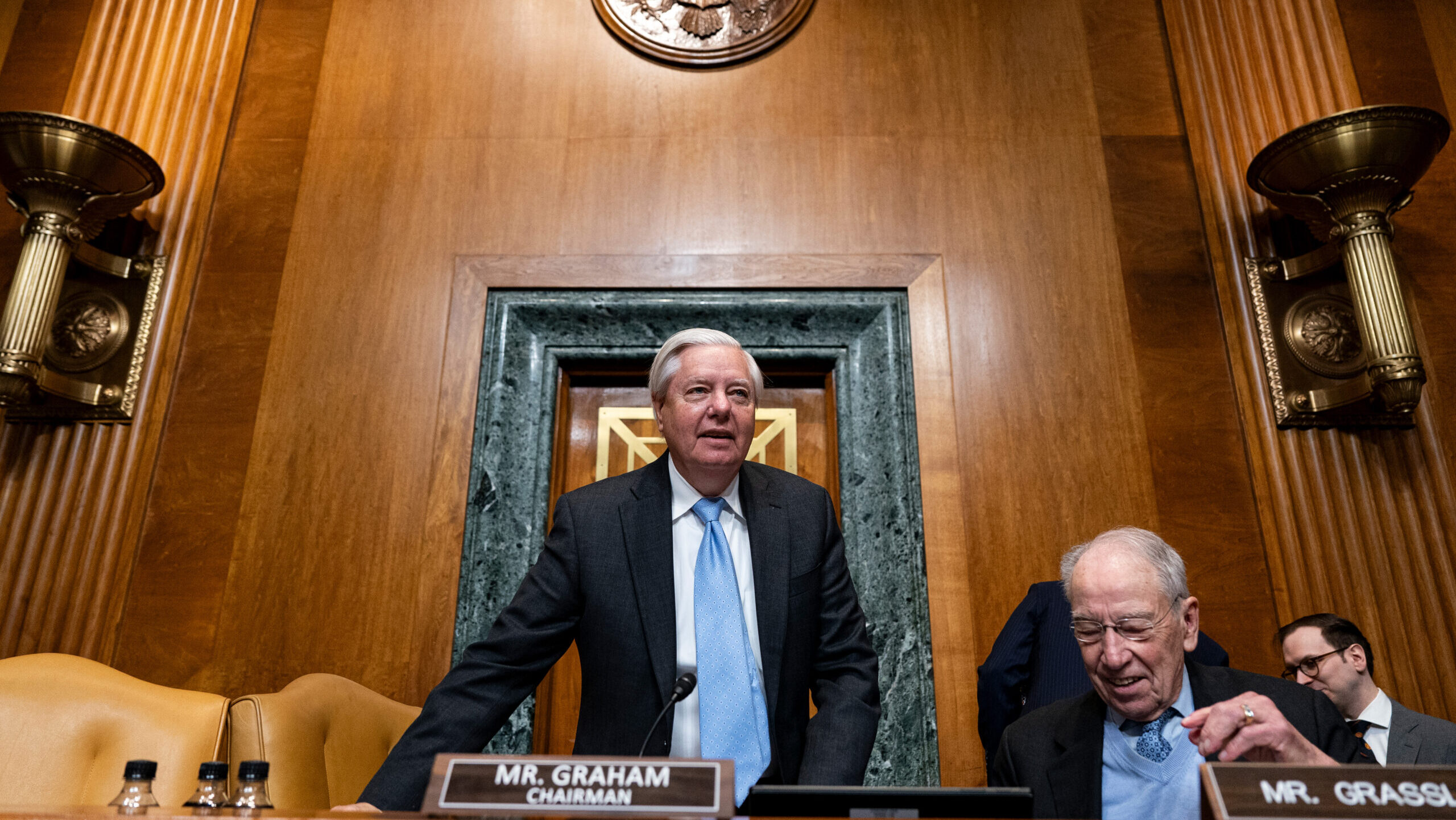
WASHINGTON — Senate Budget Committee chairman Lindsey Graham wants to keep the year’s first GOP-led reconciliation bill focused on funds for immigration enforcement and not defense, he said today — while leaving open the possibility of a second, defense-focused reconciliation bill in the future.
During a hearing on the fiscal 2027 budget, Graham opened by saying that the Senate would move on a reconciliation bill narrowly-tailored on funding Immigration and Customs Enforcement and Customs and Border Patrol for the rest of President Donald Trump’s term.
Instead, he seemed to point to a forthcoming supplemental funding request — which will include money for equipment expended during US-Israeli operations against Iran — as a venue to pay for some defense funding requirements laid out in the White House’s $350 billion reconciliation request for defense.
“Defense hawks want defense money in the reconciliation bill. I’m trying to keep it as small and focused as possible,” said Graham, R-S.C., said to Office of Management and Budget director Russ Vought. “I have hope that the supplemental will get passed — whenever you send one over — with what you need for the military, that we can work in a bipartisan fashion, pass that supplemental. We’ll have some things in it that my Democratic colleagues want, as well as military funding.”
“If that fails, I will urge the president to do another reconciliation bill for defense,” he said, adding that in that case, “the appropriations process would have failed, and we can’t accept failure when it comes to funding the Border Patrol, ICE or additional money for the military.”
Graham plays a crucial role in any reconciliation process, as the congressional budget committees write the overarching legislation that determines where, and how much, funding will be obligated. In last year’s reconciliation process, the House and Senate armed services committee crafted the defense-specific funding lines for the reconciliation deal after a budget blueprint with $150 billion for the Pentagon was passed.
While Graham expressed enthusiasm for the hike in defense funding, the funding strategy he laid out appears to differ from the White House’s FY27 request, which proposes $1.15 trillion in the base discretionary budget and $350 billion in reconciliation.
Office of Management and Budget director Russell Vought, who testified at the hearing, said later in the hearing that “we’re going to need more than one reconciliation bill.”
Compared to the House Budget Committee’s hearing on the FY27 budget on Wednesday, senators were much more outspoken about the Pentagon’s spending plan. GOP lawmakers frequently asked questions of Vought that allowed him to highlight the current threat environment and investments in weapons, while Democrats slammed the administration’s cuts to nondefense funding.
Asked by Washington state Sen. Patty Murray, the top Democrat on the Appropriations Committee, about reports that Vought — a notorious budget hawk — had opposed the proposed hike in defense spending, the OMB director said he “fully” supports the budget request.
“I’ve never been more confident that the administration is doing whatever it can to be efficient at the Department of War, but there are bills that need to be paid with regard to drones and munitions and planes,” he said, noting that the it is a “one-time” increase.
Vought declined to give cost estimates for the war in Iran, stating that the figure changes on a daily basis. He also said the administration is “reviewing” the supplemental funding bill but did not give a timeline for when it would be sent to Capitol Hill.
