

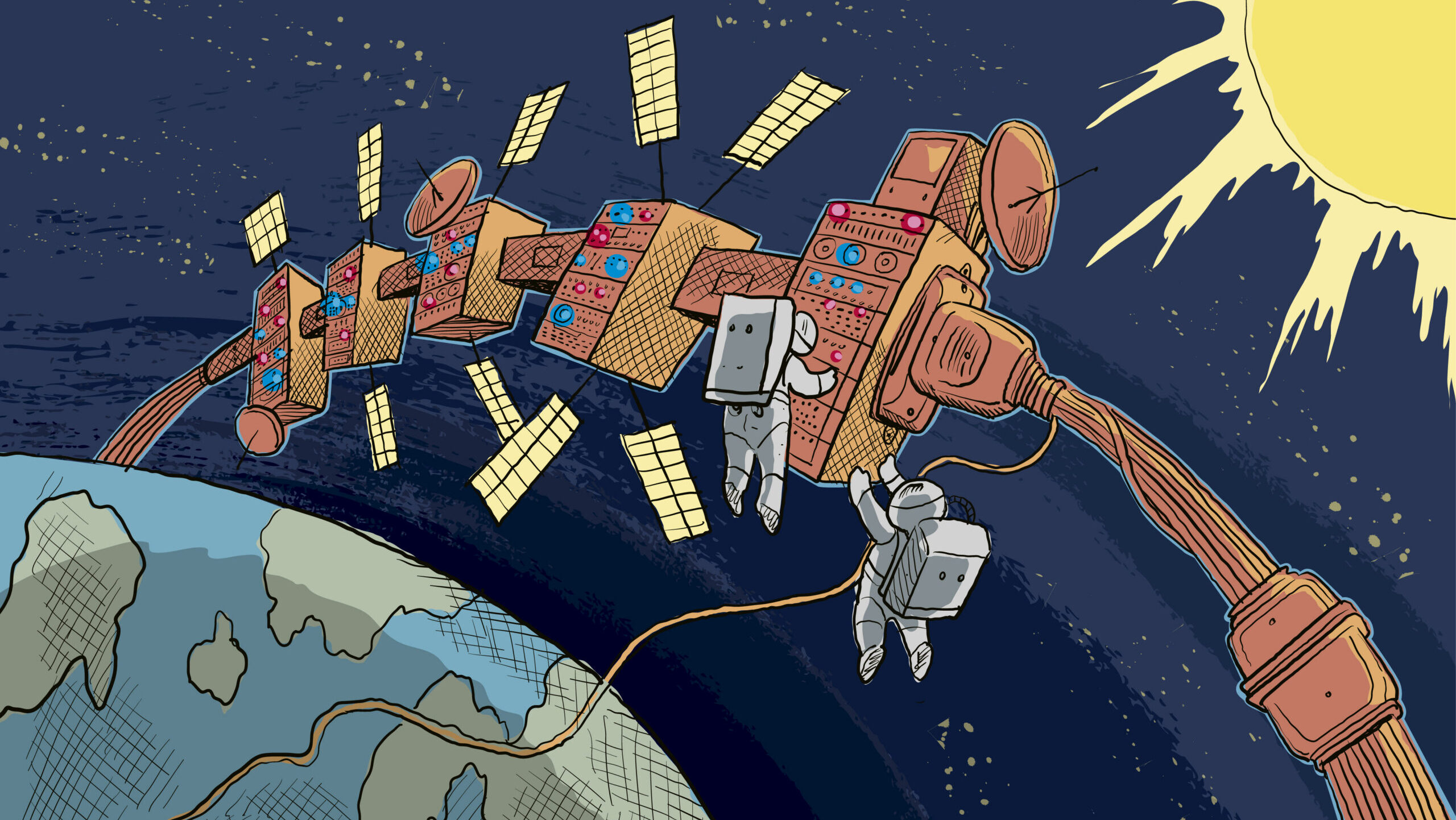
WASHINGTON ― Citing the skyrocketing demand for artificial intelligence tools to synthesize data and speed decision-making, including in the national security market, industry officials and investors are increasingly hyping orbital data centers (ODCs) as the new “It” tech in the space world.
Essentially servers in space, with large constellations of satellites carrying large numbers of high-capacity GPUs to replicate the warehouse-sized data centers popping up here on Earth, it’s easy to see why the tech community would be intrigued by the concept. And given the Pentagon’s current appetite for all things AI, it’s also easy to see why so many companies are pitching ODCs as relevant to the defense space.
Despite the big push in the tech world, there is little solid interest in ODCs being expressed by Pentagon or Intelligence Community (IC) officials, according to a dozen government and industry officials interviewed by Breaking Defense.
One industry official in the thick of the ODC boom told Breaking Defense the only government agency that has expressed any real support and actual funding is NASA as part of its game plan for future lunar operations. Instead, multiple sources said, potential national security customers are waiting to see if the commercial industry can actually demonstrate the technical capability and, just as importantly, the business case for ODCs.
Brett Scott, head of NRO’s Geospatial Intelligence Systems Acquisition directorate, told Breaking Defense on May 5 during the annual GEOINT Symposium in Denver that at the moment it is still “very early days” for understanding the viability of ODCs.
A senior Space Force officer likewise said that while the ODC concept is “intriguing,” the enabling tech is still “embryonic.” Thus, the officer said, the service is simply watching to see what happens in the commercial world.
Or, as one expert summed up the defense market viewpoint on the commercial ODC push: “If they build it, we might come.”
A ‘Feeding Frenzy’ For Investors
According to proponents, ODCs can provide the massive compute capability needed for AI processing at lower cost, and with none of the negative impacts on Earth, which include guzzling electricity, which spikes energy prices and sucking up fresh water supplies for cooling systems.
The anecdotal energy around ODCs is undeniable, and a review of investment announcements, compiled by Quilty Space for Breaking Defense, underlines that venture capital firms are placing their early bets.
Counting both companies focused solely on ODC development and those partially invested, Quilty calculated that in all of 2025, $197 million was invested in the technology. But between Jan. 1 and April. 1 of 2026, Quilty calculated investments of $541 million. And while most of that came from Starcloud’s $170 million Series A fundraising round in March, if extrapolated over a full year, that would represent an almost thousand-percent increase in investment.
“However you slice it, there’s a clear uptick in ODC financing, as investors get excited about this emerging application,” said Caleb Henry, director of research at Quilty, who added that there are major investments from “established companies SpaceX, Planet Labs and Blue Origin” which are hard to calculate and would likely increase that total.
Those investments may keep growing: According to a 2025 report by BIS Research, the ODC market is projected to hit nearly $1.8 billion in 2029, and reach $39 billion by 2035. The biggest players are tech giants SpaceX, Google and Meta, which are aiming to launch thousands, or a million in the case of SpaceX, ODC satellites.
“We’re at the height of the hype cycle,” said Dave Gauthier, former head of commercial operations at the National Geospatial-Intelligence Agency (NGA) and now chief strategy officer at consultancy firm GXO, Inc.
Kevin Hell, CEO of mPower Technology, which is building light-weight solar power cells and has financial support from Lockheed Martin Ventures, agreed.
“This all of a sudden became a feeding frenzy,” he said. “It literally went from something where it was, ‘yeah, interesting’ to ‘everybody’s got to have it’ within a period of a few months … just from December through here to May,” he said. “And now everybody in Silicon Valley essentially has an orbital data center plan.”
Major Challenges: Immature Tech, High Costs
Given what the top DoD AI official, Cameron Stanley, called an “insatiable appetite” for AI tools for everything from scanning sensor data to find targets to speeding decision-making in the field, it’s understandable that the tech sector would expect interest from the military.
In particular, the Space Force, the National Reconnaissance Office (NRO) and NGA are facing a glut of space-based intelligence, surveillance and reconnaissance imagery (ISR) and data that already is overwhelming analysts.
All three are setting their sights on AI-driven analytics and edge compute on-board satellites to help solve that problem ― a problem that will only grow if the Trump administration’s ambitious Golden Dome missile defense shield, which will require fusing ISR sensor data and transmitting precise targeting information interceptors in near-real time, comes to fruition.
And, according to Lori Gordon, systems director of the Aerospace Corporation’s Space Enterprise Evolution Directorate, there would be a real time benefit to having the data centers to process information as close to the space-based gatherers as possible.
“From missile warning and custody to maritime domain awareness, space-based missions are data-rich and time-constrained to deliver information at the speed of need,” she wrote in an article for SpaceCom’s Second Stage website. Processing from multiple sources “can be conducted in less time when processing can take place near the point of collection in space.”
So, why aren’t defense and IC officials openly hopping on the train? According to the sources who talked with Breaking Defense, there is skepticism that ODCs have, to this point, overcome a raft of technical challenges. Among those identified by different sources:
Cooling. Space is cold, but heat does not radiate in a vacuum. Satellites of all kinds need thermal management systems to dissipate heat generated by on-board operations. AI chips, in particular, generate enormous amounts of power and thus heat that in turn requires expensive, heavy and complicated thermal management systems to overcome.
Power Supply. Running large numbers of AI computer chips requires huge amounts of electricity whether on Earth or in space. Solar energy is free, much more efficient in space than on the ground, and solar panels to create power for satellites are an existing technology. However, experts say ODCs will require gargantuan solar arrays, spanning up to 16 square kilometers (about six miles), that would present a daunting on-orbit assembly challenge. And once deployed, their large size would mean that they would need to be somehow structured to prevent damage from oscillation, not to mention protected from orbital debris strikes.
Radiation Hardening. Radiation in space is a known problem, and many national security satellites for years have relied on radiation hardened microchips. But, those chips are difficult and costly to make, there is a very limited supply chain, and those available today do not supply nearly as much computing power as the more modern chips being used for AI operations.
Launch Costs. While launch costs have come down over the past decade, it is still not cheap to get mass to orbit. Data centers on orbit would require thousands and thousands of satellites. Google has estimated that to make developing ODCs about equal in costs to putting AI data centers on Earth, launch costs would need to drop to about $200 per kilogram ― something that could only be made possible by the advent of very large launch vehicles such as SpaceX’s Starship or Blue Origin’s New Glenn Block 2, neither of which are yet operational.
That price tag is a long way from current rates, with the cost of a lift on SpaceX’s Falcon 9 hovering somewhere between $4,200 and $7,000 per kilogram.
Costs of ODCs vs. Terrestrial Data Centers. A number of market analysts have warned that there simply isn’t a good business case yet for data centers in space, versus building them on the ground.
“Today, it’s something on the order of five times more expensive for an orbital data center versus a terrestrial data center over the term of 20 years,” Michael Pierce, a principal analyst at Technology Strategy Partners, told an April 30 webinar sponsored by Space News.
“I think what’s often missed from this conversation is that terrestrial data centers are infrastructure. These buildings last a long time. The power systems last a long time. Cooling systems last a long time,” he said.
By contrast, satellites in low Earth orbit, where ODCs would have to be stationed to ensure low enough latency (lag times in data transfer) to be viable, have only a five-year average lifetime, requiring routine replenishment, Pierce explained.
But even if these hurdles can be leapt, several industry and government sources said the mega-constellation ODCs currently being planned for commercial uses may simply be overkill for the needs of national security users.
These sources explained that while DoD and the IC already are investing in edge compute tech to improve and expand data processing on satellites for ISR, communications and missile defense missions ― and might even be willing to buy into data processing satellites to serve a bit like of mini-ODCs for these specific missions ― such operations are much less power-consuming than the ODCs Silicon Valley investors envision.
In other words, one expert said, there are “orders of magnitude” between what the national security wants, at least in the near-to-medium term, and what the commercial industry is so avidly trying to sell today.
