

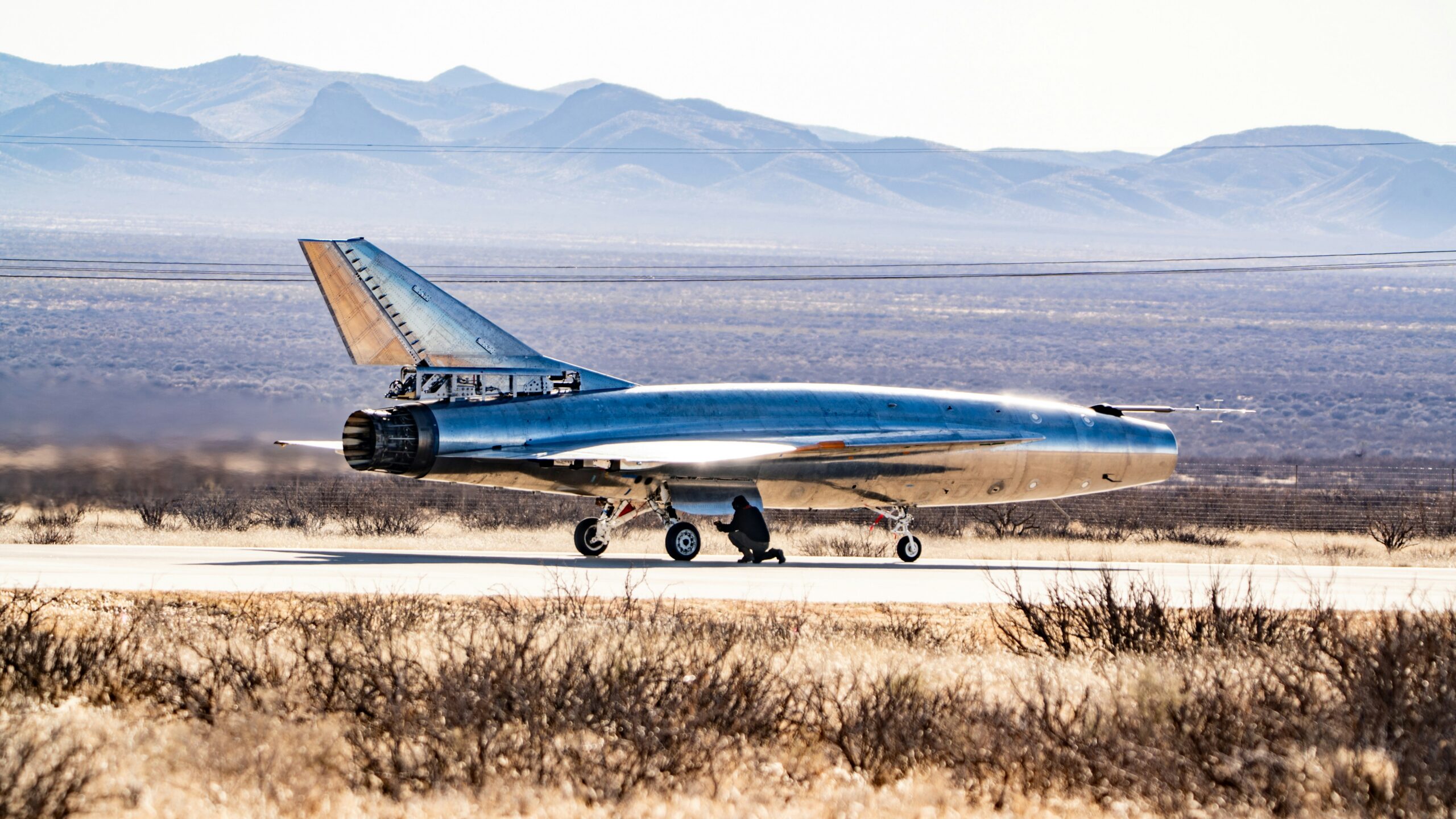
WASHINGTON — The Defense Innovation Unit awarded aircraft startup Hermeus an additional $159 million, which the company revealed today will fund work for its Quarterhorse drone to carry and release payloads at high speeds.
The award, which raises the ceiling of the DIU contract to $219 million, will cover flight tests this year and in 2027. In an interview with Breaking Defense, Hermeus CEO Zach Shore said the company is ready to begin work immediately.
“You’re looking at something that’s effectively an unmanned F-16,” Shore said, referring to the company’s Mk 2 Quarterhorse drone. “When we’re done with the series, you’ll have an unmanned F-16 that could hit Mach 3.”
Shore did not disclose the payloads the Quarterhorse would release, which will be mounted externally on hardpoints. The goal, however, is to release those payloads at speeds “up to and including Mach 3.”
Air Force Maj. Gen. Joseph Kunkel, the DIU’s military deputy, expressed strong support for the aircraft. “If we can mass produce this,” Kunkel said in a Hermeus press release, “then it becomes a game-changing warfighting capability, where we use it as a weapon instead of a test platform, and I think we found a significant number of use cases where it can be used as a weapon.”
Founded in 2018, Hermeus has been iteratively developing the Quarterhorse through a series of flight tests. Last year, the company flew its “Mk 1” version of the aircraft at subsonic speeds, and recently followed that up with a supersonic flight of the larger Mk 2.1. Upcoming flight tests will evaluate features like a new inlet, a precooler technology developed by Hermeus and an airframe made of steel to help the Quarterhorse achieve and sustain higher Mach speeds.
Hermeus eventually hopes to get to hypersonic flight — consisting of speeds at Mach 5 and above — leveraging a turbine-based, combined-cycle engine the company dubs Chimera, which would use a gas turbine engine to power the aircraft at lower Mach speeds and then switch over to a ramjet at higher velocities. That series of aircraft, Shore said, would be the Mk 3 version of the Quarterhorse, or what what the company refers to as the Darkhorse.
But in the meantime, Shore said the Quarterhorse can stand as its own product.
“We realized though that there are very real and time-now uses for that platform alone,” he said, referring to the Mk. 2 series. “It’s not an either or, it’s a yes and.”
The Quarterhorse 2.2, specifically, is slated to fly this year, with the 2.3 planned to follow in the “first half of 2027,” according to Shore. He said the flight tests and related development will essentially complete the Mk. 2 series, but he expects work with DIU could continue beyond that.
“Once 2.3 hits its milestones, we’ve definitively proven the viability,” Shore said, at which point the company would be “rounding the edges” by integrating different features and possibly joining with a military branch to transition the aircraft into service. The recent DIU award, Shore noted, brought on the Air Force and Navy as partners.
“The most senior leaders in the services are very well aware of this. We have direct communications with all of them,” he said. “They are closely watching it. They are supportive, and I feel very strongly that if we continue to execute as we have described, we will have very strong opportunities to scale.”
The Quarterhorse is initially being offered with the Pratt & Whitney F100 engine, which Shore said Hermeus can even refurbish from the Air Force. He did not specify a price tag for the aircraft, but said it would be “certainly less expensive than a manned fighter and highly competitive to a CCA,” referring to Collaborative Combat Aircraft drone wingmen.
The company does not yet have manufacturing facilities, which Shore said would be the focus of a future round of capital raising. Still, he emphasized that the aircraft is designed to be highly producible, and that its ultimate production outlook depends on demand from the government. If all goes well with the Mk 2 series, Shore said “right off the bat” the company could build “12 to 15 a year, we believe today, and then at scale from there.”
