

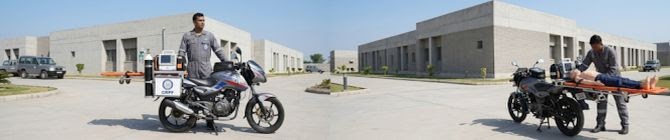
DRDO’s ‘Rakshita’ bike ambulance is a cost‑effective, compact emergency vehicle designed for rapid casualty evacuation in narrow lanes, disaster zones, and conflict areas.
It combines advanced monitoring systems, oxygen support, and modular seating to deliver life‑saving aid during the golden hour, at nearly half the cost of a conventional ambulance.
The Defence Research and Development Organisation has unveiled the Rakshita bike ambulance to provide quick medical assistance in locations where traditional four‑wheeled ambulances cannot operate.
Developed by the Institute of Nuclear Medicine and Allied Sciences in collaboration with Skylane Power Solution, the vehicle was initially created for the Central Reserve Police Force. Twenty‑one units were inducted into CRPF service, particularly for Maoist‑affected and remote zones, before interest spread to hospitals and civilian institutions.
The Rakshita is equipped with a specially designed casualty evacuation seat made of high‑strength alloys. This seat is ergonomically contoured, fitted with an adjustable headrest, lumbar support, and movable armrests, and can be reclined into a semi‑sleeping position.
It can function both as a chair and a stretcher, ensuring patient comfort and stability during transport. Safety is enhanced through a head immobiliser, harness systems, and adjustable footrests.
The bike carries a compact oxygen cylinder beneath the patient seat, alongside provisions for IV fluids, splint sets, medicines, and a first‑aid kit. A telescopic IV stand is integrated for convenience. The ambulance also features a multi‑parameter physiological monitoring system capable of displaying oxygen levels, ECG readings, and other vital signs on a dashboard‑mounted screen.
These parameters can be transmitted via Bluetooth to nearby medical facilities, enabling doctors to prepare before the patient arrives.
Additional features include sirens and flasher lights for rapid access through congested areas. The Rakshita is particularly effective in disaster‑hit regions, flood‑affected zones, and urban by‑lanes where conventional ambulances struggle. Its compact design allows it to reach patients within the critical golden hour, offering immediate first aid and swift evacuation.
The cost of the Rakshita has been fixed at approximately ₹3.5 lakh, nearly half the price of a standard ambulance. This affordability makes it attractive not only to paramilitary forces but also to hospitals and emergency response organisations. Its deployment demonstrates DRDO’s commitment to indigenous, practical solutions for India’s unique operational challenges.
By combining mobility, affordability, and advanced medical support, the Rakshita bike ambulance represents a significant innovation in India’s emergency healthcare infrastructure.
It bridges the gap between inaccessible terrain and timely medical intervention, ensuring that life‑saving aid reaches those in need without delay.
Agencies
