

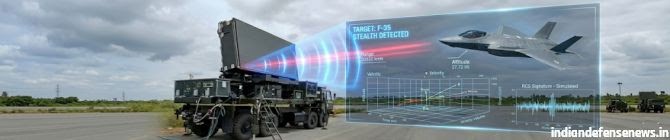
India’s Arudhra radar has demonstrated simulated capability to track an F‑35 stealth fighter, though this remains a computer‑based test rather than proven live detection. While the radar’s specifications suggest it could detect low‑observable aircraft under certain conditions, operational validation against an actual F‑35 has not yet taken place.
The Arudhra is a 4D multi‑function phased‑array radar with electronic steering in both azimuth and elevation. It has an instrumented range of up to 400 kilometres and can detect targets with a radar cross‑section of 2 square metres at 300 kilometres.
Its altitude coverage extends from 100 metres to 30 kilometres, enabling detection of both low‑flying drones and high‑altitude aircraft. The radar is integrated into India’s Integrated Air Command and Control System, fusing data from multiple sensors to provide a unified air picture.
By contrast, the F‑35 Lightning-II is designed with advanced stealth characteristics. Its radar cross‑section is estimated between 0.001 and 0.005 square metres, significantly smaller than the 2 square metre benchmark used in Arudhra’s detection claims.
The aircraft employs shaping, radar‑absorbent materials, sensor fusion, and electronic warfare tools to reduce detectability. Conventional radars struggle to detect such low‑RCS targets, particularly at long ranges, making the challenge of live detection formidable.
In 2026, an AI‑assisted simulation test showed Arudhra successfully tracking a virtual F‑35A Lightning II in a computer‑generated environment. This outcome demonstrated the radar’s potential to detect and follow low‑observable targets when integrated into the IACCS network.
However, the test was not a live intercept, only a computer‑based scenario. It shows promise but does not confirm real‑world detection capability against operational stealth aircraft.
Strategically, this development aligns with India’s Mission Sudarshan Chakra, which aims to build next‑generation anti‑stealth radar grids to counter aircraft such as the F‑35, Su‑57, and J‑35.
The indigenous push includes Arudhra, Ashwini, and Rohini radars as part of a layered surveillance network, reducing reliance on imported systems.
Detecting stealth aircraft in practice requires multi‑band radar coverage, sensor fusion, and electronic counter‑countermeasures. Arudhra contributes to this layered approach but is not a standalone solution.
LRDE’s Arudhra’s range and phased‑array design suggest potential against stealth targets. In simulation, it has tracked a virtual F‑35. In reality, however, there has been no confirmed live detection, and stealth aircraft remain extremely difficult to track with conventional radar.
India’s radar network is evolving rapidly, but operational proof against fifth‑generation stealth fighters like the F‑35 is still pending.
Agencies
