

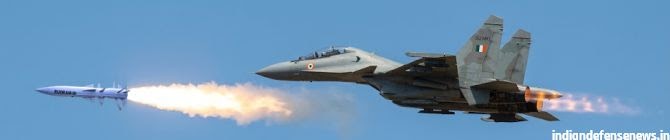
The Indian Air Force is advancing a heavy Suppression of Enemy Air Defences (SEAD) doctrine by integrating the indigenous Rudram-3 hypersonic missile with its frontline Su-30MKI fighter fleet.
This marks a decisive step in India’s strategy to neutralise hostile radar networks, hardened bunkers, air defence systems, and fortified military targets from stand-off ranges that exceed 550 kilometres.
By enabling strikes without entering hostile airspace, the doctrine significantly reduces risk to pilots and aircraft while expanding India’s offensive reach.
The Rudram-3 missile has been engineered to operate at hypersonic speeds, a capability that makes interception extremely difficult for adversary defence systems. Its advanced guidance package ensures precision targeting even in contested environments, thereby improving the survivability of strike missions.
This combination of speed and accuracy positions Rudram-3 as a formidable weapon in India’s arsenal, designed to penetrate and dismantle layered enemy defences.
Integration with the Su-30MKI platform has been a complex process, requiring solutions to structural, aerodynamic, and electronic challenges. India has successfully completed important release and firing trials, validating the missile’s compatibility with the aircraft.
These trials demonstrate the ability of the Su-30MKI to carry and deploy the Rudram-3 effectively, ensuring that the missile can be operationalised in real-world combat scenarios.
The doctrine is closely aligned with the ongoing ‘Super Sukhoi’ upgrade programme, which is modernising the Su-30MKI fleet with advanced avionics, electronic warfare suites, and enhanced radar systems.
The Rudram-3 integration ensures that upgraded aircraft will lead deep-strike and suppression missions during future high-intensity conflicts. This synergy between missile development and aircraft modernisation reflects India’s intent to build a network-centric, multi-layered strike capability.
Beyond its immediate role in SEAD operations, Rudram-3 strengthens India’s deterrence posture. The ability to destroy enemy air defence infrastructure from long ranges undermines the effectiveness of adversary surveillance and missile systems, creating windows of opportunity for follow-on strikes by other platforms. It also enhances India’s capacity to project power across contested regions, reinforcing its strategic autonomy.
The missile’s development is part of a broader effort by the Defence Research and Development Organisation to field indigenous hypersonic systems. India is simultaneously pursuing hypersonic glide vehicles, scramjet-powered missiles, and directed energy weapons, all of which are intended to give the armed forces decisive advantages in future warfare. Rudram-3 represents the operational spearhead of this effort, being the first hypersonic missile integrated into frontline combat aircraft.
In the context of regional security, the induction of Rudram-3 is expected to alter the balance of air power. With adversaries investing heavily in advanced surface-to-air missile systems and electronic warfare, India’s ability to neutralise these defences at long range is a critical countermeasure. The missile’s deployment will ensure that the Indian Air Force retains freedom of action in contested airspace, a prerequisite for achieving air superiority.
The Rudram-3 program also underscores India’s commitment to self-reliance in defence technology. By fielding an indigenous hypersonic SEAD weapon, India reduces dependence on foreign suppliers while demonstrating its capacity to innovate in cutting-edge domains.
This achievement is likely to accelerate further collaborations between DRDO, Hindustan Aeronautics Limited, and the armed forces in developing next-generation strike systems.
With the Rudram-3 integrated into the Su-30MKI fleet, India is preparing its air force for the demands of modern high-intensity warfare. The missile’s hypersonic speed, precision guidance, and stand-off range will enable the IAF to dismantle enemy defences swiftly and decisively, ensuring that strike missions remain survivable and effective.
As the Super Sukhoi program progresses, Rudram-3 will stand as a cornerstone of India’s evolving doctrine of deep-strike and suppression operations.
IDN (With Agency Inputs)
