

Across aviation, ground systems, and surface and subsurface maritime platforms, the demand for edge computing power relentlessly and exponentially moves in one direction: more data processed closer to the mission. Operators need new communications pathways, autonomy tools and AI-enabled mission applications, alongside faster software-driven upgrades at the tactical edge.
There’s a problem, though, as the hardware architectures inside many of those air, ground, and naval systems – the boxes, in other words – were designed for an era where it commonly took years for upgrades and capability integrations to reach the battlefield.
That reality is no longer acceptable. To leap ahead, Ultra I&C developed the Knox family of processors to meet evolving challenges. The company isn’t just making a case for more compute; rather, it’s a case for a different kind of computing architecture to keep pace with changing mission needs without forcing costly, complex and time-consuming upgrades every time a new mission capability is identified.
“We’re enabling the rapid tech insertion of new capabilities into legacy airframes that are often vendor locked. That lock is slowing down our ability as a nation to deliver capabilities at the speed of innovation,” said Ultra I&C Chief Technology Officer and Edge Compute General Manager, Randy Fields.
The issue is not that the various services lack ideas for new capability. It’s that legacy architectures often make new capabilities too difficult to field. When platforms are tied to original hardware specs, vendors and interfaces, even relatively modest upgrades can trigger expensive redesign work, new testing, and delays.
Merely having a faster processor is not enough if the surrounding architecture cannot absorb change. Once cables are run, interfaces are fixed, and front-panel decisions are made, programs can become effectively trapped inside the original design of the box. Even if a platform has years of life left, the lack of flexibility in the mission system architecture limits mission impact.
To avoid that problem, Ultra I&C developed Knox processors to break the cycle by modernizing the inside of the mission system while leaving the surrounding platform intact.
Tech insertion matters most when it happens in the field
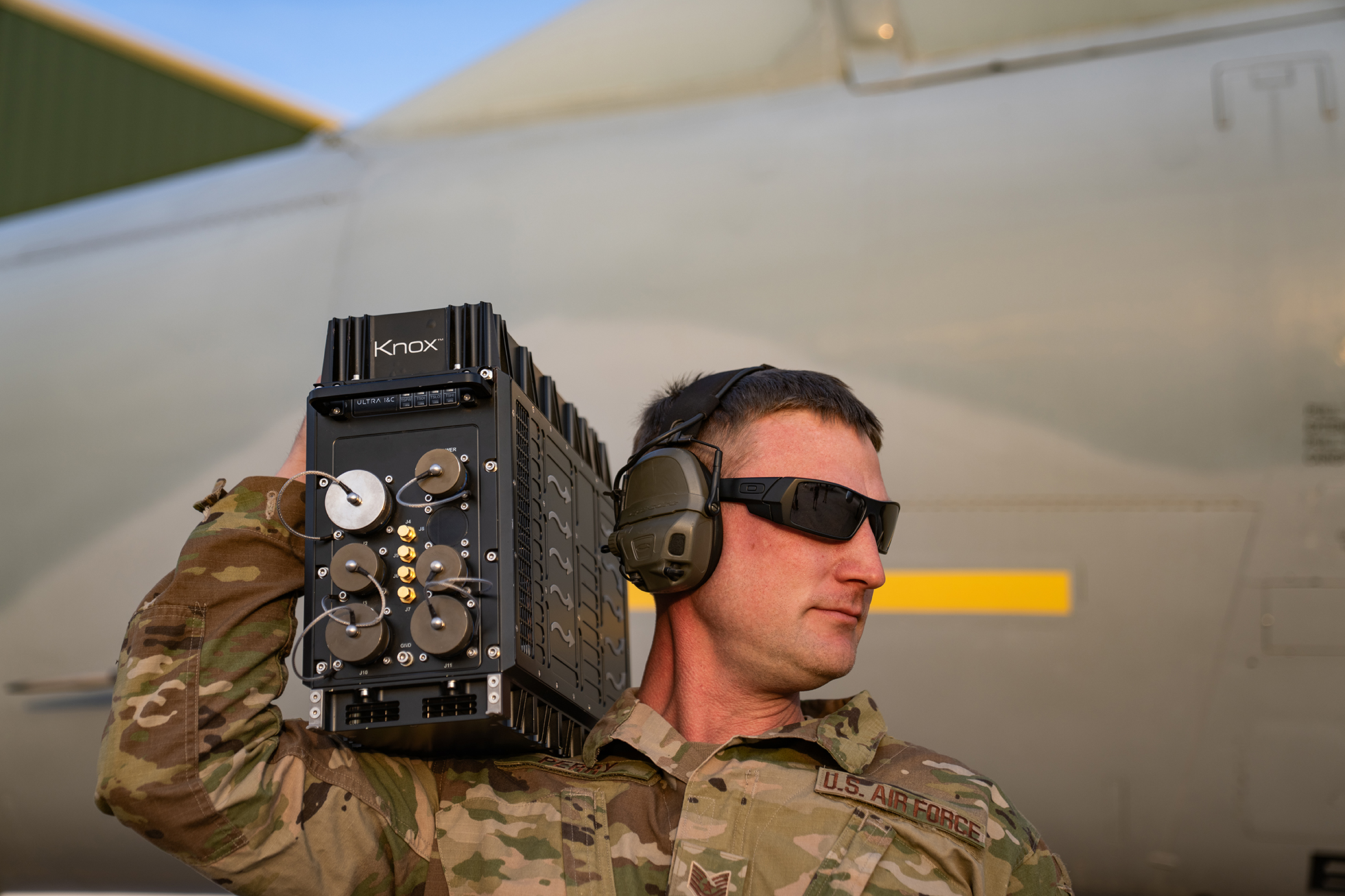
Knox uses what Fields describes as a flexible backplane and commercial off‑the‑shelf Modular Open Systems Approach (MOSA)/Sensor Open Systems Architecture (SOSA)-aligned cards. This allows platforms to upgrade processing, communications and mission applications in place, without costly chassis replacement or aircraft re-cabling.
That approach is the unlock. Knox processors support unlimited backplane and card upgrades, allowing programs to keep inserting new capability as mission needs change instead of redesigning the box every time the mission evolves.
The front panel preserves the platform’s connections to sensors, radars, weapons and communications, while the backplane routes data internally to the processing layer and mission applications that turn raw inputs into actionable information for the operator.
Fields describes Knox as the central processing “brain” for the mission system. It can route data from sensors, weapons and communications links such as Starlink or Starshield through a configurable backplane to mission applications, cockpit displays or common-operating-picture displays. It supports rapid field insertion of new waveforms, RF capabilities, high-performance embedded computing VPX GPUs, and other mission cards.
The US Marine Corps is already applying that capability to improve its medium-altitude, long-endurance MQ-9B Reapers flying ISR, target acquisition and maritime domain awareness. Earlier this year, the USMC ordered Knox-5 processors for to improve edge processing for mission-critical data on its MQ-9Bs. The Knox-5 is specifically optimized for size-constrained unmanned platforms.
The same modular approach applies across crewed and uncrewed aircraft, ground vehicles, and surface and subsurface maritime platforms, enabling common components and autonomy stacks to be deployed across domains. The outside form factor can remain stable while the internal systems evolve, allowing the warfighter to add capability without costly system rip and replace or delays for platform integration.
This is what separates Knox from more rigid systems that are modular in theory but constrained in practice. While they may allow cards to be swapped, the systems still rely on a fixed internal architecture that makes real change expensive and disruptive. “Our flexible backplane approach enables us to upgrade indefinitely,” Fields said.
For the government, that changes the buying decision. “The government is not just buying a box that works today,” he said. “It’s buying a foundation it can keep using as mission needs change.”
That same approach extends to the supply chain. Built from commercial products and supported by a diversified US defense industrial base, Knox systems can be sourced from multiple pre-qualified vendors for processors and switches, enabling fixed-price delivery at scale and reducing schedule, cost, and risk compared to single-source solutions.
Together, the commercial MOSA/SOSA foundations, flexible backplane design and open government data rights combination helps break vendor lock, supports government reference architectures, and delivers a sustained edge-computing advantage through in-theater upgrades.
SWaP matters because warfighters need the room back
Legacy multi-level security setups often require separate boxes, switches, and power supplies that add weight, take up space, burn power. Knox compresses that burden into fewer systems, and in some cases into a single flight certified unit capable of handling multiple security domains and mission functions internally.
That means improved size, weight and power (SWaP), more room for sensors and weapons, and less fuel requirements and logistics burdens for the warfighter.
“The ability to actually do multi-level security inside of one box, that’s the kind of thing that saves you fuel,” said Fields. “It also gives you more space in the aircraft to put things that matter. More weapons, more sensors. We’re giving back space inside of these airframes, and that’s what the warfighter needs right now – more capability, less constraint, and additional capacity to deliver success on tonight and tomorrow’s missions.”
That same logic applies to lifecycle cost. Knox is not only reducing the number of systems a platform needs today, it is also creating an upgrade path for what the mission may require tomorrow. If a system can consolidate multiple functions now and can accept new internals tomorrow or later, the government is not forced to choose between obsolescence and paying for another disruptive integration cycle.
For example, the Knox-10 processor brings MLS processing with 100 gigabit Ethernet switching into a single unit, a capability that previously required three separate systems. Rapid tech insertion without starting over is the proverbial game changer for all platforms.
Capabilities like Starlink and Starshield were not part of the equation a few years ago, Fields noted, but are now mission-relevant. With a modular compute architecture in place, those capabilities can be inserted as they become relevant. The same is true for the next waveform, RF card, communications solution, allied interoperability system, AI application or autonomy capability moving to the edge.
Ultra I&C’s Knox processors have obvious applications in aerospace, but the same basic architecture applies across air, land, and maritime missions that depend on communications, networking, switching, compute and mission applications. Ultra I&C sees that as an opportunity to give the government a common foundation it can adapt across platforms and domains without abandoning its core architecture.
Turning openness into supply chain agility
“Speed is a weapon,” Fields said. In this case, that means speed in sourcing, production, delivery and field upgrades, not raw compute alone.
Knox’s commercial, MOSA-based approach gives Ultra I&C more flexibility to source key components from multiple pre-qualified suppliers across the defense industrial base (DIB). That makes Knox processors built to scale, with a supply chain designed to support urgent delivery – especially as a new Knox production line standing up in Columbus, Ohio.
That flexibility is what openness is meant to deliver. An open system should not only make future tech insertion easier, but it should also bring resilience to the DIB by avoiding chokepoints and allowing qualified components to come from a broader industrial base.
“We are a company that is breaking vendor lock, meeting the urgency of the moment and focusing on US manufacturing to deliver at the speed of mission need,” said Fields. “We can upgrade in the field. That’s a capability advantage versus having to take it out of theater to get back to the factory to get an upgrade.”
Knox is not only a faster processor, it is a way for the Pentagon to keep pace by reducing SWaP, adding options, updating in place, expanding allied interoperability, and fielding capability faster than traditional architectures allow. In a Pentagon increasingly focused on speed, openness, and adaptability, more compute is not enough. The architecture has to keep up, too.
