

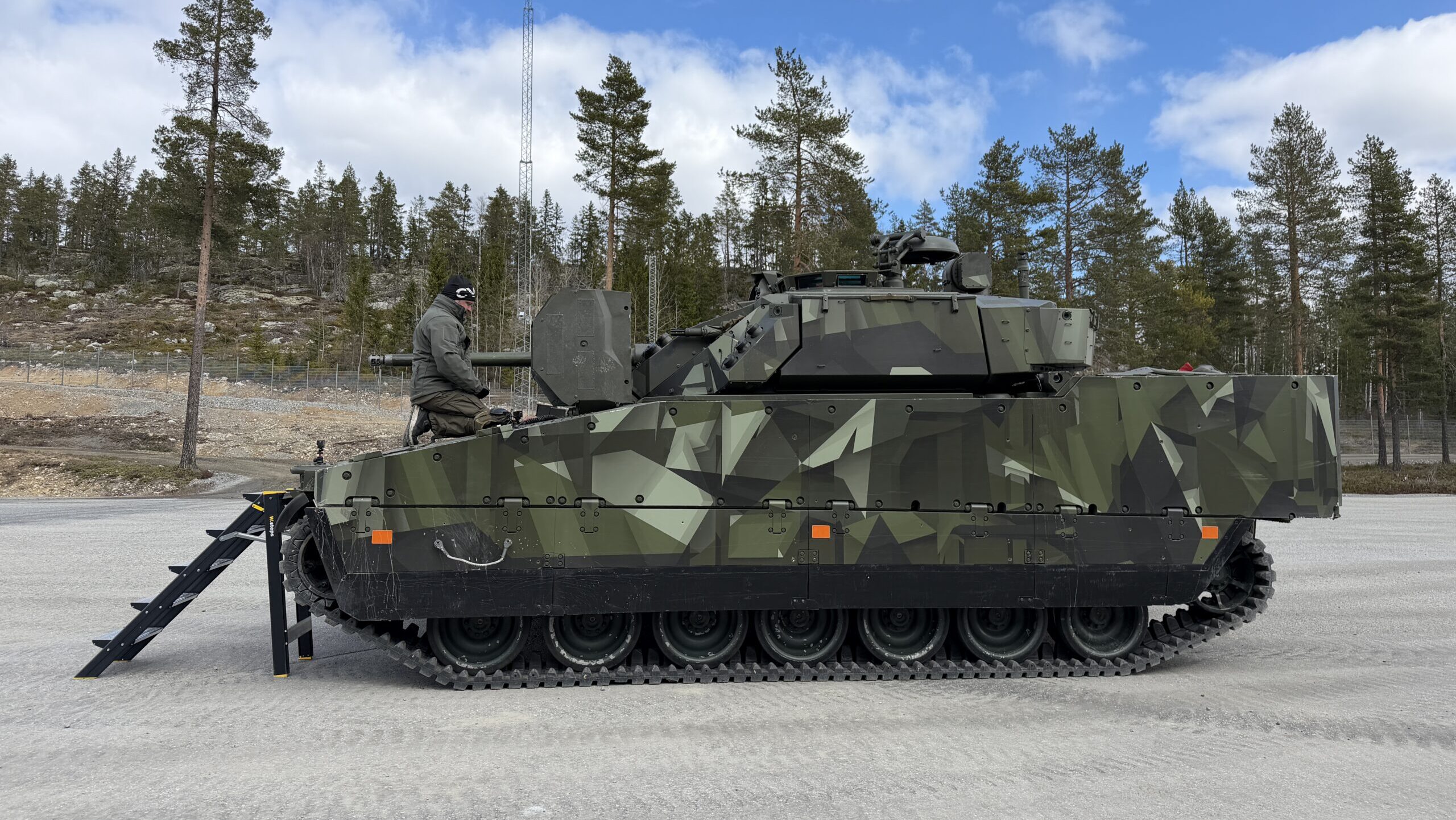
ÖRNSKÖLDSVIK, Sweden — As high-level negotiations between Sweden’s BAE Systems Hagglunds and five European nations over a joint procurement of CV90 infantry fighting vehicles intensify, the head of the firm is downplaying the impact of Estonia walking away from the multimillion-dollar program.
The company expects only a “marginal” impact on its production plans due to Tallinn’s withdrawal earlier this month, Tommy Gustafsson-Rask, general manager of BAE Systems Hägglunds, said during a media visit to its Ornskoldsvik site.
“To put it straightforward, Estonia had one of the lower quantities in this. … So the effect is marginal. I think the other customers will get vehicles earlier, so they’re happy. I think it’s in the margin, it’s not such a big effect,” Gustafsson-Rask said. (Breaking Defense accepted accommodation from BAE for the trip.)
Last year Finland, Sweden, Norway, Lithuania, Estonia and the Netherlands signed a statement of intent to jointly procure CV90 armored infantry fighting vehicles from BAE Systems Hägglunds. The agreement was formalized at the NATO defense ministers’ meeting in Brussels. BAE “expect[s] common configurations and shared upgrade paths whilst allowing for national differences in equipment for example,” the company said.
However, the program took a hit when Estonia stepped back earlier this month, stating that it favors prioritizing air defense systems over acquiring additional CV90s. Instead, Estonia intends to retain and upgrade its existing CV90 fleet of around 50 vehicles.
The move did not come entirely out of the blue; Estonian Minister of Defense Hanno Pevkur told Breaking Defense in February that Tallinn was pushing for local supplier involvement and vehicle deliveries by the end of 2030, and made clear the timeframe didn’t line up with Hägglunds’ expectations. But in theory, Estonia’s exit may raise the price per unit for the other nations, all of whom are negotiating individually with the contractor.
That negotiation “is ongoing as we speak, and we hope to close that, I will say Q3 this year,” Gustafsson-Rask said.
Asked if he was disappointed by Estonia’s move, Gustafsson-Rask added, “No, not at all,” noting the “turbulent security situation” in the world means governments are naturally going to have to adjust their plans.
Production Questions
Part of Pevkur’s concerns about the CV90 effort was whether Hägglunds can actually produce at the scale and speed needed to get multiple customers their vehicles in a timely manner.
Regarding the production question, Gustafsson-Rask stressed that BAE Systems is investing heavily to expand the Hägglunds facility. Since 2020, BAE Systems has invested approximately $300 million in the location, according to company representatives, with the workforce increasing from 750 in 2020 to 2,600 today.
Another influx of capital is coming, with a planned $150 million investment between 2026 and 2028. The focus of the new money will be to further increase welding capacity for the CV90 hulls and to continue optimizing the production line for the BvS10 armored all-terrain vehicle and related platforms at the Örnsköldsvik site, Gustafsson-Rask said. The company is also committed to building a new logistics center, which will free up manufacturing capacity in existing workshops, as well as an inspection facility near the test track.
BAE Hägglunds currently has an order book of around 600 CV90s. The now five-country joint procurement is expected to cover at least 500 more vehicles, underscoring the need to expand capacity.
“Probably, we’re gonna deliver a CV90 per day [after the investments]. That’s roughly where we’re gonna be,” Gustafsson-Rask said. “We will probably deliver the last vehicles — given approximate volume of 500 vehicles, adding into current order book — we will be until 2032-ish.”
To help meet the demand, BAE Hägglunds is also operating an extended industrial cooperation model with eleven production sites in Europe tied into the CV90 program. Many of these are long-standing partner facilities, though both the Czech Republic and Slovakia, two recent CV90 customers, are standing up facilities where local partners will assemble chassis and turrets as well as carry out system integration and testing based on welded hulls supplied from Sweden.
While the company continues to rely heavily on partners for final assembly, the core welding and structural work in Örnsköldsvik remains central to the program, the general manager said. The company now sees the supply chain as its main bottleneck, particularly “the need for second and third sources to keep pace with demand.”
The expanded investment also reflects lessons learned from the war in Ukraine, where 50 CV90s donated by Sweden have been deployed in combat. Company representatives emphasize that the vehicle has demonstrated strong protection, firepower, and mobility, and that — according to their knowledge — “no soldiers have been killed inside a CV90 in Ukraine so far.”
At the same time, experience from the “drone war” has prompted upgrades to better protect newer vehicles against unmanned aerial threats and has reinforced the importance of logistics, spare parts, and long-term sustainment.
“I think we also learned that the earlier generation of CV90 was not protected for drones, and the drone war that everybody learns the hard way in Ukraine,” Gustafsson-Rask acknowledged.
