

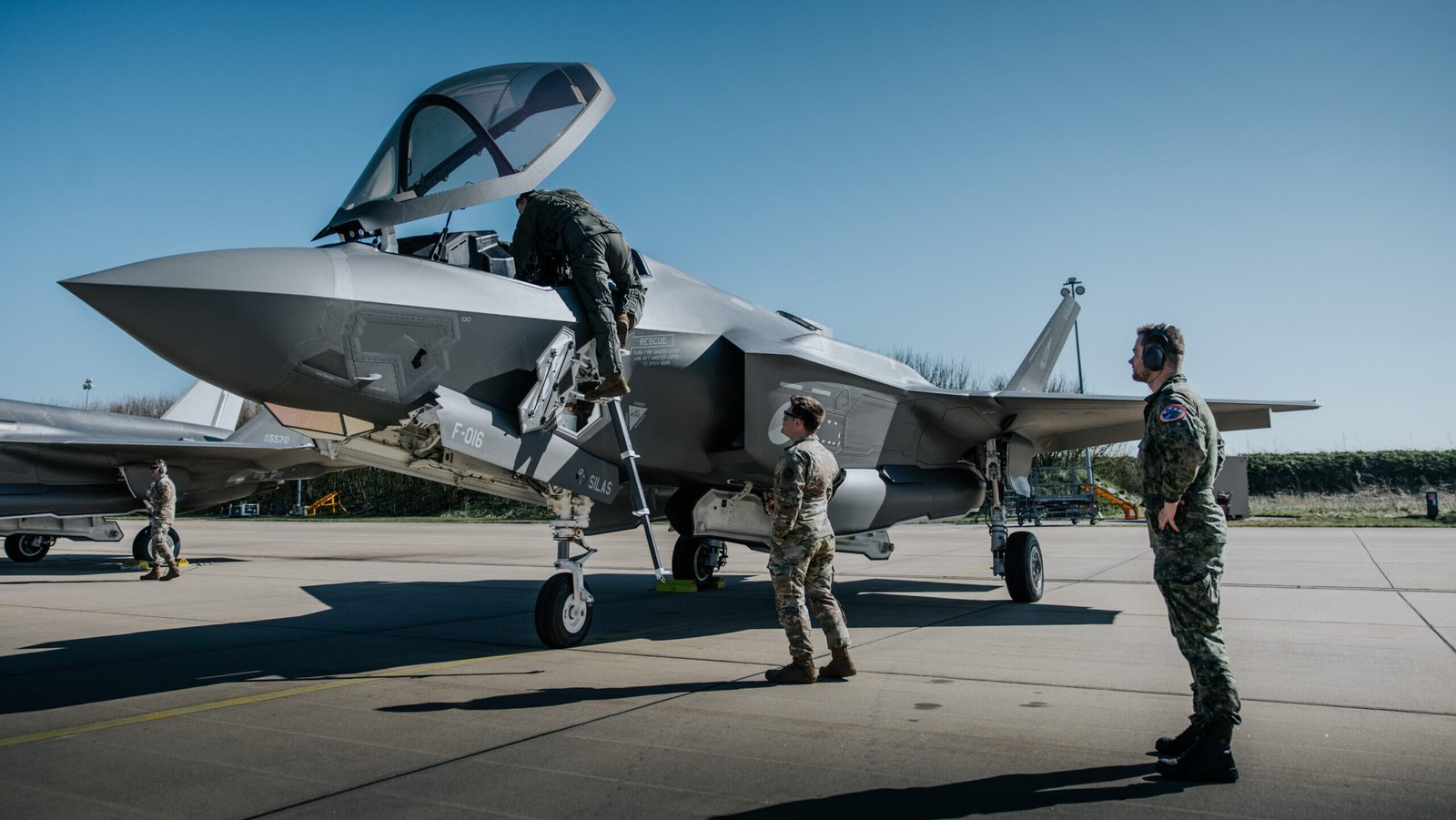
WASHINGTON and FARNBOROUGH — US firms seeking to tap into ballooning European defense budgets are finding a new roadblock emerging: a desire by European capitals to avoid US control of weapon sales.
There have long been concerns about how American International Traffic in Arms Regulations (ITAR) restrict foreign governments’ ability to sell or transfer domestically built weapons that contain components originating in the US. And that concern is becoming harder to ignore as skepticism surrounding US and European relations has led to a serious push on the continent to move away from buying weapons with US-controlled parts, according to a half-dozen people who talked to Breaking Defense.
“I see that as a growing trend that needs to happen within the EU, as sort of, like, an edict that’s come out,” Honeywell Aerospace CEO Jim Currier told Breaking Defense during last month’s Farnborough Airshow.
European governments have “been very, very clear in terms of how they want to fund, where they want to fund, their desire to have a more sovereign exposure,” Currier added. “That’s going to be an ongoing trend going forward.”
Currier isn’t alone in his view, with industry officials, analysts and lawyers also monitoring the changing market.
Tom Kanewske, the chief strategy officer for US-based Zone 5, said that in recent months, he has seen a sizable shift, with potential European partners becoming “increasingly opposed” to ITAR restrictions.
“Unfortunately, a belief has developed that ITAR will negatively affect their sovereign tech contribution and that they can avoid these challenges by steering away from US weapons systems,” Kanewske added.
Ins And Outs
In its simplest terms, ITAR is a set of US government rules to regulate the export and import of defense and military items on the United States Munitions List (USML), including services and technical data.
Scott Wise, a partner at Crowell & Moring and a member of the law firm’s international trade group, said the bulk of foreign governments’ concerns on ITAR is the “see-through rule.” That rule, he told Breaking Defense, means ITAR regulators track the US-made components inside a foreign-built weapon system and control where those parts go and what they’re used for.
“If, for example, you are building a fighter jet in France, if you source ITAR components from the US, it’s not that the fighter jet that becomes ITAR subject, [but] the item that you integrate into that fighter jet remains [an] ITAR subject,” he explained. “So theoretically, if you take that fighter jet somewhere that would require a license, you don’t need a license for the jet itself. You need a license for the [US] component that may be its engine, it’s a turbine, [or] it’s a wing.”
Working with that example, if the French government wants to sell that military aircraft to another country, it will need US government permission to do so. And it could take days, weeks or months to obtain the required US license depending on which country is the buyer, according to a second lawyer working on ITAR-related issues who was granted anonymity to speak freely.
There are also fears among some European governments that that time frame could be dragged out for political reasons if the weapon sale doesn’t align with US interests.
When it comes to Europeans selling weapon components to US defense prime contractors, only US produced items tracked by ITAR, or those items (including non-US items) produced with ITAR-controlled technical data, will be subject to ITAR, not the entire lot of European components, per both Wise and the second lawyer.
However, if that European component is then modified for the US weapon, the modified version could become an ITAR-controlled item. That necessitates careful planning and development on the part of European companies, which have to avoid incorporating technical data obtained from US primes they’re doing business with into their products, the second lawyer said.
“You wouldn’t want to be incorporating that back into your main design because you could taint your own technology,” the second lawyer added.
Changing Tides
ITAR has been around for decades, and the concerns over the regime’s process slowing down potential sales or giving the US too much control have been around almost as long. But the US, especially in the last 20 years, has been effectively the only game in town for many weapons used by western nations, and so the issue was accepted.
That seems to be changing thanks to the two-pronged realities of deteriorating relationships between Washington and Europe, and the sudden surge in European defense spending and subsequent push to build weapons domestically.
While Canada isn’t in Europe, it is a member of NATO with close ties to the US defense industrial base. The recent Canadian Defence Industrial Strategy is designed, in part, to depend less on US defense contractors by growing production capability at home and inking “new, ambitious, and comprehensive” partnerships with the European Union and the United Kingdom given their “shared values and common interests.”
European nations are also looking to shore up their production lines, as outlined in the 2024 European Defence Industrial Strategy.
The Trump administration has taken credit for NATO allies stepping up defense spending and boosting production, and senior officials have dismissed the possibility of second-order effects that could impact the US defense industry.
Undersecretary of Defense for Policy Elbridge Colby recently took to social media to dispute “commentary” that “alleged frustrations” with the US in Europe will lead to fewer weapons sales.
“This is neither feasible nor accurate,” he wrote.
“The simple fact of the matter is that no alternative country or countries can compete with the U.S. defense industrial base, either in quantity or quality,” Colby added. “The United States, as the President says, makes the best equipment, and we make it at a scale that no plausible competitor can match. If anything, access to the American DIB is a privilege, not a right.”

Elias Yousif, a Stimson Center fellow and deputy director for Conventional Defense, called this “seemingly paradoxical approach” by the Trump administration interesting. He said the growing “ITAR-free” push is one avenue for foreign allies and partners to create defense independence and to minimize US imports.
“There are real operational and strategic costs about having defense systems in place that demand sustained, enduring support from Washington to keep functioning, [like] software updates and supply components,” Yousif said.
“If one day the United States is at odds with Europe and it has the ability to turn the off switch on,” he added, “that’s a real problem.”
Long-Term Implications
Industry seems to be viewing the ITAR concerns as a growing trend, one they are only starting to react to. European firms, meanwhile, are starting to use being “ITAR-free” as a marketing move, Zone 5’s Kanewske said.
“[They are] weaponizing the fact that they are ‘ITAR-free’ and gaining unique market access in countries where US defense firms previously held a more secure footing,” Kanewske explained during a recent interview.
“As NATO countries commit more to defense spending, we will likely see an increasing trend of European defense firms leveraging this ‘ITAR-free’ buzz line to their advantage,” he said.
Lithuania’s Aktyvus Photonics is one such company proactively marketing its laser targeting payloads as an ITAR-free option for European-based companies to use.
“People are seeing US as a reliable partner, but if there is a possibility not to have US in the supply chain for some of the products and the components, they would love to have some counterweight along that, so that’s what we are typically discussing with our customers,” Aktyvus CEO Laurynas Šatas told Breaking Defense during a recent interview.
However, producing a system free of US tech is easier said than done. Šatas called it a“huge challenge” for the company to produce products that are “equally good or better” in terms of size, weight, power, and operational parameters, without using US components.
“It is very clear that when you go deeper into a supply chain, there are lots of technologies, especially in the dual-use and military [realms], which are not usable in other markets [outside of the US],” he added.

Kanewske is hopeful that before US firms start losing workshare in Europe, the government will push for reforms. While the Pentagon and State Department are engaged in a larger defense export reform effort, it’s not clear whether that will impact ITAR requirements.
“Now is the time to cooperatively work with US government stakeholders to reorient ITAR so that we better separate defense export/re-export from tech security and tech diffusion,” he said.
Aerospace Industries Association (AIA) CEO Eric Fanning told Breaking Defense that ITAR reform is “always a big topic” for American companies, and said that now is the time to seek reforms.
“There is a lot of talk from the Europeans about trying to buy ITAR-free, develop ITAR-free equipment. We want to avoid getting to that state so we have to reform the system on our side, I think,” Fanning, a former US Army secretary, said at the Farnborough Airshow.
That reform, however, has to be done in the “right” way, he said. ITAR, after all, exists for a reason.
“You want to make sure that our technology doesn’t get into the wrong hands, and so it’s a complicated process,” he said. “But I don’t think anybody believes there aren’t ways to accelerate it and streamline it and still get it right, and maybe even get it better.
ITAR reforms should involve informing allies as soon as possible whether or not a certain US-made component can be sold to a foreign buyer, according to Fanning. “The worst thing is to make an ally wait,” he said.
“If we’re not gonna sell to them, we ought to just say that up front,” he added. “Everybody wants reform on that, so that we don’t push people away.”
In the meantime, US firms are left to consider how to respond to the ITAR-free push in Europe — and how to market themselves.
At Honeywell Aerospace, Currier said the company is looking for ways to capitalize on the Europeans desires, and that means talking more about the 13 European countries his company operates in and the five that have manufacturing facilities on the continent.
“We already have all of that footprint in place, and so it’s…looking, acting [and] feeling like you’re a European company when you do this,” Currier added. “And there’s been recognition of that, to be very honest with you.”
