

This move aligns with India’s shipbuilding ambitions and could significantly strengthen domestic maritime capabilities.
Everllence SE has confirmed that it does not directly manufacture two‑stroke engines but instead follows a global licensing model. Under this arrangement, the company provides technology, design, and branding, while licensees handle production, with Everllence earning royalties.
South Korea’s HD Hyundai Heavy Industries and Japan’s Mitsui E&S are among its notable licensees worldwide. The company is now seeking one or two Indian partners to become licensees for large commercial vessels, though it has declined to name the firms, describing them only as “big names.”
Two‑stroke engines are the preferred choice for large ships because they deliver twice the power of four‑stroke engines, operate more fuel‑efficiently, and run on cheaper heavy fuel oil.
Their design allows direct connection to the propeller shaft, enabling quicker acceleration and reduced weight. These attributes make them indispensable for bulk carriers, container ships, and tankers, where efficiency and reliability are paramount.
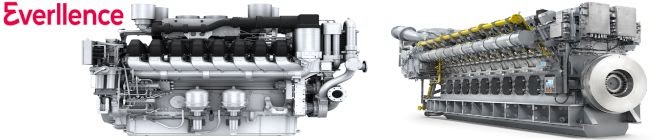
In parallel, Everllence is weighing plans to manufacture its four‑stroke 175D engine in India independently. Unlike the licensing model, this would involve direct investment and ownership of a facility, signalling a deeper long‑term commitment to the Indian market.
The 175D is a high‑speed engine designed for versatile applications, including marine propulsion and power generation, and its local production could support both shipbuilding and broader industrial needs.
The timing of Everllence’s interest coincides with India’s government push to expand its shipbuilding industry. A ₹69,725 crore package approved by the Union Cabinet last year aims to make India one of the top five shipbuilding nations by 2047.
Ship propulsion engines are critical to this ambition, yet Indian shipyards often face delays of 18–24 months in engine deliveries due to low priority in global supply chains. Local manufacturing of Everllence’s engines could help reduce these bottlenecks and accelerate ship construction timelines.
Everllence already has a presence in India through its medium‑speed four‑stroke engine factory at Chhatrapati Sambhajinagar (formerly Aurangabad), Maharashtra. Since 2000, this facility has produced around 440 engines, most of which were exported. It currently manufactures about 40 engines annually in the 1–10 MW range for marine and power markets, including gensets and propulsion systems. The company employs approximately 800 people in India, providing a strong base for expansion into two‑stroke and high‑speed four‑stroke production.
Gaby Hanna, Everllence’s managing director and senior vice president for the Middle East and Africa region, emphasised the company’s readiness to grow in India. He noted that the firm is “very interested in having an Indian licensee for our two‑stroke business,” underscoring the strategic importance of local partnerships.
If successful, this initiative would not only strengthen India’s maritime supply chain but also integrate the country more deeply into the global shipbuilding ecosystem.
The dual‑track strategy—licensing two‑stroke production while potentially owning four‑stroke manufacturing—reflects Everllence’s balanced approach to risk and opportunity.
Licensing offers asset‑light expansion with lower capital requirements, while direct manufacturing signals confidence in long‑term demand and provides greater control over quality and operations. Together, these moves could mark a turning point in India’s shipbuilding journey, reducing dependence on imports and positioning the country as a hub for advanced marine engine technology.
Agencies
