

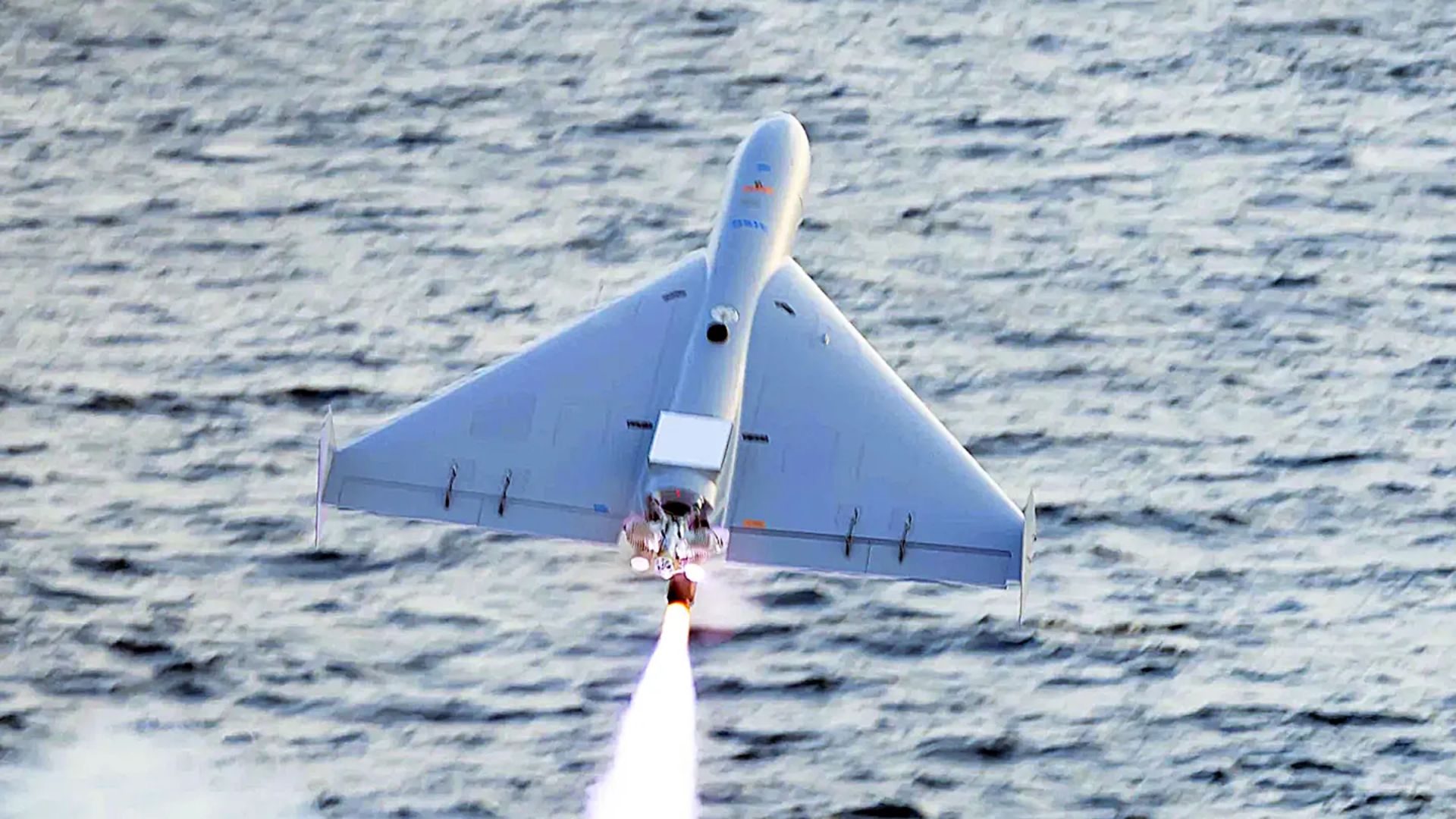
Seeing the dual-tactical and strategic impacts of one-way attack (OWA) drones in the Russia-Ukraine War and the Persian Gulf Crisis, the world’s militaries – small and large alike – are adopting OWA-centered strategies. With a USD $54.6 billion budget proposal for the Defense Autonomous Warfare Group (DAWG) in FY2027, the United States is aiming to lead the surge.[1] Army Secretary Dan Driscoll set a target of equipping every US Army squad with expendable one-way attack (OWA) drones and acquiring at least 1 million units within 2 to 3 years.[2]
Though loitering munitions, such as the Shahed and its growing list of analogues – e.g., the Russian Geran, American LUCAS, Pakistani HiMark-25, and others – are writing headlines, and understandably so as they have disrupted the cost ratios of strikes (i.e., low-cost weapons inflicting high-cost damage), the actual bulk of OWA adoption is driven by first-person view (FPV) drones.
FPV drones are small, low-cost systems that are manually controlled via a physical, microscopic fibre-optic line – i.e., hardwired, not wireless. This allows FPV drones to operate in environments with dense electronic warfare (EW) and electronic attack (EA) activity, especially targeting communications data links.
When the Department of War Secretary, Pete Hegseth, re-classified unmanned aerial systems (UAS) of less than 50 lbs as single-use ammunition rather than full aircraft systems, he was essentially referring to FPVs and other small drones.
To put the scale into perspective, in the Russia-Ukraine War, both sides have burned through an average of seven million FPV drones per year combined, with Ukraine alone using 9,000 such systems daily.[3] Moreover, according to Ukraine, FPV drones account for 60–70% of Russian equipment losses at the front.[4]
Of course, this is not to discount the impact of larger Shahed-style munitions – indeed, militaries are adopting analogous solutions for strike. However, they are also, again, looking towards drones to counter such munitions. For example, the Pentagon will deploy Ukrainian-origin Merops interceptor drones, which currently cost $14,000–$15,000 per unit [5], providing a more scalable solution against the mass salvo threats posed by Shahed-style loitering munitions.
However, when closely examining both FPVs and interceptor drones, one will see that both of these otherwise essential, scale-heavy solutions carry one potentially high-risk factor for US and US-allied partners: China.
Small FPVs greatly depend on commercial-grade – if not consumer-origin – parts, such as the electric, brushless motors powering the fans, the microelectronics for the optronics, and the fibre-optic cables, among other inputs. When looking at the Ukrainian Merops, it seems that the most scalable interceptor drones leverage the same technologies. To be clear, the Merops’ OEM – i.e., Perennial Autonomy – did not confirm how the Merops is powered, but the visible design features, e.g., small size, pneumatic launch system, and $15,000 per unit cost point to the use of an electric brushless motor and other commercially off-the-shelf (COTS) inputs.
That said, there is a push, especially on Ukraine’s side, to ‘de-Sinocize’ its drones, especially the FPVs and interceptors. Likewise, the US-led Blue UAS certification program aims to identify drones with Chinese inputs and create a Sino-free supply chain. However, in 2025, of the 300 submissions for Blue UAS, only 23 companies and solutions passed. Most of the failures were due to Chinese-sourced inputs. [6]
Reliance on Chinese factors will be a risk factor for every US/US-allied procurer in the near-term as (1) true Sino-free solutions at competitive costs do not exist and (2) large-scale demand is urgent.
China controls about 80% of the world’s drone component production, 75% of global lithium-ion battery output, 80% of neodymium magnet manufacturing, and 98% of rare-earth permanent magnets – i.e. the magnets that drive the brushless motors in nearly every small drone on the market.[7][8][9]
Virtually every country producing FPV drones and LMs – including the US, Russia, Iran, Ukraine, and India – depends on Chinese inputs for the majority of its critical components. Interestingly, even Blue UAS-approved vendors were not immune to the impacts of Chinese supply chain controls.
