

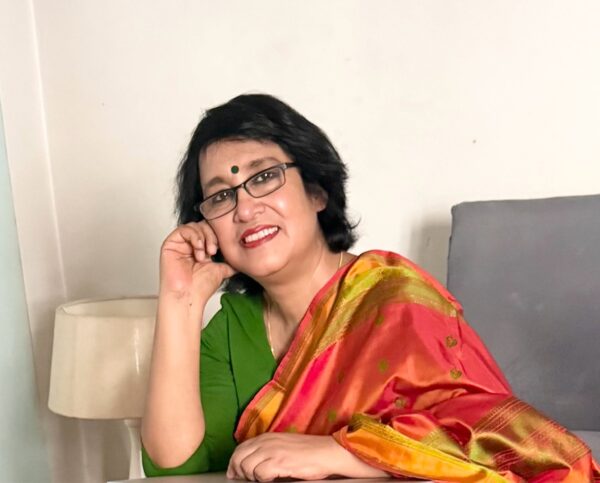
Author Taslima Nasrin is slated to attend an event in Kolkata in India’s West Bengal state on August 1. The city threw her out and slammed its door shut on her face 19 years ago.
A self-proclaimed atheist and feminist, Nasrin is of Bangladeshi origin and was exiled from Bangladesh in 1994, when her book Lajja (“Shame”) created a furor, prompting Islamic fundamentalists to issue a fatwa and death threats against her.
After living in Europe and the U.S. for a decade, she moved to Kolkata, where Muslim fundamentalists were against her presence from the start.
Before she arrived in the city in 2004, West Bengal’s Left Front government had banned her book, “Dwikhandito” (“Split in Two”), arguing that the book could “spark off communal tension.” Eventually, Muslim fundamentalists forced the government to drive her out in 2007. Nasrin, who holds a Swedish passport, has been living in Delhi since then. She holds a Swedish passport.
Nasrin’s return to Kolkata has now become a tool for the Hindu nationalist Bharatiya Janata Party (BJP), which has been ruling India since 2014 and West Bengal since May this year, to showcase itself as a liberal party that allowed her to flourish.
India has a history of appeasing religious fundamentalist demands. In 1988, India became the first country in the world to ban Salman Rushdie’s novel, The Satanic Verses, even before Iran’s Supreme Leader Ayatollah Ruhollah Khomeini issued a fatwa against the author. Celebrated painter Maqbool Fida Hussain left India in 2006 after facing threats from Hindu fundamentalist forces.
Kolkata has long held the reputation of being India’s cultural capital and a hub of progressive-liberal ideals, largely thanks to its status at the forefront of the 19th-century Bengal Renaissance and the subsequent prolonged communist influence.
That Nasrin could not enter for 19 years exposes the double standards of successive governments of the secular-liberal camp, whether of the Left or the Trinamool Congress (TMC), claim the Hindu nationalists.
“Nasrin’s departure from Kolkata marked the beginning of an era in which Bengal’s famed secularism kneeled before Islamic ‘fatwa culture’ and never managed to speak up against Islamic fundamentalism thereafter,” said Mohit Roy, who heads Poschimbonger Jonyo, a Hindu nationalist think-tank, one of the three organizers of the event. Roy earlier headed the BJP’s refugee cell, which deals with Hindu migrants from Bangladesh.
The other co-organizers are little-known outfits: Secular Mission Trust and Human Rights Beyond Frontiers Foundation (HRBFF).
Of all Indian cities, Kolkata has been special to Nasrin given its linguistic and cultural connect with Dhaka, the Bangladeshi capital, and her original home. She is understandably elated at the prospect of returning to Kolkata after nearly two decades.
The deep Hindu nationalist association of the organizers of the August 1 event – West Bengal’s new BJP Chief Minister Suvendu Adhikari is expected to attend the event – has prompted questions about her rather selective targeting of fundamentalism. She has been vociferous in her condemnation of Islamic fundamentalism. But at a time when Muslims in India are being targeted violently by Hindu nationalists, will she speak up about Hindu extremism as well? She has mostly avoided the subject while using her social media platforms.
Poschimbonger Jonyo was launched in Kolkata in June 2014, a month after the BJP came to power nationally. Headed by Roy since then, it works to popularize the Hindu nationalist idea that West Bengal was meant to be a homeland for the Bengali Hindus—as Bangladesh is a homeland for Bengali Muslims. The growing Muslim population and influence in West Bengal is turning the state into an extension of Bangladesh, they argue.
In their narrative, Bangladesh is a land of Islamic bigotry that West Bengal must not become. This has been the central campaign plank of the Hindu nationalist forces in West Bengal.
Hindutva activist Shantanu Sinha heads HRBFF, while Osman Mallick, a lawyer, heads Secular Mission Trust. Mallick is a vocal proponent of reforms in Muslim society and has supported some of the most controversial Hindu nationalist moves—the Kashmir reorganization in 2019, the Citizenship Amendment Act and the Uniform Civil Code (UCC). He is the only Muslim member in the BJP government-formed committee on the UCC.
Roy argues that when Nasrin was forced to leave Kolkata a few intellectuals spoke up, but they all fell silent later. “None demanded her return. None said that it was the responsibility of the government to protect her freedom of speech,” said Roy. Nasrin’s return to Kolkata marks the beginning of another era in which the government is not scared of Muslim fundamentalists, he says.
On July 19, Nasrin took to social media to lambast the “Leftists” who were criticizing her Kolkata visit for the Hindutva connection of the hosts. She argued that she had been invited by Secular Mission, led by Mallick, “a progressive Muslim.” That she mentioned only one of the three organizers makes one wonder if she was unaware of the two Hindu nationalist co-organizers.
The Leftists “were the ones who drove me out,” she said, and it is they who are now labeling her a supporter of the agent of Hindutva.
“How much longer will they continue to speak the language of jihadists while wearing the mask of progressivism?” Nasrin asked, adding, “They refuse to acknowledge the right to criticize Islam as a form of free speech. Their liberalism stops abruptly at the doorstep of Islam.” She alleged that the Leftists want Muslims to remain caught in the “misogyny, religious fanaticism, and intolerance of fourteen centuries ago.”
Veteran journalist Avijit Ghosal says Nasrin is unlikely to broach matters concerning Hindu fundamentalism, as that could risk her stay in India, which depends on the extensions being granted by the federal government. “Staying in India is her overriding concern. Intellectual honesty is secondary,” Ghosal said, adding, “I don’t think she will choose to be a modern-day Giordano Bruno.” The Italian philosopher was burned to death in 1600 for questioning the teachings of the church.
Researcher Somen Sengupta believes Nasrin need not speak on Hindu fundamentalism, as there are plenty of Hindus who speak out against it. “Give her the chance to speak against Muslim communalism. Hindu secularists lack the moral courage to speak out against that,” he said.
In 2012, the scheduled launch of her book, Nirbashan (“The Exile”), at the Kolkata Book Fair, was cancelled after some Muslim community leaders objected. This book details her forced exile from Kolkata. Nasrin had said then that she was surprised that the few intellectuals who had spoken up against her forced departure under the Left Front government did not protest the 2012 incident, which happened under the new TMC government.
“The Left Front drove me out to ensure that the minority votes went its way. But did they eventually get the votes?” she asked in 2012, adding, “How much do I really matter in swaying a vote bank?”
Nevertheless, Nasrin remained banned from entering the state. In March 2013, some of the speakers at a Kolkata rally of different Muslim organizations boasted about how they drove her out of Kolkata in 2007 and prevented Salman Rushdie from coming to the city in January 2013.
A few months later, after a cleric announced rewards for heckling her—and she called the cleric a criminal in response—a police case was filed against her in Kolkata.
In December 2013, a protest by Muslim fundamentalists forced a Bengali channel to postpone the broadcast of a TV serial based on a story written by her. While both Nasrin and the channel categorically said the serial had no religious content, Abdul Aziz of the Milli Ittehad Parishad made it clear that they were opposed to the serial because they believed she was trying to make a comeback to Kolkata through it.
According to actor Kaushik Sen, the Nasrin episode exposes the collective failure of the city’s liberal intelligentsia and civil society. Political forces, including the Left and the TMC, succumbed to pressure from Muslim fundamentalists due to their electoral interests. Civil society should have stood up to the threat to freedom of speech and expression, but it did not.
Sen argues that the Hindutva forces are trying to spread the message that they are tolerant and liberal, which is untrue. Across India, liberal ideas are coming under threat from the Hindutva forces, he notes. “However, in Kolkata, the failure of the civil society and the liberal intelligentsia in defending Nasrin’s freedom of speech has handed the Hindutva forces a major weapon to shape the narrative their way,” Sen told The Diplomat.
